(Reminder: this site is now ONLY my blog. If you're looking for my
book links or contact options, events, or any other aspects of my writer
life, please visit http://dangerouswhenbored.com )
Welcome
to the first Wednesday of the month. You know what that means! It's
time to let our insecurities hang out. Yep, it's the Insecure Writer's Support Group blog hop.
If you're a writer at any stage of career, I highly recommend this blog
hop as a way to connect with other writers for support, sympathy,
ideas, and networking. If you're a reader, it's a great way to peek
behind the curtain of a writing life.
February
4 question - Many writers have written about the experience of
rereading their work years later. Have you reread any of your early
works? What was that experience like for you?
___________________________________
I didn't really start taking my writing life seriously, finishing things, and seeing them into publication until I was in my 40s…so "early works" in that sense is really only a decade or so ago, and while I have grown as a person and a writer in those ten years, it's not startling in the way it might be if I'd been at this longer.
I *did* write when I was child and young woman: poetry, essays, short stories. Mostly, when I look back at those, I'm kind of charmed at my child/younger self. Sometimes, it makes me cringe a little to see how directly autobiographical I was…but capturing your own lived experiences and considering what they might mean isn't such a bad place to start in a life of making art.
Young Samantha and her scribblings led to the Samantha I am now, after all, and I like me and the work I do now, so I can't be too hard on her. :-)
Somewhere along the line, I learned to be a little less "on the nose" but I do still process all the things that worry, bother, or anger me in my writing. And it still works for me.
Welcome to Open Book Blog Hop. You can find us every Monday talking about the writing life. I hope you'll check out all the posts: you'll find the links at the bottom of this post.
What is your area of the world known for (in your opinion)? ______________________
I live in Hillsborough, North Carolina, United States. Chance are high that, unless you're relatively local, you've never heard of it. It's a nice little town. Roughly 10,000 people including a mixture of "townies" (people who live downtown), housing development/neighborhood folks (like me), and more rural or agrarian settings.
Hillsborough's main claim to fame is the Revolutionary War/Colonial era in American History. Lots of state politics included meetings or people in Hillsborough, and even some national. There's also a Scottish connection that got Hillsborough mentioned in the famous Outlander book series by Diana Gabaldon and the television adaptation.
These days, Hillsborough has a reputation as a great place for writers and artists. We've got a pretty robust literary community for such a small place. There must be something in the water.
In fact, I joke that you can't throw a stone without hitting a writer in Hillsborough. Some of the ones you might have heard of are: Lee Smith, Jill McCorkle, Allan Gurganus, Michael Malone, Annie Dillard, Hal Crowther, Frances Mayes, and David Payne.
Of course, there are also less famous working writers around here too, like me! Some of my writing friends from Hillsborough include James Maxey, Adrienne Moore, Jane Buehler, and Barbara Claypole White. (They're all fabulous, by the way, and you should read their books!)
I've lived here seventeen years, so I don't count as local yet (by Southern United States standards, I think it takes three generations before you count as local), but I've come to love my adopted hometown. We have truly lovely parks, a good range of businesses, and lots of social opportunities that stay small enough for an introvert like me to actually enjoy them.
Let me know if you want to come visit! I'd love to show it off!
Welcome to Open Book Blog Hop. You can find us every Monday talking about the writing life. I hope you'll check out all the posts: you'll find the links at the bottom of this post.
Who was the first person who believed in you?
______________________
I have been lucky to have support for me as a person and me as a creative from the get-go. My first cheerleader was (and still is) my mother.
From the very beginning, she fostered my interest in reading and writing, taking me to the library, running to catch the book mobile, taking me to the used book store on the avenue and letting me spend some of her precious and limited monthly book budget, sharing her own love of story.
It takes a special person to support the writing of a child--to understand the balance of praise and pushing to do something better. My mom really *got* me as a creative and exercised such patience as I told her my stories and wrote those early poems. She has been my first audience and teacher wrapped up in one.
My mom, in the magic light, on our trip to Ireland in 2022.
One could definitely argue that I wouldn't have become a writer if I hadn't had my mother, or at least that it would have been less likely.
My family has been very supportive in general--my dad, my sister, my aunts and uncles, my cousins, my grandparents and then my husband and our children, too. When I see how hard some of my writing friends have had to fight for their writing lives, I know I am lucky beyond the pale.
How about you? Did you have to fight for your creative self? Or did you find support when you needed it? I'd love to hear about it in the comments.
I've been a teacher my whole life. Just ask my cousins and my poor little sister about the days when I forced them to play school with me in the basement, when I was five and they were still toddlers. I even had school desks and a chalkboard. I made worksheets for them and corrected their letters.
Admittedly, I was a bossy little thing, and that probably had something to do with it, but it's also about sharing an enthusiasm for learning. What can I say? I LOVE school. Learning and books are part of my soul.
I was probably only six or seven when I started telling people that I was going to be a teacher when I grew up. I was also going to be a witch, a dancer, a veterinarian, a reporter, a writer, and an astronaut…only some of those stuck.
Unlike most people I know who changed their minds multiple times about what to be as they grew up, I stuck to that childhood plan of becoming a teacher. The only thing that changed was what level I thought I wanted to teach (elementary, middle, high, college).
I went to college and earned a degree in English education with minors in Spanish, Creative Writing, and a sort of Humanities add-on they called "Honors." Other than a minor gig with my college public radio station and a brief secretarial job, all my work life was teaching or education adjacent. I tutored, served as a classroom aide, subbed, and taught in my own public school classroom, in summer programs, and on college campuses.
The work was never easy, but it was worth it. There's such power in being there at the moment of elucidation or new comprehension or boundaries being stretched and helping people gain the tools they need to make their goals and improve their lives. I felt useful, important…like I made a difference.
Even now, after 27 classroom years, I still believe public education is the most important idea to rise out of American democracy: the idea that ALL citizens have the right to education was and is ground-breaking and represents all that is best about my country. (we can talk another day about the forces trying to kill that from within).
The realities of choosing a teaching life can be pretty grim. Nearly always, it means sacrifice in other aspects of your life.
You'll always earn a low salary, especially considering the education required, the importance of the work, and the stress and danger involved.
It's the only profession I know of where people who have never attempted the work themselves (or worse yet: FAILED at it) are in charge of the system, and the whole world thinks they know better than the trained professionals how to do the work. (Well, maybe mothering--that also came with a TON of irrelevant, hateful, and unwanted "feedback" from people who don't know a darn thing about it--we can talk another time about misogyny and the value of women's work).
You might as well change your middle name to scapegoat, because you'll collect ALL the blame and none of the credit.
The stress levels are sky-high and self-care is just two words people like to say, about as useful as sending "thoughts and prayers" during a tragedy. No one means it; no one cares.
You'll be overworked every single day. Schools are underfunded, which leads to being understaffed, which leads to one person shouldering a work load more appropriate for three to five people.
People will call you a hero, but it's lip service they pay to avoid paying you in respect, support, or dollars (you know: things that MATTER and might make a difference). It's disingenuous at best, and often far darker than that.
You'll feel helpless a lot because you can see the problems and what needs to be done, but you don't have the tools, time, or resources to fix things. It'll break your heart a little bit every day…and can eventually make you shut down out of self-protection.
It's not sustainable. The system was built on the backs of women--something we allowed at a historical moment when it was hard for a woman to get paying work of any kind at all and have been stuck with ever since. When the entire system is predicated on the exploitation of the workers, there's something wrong.
It's even worse in states like North Carolina: "Right to Work" states they call them. Anti-union is probably a step more honest. No protection for the worker--not even the basic protection I'd enjoyed in other states like a guaranteed lunch break every day or due process if I got fired.
Sometimes I stayed out of passion--to try and make change from the inside.
Sometimes I stayed because I'd been gaslighted so much that I'd internalized the idea that the problems were about me instead of about the work conditions.
Sometimes I stayed out of exhaustion--too tired to put in the footwork to find something else.
It was like having an abusive spouse in a lot of ways. You convince yourself that it's not as bad as it is. You stay "for the kids." Fear and manipulation reign over all.
Well, reader, I left him: that abusive spouse I called a teaching career.
Two weeks ago, I said goodbye to my last group of students and walked out into the sunlight. I'm corporate Samantha now, working as a content strategist for a large financial firm. I've had my new job for all of nine days as I write this, and it's already a world of difference in terms of stress and work-life balance.
It was my birthday a couple of days ago. On a Thursday. A workday. So, not the best day for celebration, but adult life, you know? It is what it is.
I figured my 50th year on planet earth was going to be an exciting one. It's just one of those landmark years, you know, and here I am now, a few days on the other side. Fifty-one? Whoosh! (That's the sound of time passing at what feels like supersonic speed.)
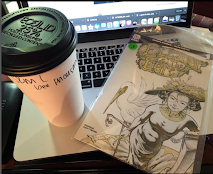
Not today's treat, but you get the idea
The day itself, was pretty good. I let myself have a Bee One Thousand (cinnamon and honey concoction) skim latte, a country ham and cheddar biscuit, and a comic book from the Hillsborough Cup-a-Joe, even though that's a treat normally reserved for Fridays.
I'm a great believer in small treats and pleasures as a way to keep your spirits up and getting out of bed had been a hard sell.
When I got to school, I found that my Bulldog Buddy (a sort of year long Secret Santa) had left me a birthday bag on my chair with a beautiful cupcake on top and lots of great treats inside including a bookstore gift card! (I've got some suspicions about who my Buddy is, and some guilt because I'm not nearly as good at finding awesome things for MY Bulldog Buddy).
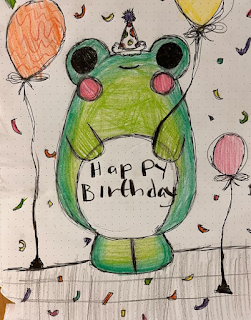
Another teacher friend made sure to tell all the sixth graders that it was my birthday, so all day, kids stopped by my room and stuck notes and little pieces of art to my classroom door. Kids at their most charming and endearing :-)
This kid didn't even know how much I love frogs
After school, I picked up some fast food. It's not the meal I would have picked, but there was limited time between school and my hair appointment, and I get hangry if I don't see to those needs.
Throughout the day, I received text and social media well wishes, and lots of silly memes and songs to make me smile.
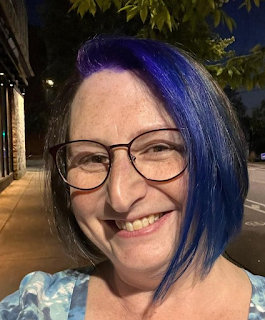
I spent the evening getting my locks colored and shaped at Syd's, which is a really charming hair shop in Carrboro that deals well with customers like me (middle aged ladies who want funky-colored hair and low fuss but awesome haircuts) and the younger kid (awesome but picky and prickly teenager). I've been a customer there off and on during all my time in North Carolina, and I appreciate the vibe as well as the hair expertise.
Feeling pretty
Then I got home, finally ate that pretty cupcake and opened some gifts from my sister (extra sweet of her now that she lives further away and had to ship them to me), and caught up with my husband, dogs, and the kid still at home.
It was a nice respite in what has felt like a whirlpool (of the Scylla and Charybdis variety) these past few weeks.
I've been in the middle of a job hunt (leaving teaching for the corporate world for a different variety of stress, some flexibility, and more money).
My eldest kid is about to graduate college.
We've had some new health things to deal with as well as a home improvement project that we're still resettling the house after.
It feels like everyone around me is facing heartache. Some friends lost their son. A student lost her father. A colleague is battling cancer. The youngest kid's best friend just lost their dog.
So, my emotions have been seriously mixed. Celebrating my own good news can feel heartless when those around me are suffering.
But a birthday is a natural time to look back at your life. My 50th year on planet earth was, in the scheme of things, pretty damn good.
Personal: my health is good as in that of all my nearest and dearest, my life is stable, and I have lots of love around me. 16 years into marriage, I'm still stupidly happy. 22 years into motherhood and my kids are still the best ones in the world. Nearly a year into life with our new pups and they charm me daily.
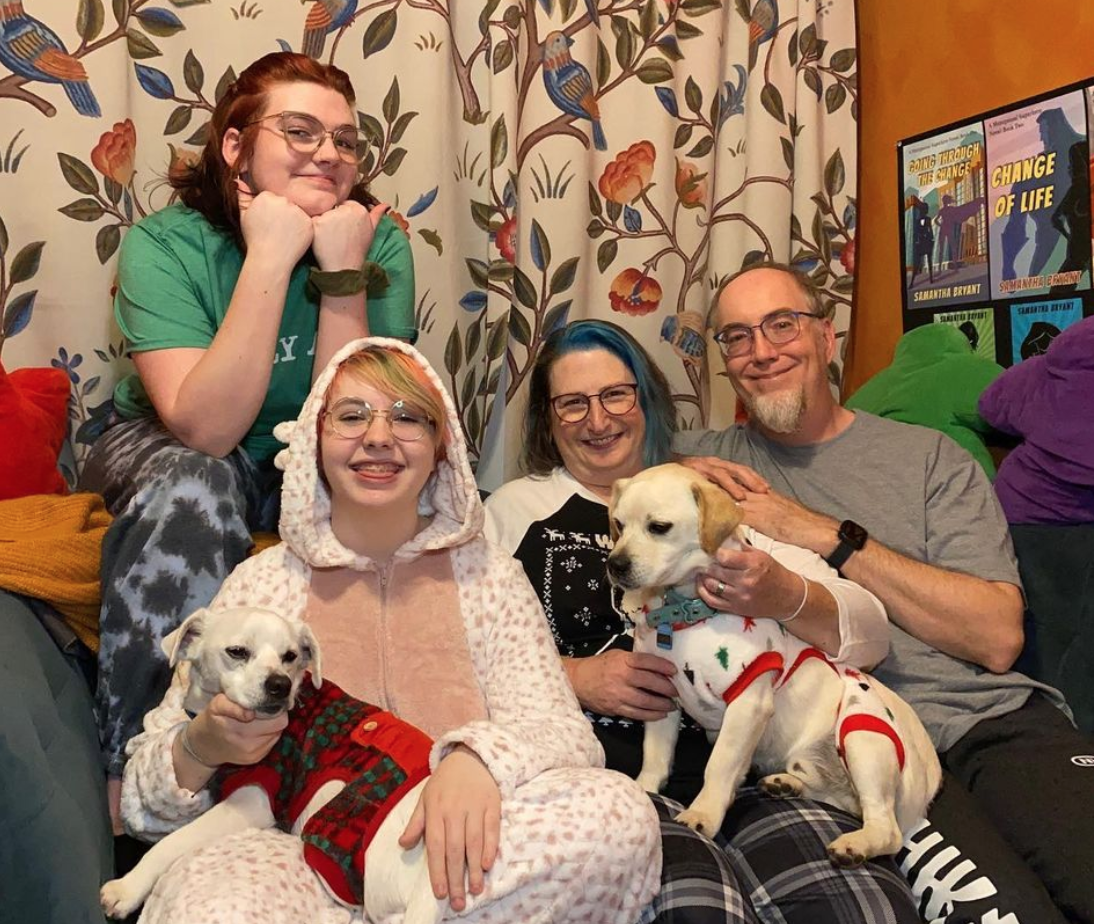
My family in our holiday PJs
I always tell folks that I love drama in my fiction, but I want a rather boring and serene life, and right now that's what I've got and I am grateful for that.
Writing: It was a pretty good year for my writing life. I began my 50th year by entering the editing process on the fourth Menopausal Superhero novel, Be the Change, and seeing it through to publication.
Five of my short stories made it out there into the world, too. You can read four of them online here:
The fifth one was in an anthology and came out on my 51st birthday, so that was a nice present :-)
I wrote a lot, too. From birthday to birthday, I wrote 379,046 words. I revised 179, 611 words. For 2022, I set a goal of submitting my writing 100 times and I've already hit 56 submissions at the 1/4 of the year mark. Not too shabby! Especially when you consider that I do this with a full time day job.
All in all, quite a good year and my 51st year is already shaping up with some exciting adventures including a change of career and some travel! Keep an eye on this spot for the details. In the meantime, may this year be your best year yet and give you many reasons for joy.
Welcome to the first Wednesday of the month. You know what that means! It's time to let our insecurities hang out. Yep, it's the Insecure Writer's Support Group blog hop. If you're a writer at any stage of career, I highly recommend this blog hop as a way to connect with other writers for support, sympathy, ideas, and networking.
If you're a reader, it's a great way to peek behind the curtain of a writing life.
September 2 question - If you could choose one author, living or dead, to be your beta partner, who would it be and why?
I've been fascinated with Shirley Jackson's work since I first encountered her book We Have Always Lived in the Castlein my library when I was weird thirteen year old kid.
I've returned to her work over and over since then, revisiting her work once a decade or so--re-reading favorites and finding new pieces I've missed. Even though my own writing is not disturbing in the same vein as Shirley's, I feel a connection to her, as if she speaks something inarticulate from deep inside my own consciousness.
Recently, I watched the quasi-biopic of her, based on the novel by Susan Scarf Merrell, and that feeling of connection was only strengthened. (The book/movie isn't accurate in a biographical sense, BTW, but it evokes a feel that I believed).
Like Shirley, I am ill-suited to be a housewife, even though I love my husband, my home, and our children and sometimes revel in taking care of them--and sometimes wish they weren't there, so I could focus on my life of words. We'd have that push and pull in common.
I, too, have a creative bent, and though I look pretty darn normal on the outside, it's more than a little weird inside my brain. Sometimes my mundane life and the worlds within my mind don't mesh well.
It's probably why her horror works so well for me. We both see the weird in the seemingly ordinary.
Luckily, I'm living my adult years in a different era than she did--she died six years before I was born. The expectation that I would marry and devote my life to only the work of household and children still lingers in the corners of my experience with other misogynist mumbo-jumbo, but no one is terribly shocked to learn that I work full time, or that I write. Those limiting views of femininity and a woman's role in the world have lost cachet and are no longer the norm, at least not that in my peer group.
I don't face social censure for the kinds of things that I write either. Not like she did. I also have a better husband than she did (at least as far as you can judge someone else's husband from what you see from the outside of the relationship).
I don't know that Shirley would have liked my work. She might accuse me of being too light or fluffy. But I suspect that if I could thicken my skin enough to take her criticism, my work would be the better for it. She would call me on it when I try to pull back from hard emotional moments or take it too easy on characters I've grown attached to, even more than my real-life critique partners do (and they don't really pull any punches--especially not Rebecca).
Would Shirley want or respect my opinion on her work? Maybe? I do have a lot of practice, as a middle school teacher, giving constructive criticism kindly and with support and compassion interlaced. And my admiration is sincere. I would mean the praise I offered.
Given the chance, I'd sit on the veranda with her and talk about the life of words, even if I had to put up with her cigarette smoke to do it. I like to think we'd get each other.
Critical Read put out a call recently for short nonfiction posts about art that is seeing you through the pandemic. They rejected my submission, but were kind about it and invited me to submit something else, with a focus on an American artist. I probably will. In the meantime, I highly recommend checking out the posts on their site (and, of course, mine below).
_________________________
Shakespeare in Quarantine
I often turn to poetry when my soul is troubled, especially older, metered poetry. The rhythm soothes me while the language pulls me out of my here and now and transports me to another time and place. This time, it’s Shakespeare seeing me through the quarantine.
Shakespeare’s birthday, April 23, is also the day that my husband and I had our first date, on which we watched a movie production of one of the Bard’s plays, 10 Things I Hate About You. We’ve made a tradition of celebrating our anniversary with a Shakespearean performance every year since as near to the day as we can manage, live when possible, recorded when not.
So, it seems apropos that it is Shakespeare in a thoroughly modern context that is pulling me through right now. Each day, I wait for Patrick Stewart to upload his daily sonnet video to social media and I find a quiet space to sit and listen alone, just me and Sir Patrick and the day’s verse. As I write this, he’s been recording a sonnet a day for nearly two months.
He began with Sonnet 116 “Let me not to the marriage of true minds/Admit impediments” which of course, I already loved. I fell in love with it when I first read it as an undergrad, and again when Kate Winslet’s Marianne of Sense and Sensibility quoted it breathlessly, and yet again when Sir Patrick Stewart read it to his wife who held a phone to record the moment for us.
Words written more than four hundred years ago are performed for me by a spaceship captain in the privacy of my own home. What a gift!
__________________
What art is seeing you through quarantine? I'd love to hear about it in the comments!
My youngest daughter and I both have April birthdays.
The last time I had a birthday party, I turned forty-two. She's still in the party-every-year phase of life.
I had a Douglas Adams themed birthday party, including petunia and whale related art, and had friends over to play games with us. Some wouldn't have considered it a real party because no one got drunk and it was overall pretty quiet, but it was exactly the kind of celebration I wanted. Good food and good fun with good friends.
It's been a few years since then, and I've been fine without another party in the intervening years, so clearly I'm not anyone's definition of a party animal.
I didn't plan to have a birthday party this year. Forty-nine didn't feel like a milestone or anything. I am hoping to celebrate bigger next year, when I hit the big five-oh. But still, knowing that I *couldn't* have a party felt strange. Knowing I couldn't invite my parents down for their usual visit made me feel cut off, even though I'm introverted enough to not really feel that sting as hard as some.
But my daughter . . .well, she turned thirteen and that was a rough one to spend in solitude. It should have been a big sleepover extravaganza with so much giggling. Dad and I should have woken up the next morning bleary eyed and grumpy, but happy that our girl had a great time.
Lots of us are celebrating different milestones in quarantine: important birthdays, anniversaries, big moments of life like retirement or publishing a book. It's harder to make those moments shine when a lot of our go-to celebration ideas are just not available to us.
So, here's what we did for our special days:
My girl was allowed to "skip" school on her birthday and sleep until lunch.
Lunch was the takeout of her choice (Chik-fil-a). Dinner was the mom-and-dad-prepped meal of her choice (pot roast, mashed potatoes, and broccoli).
She helped make her own birthday cake because she likes baking almost as much as she likes eating sweets: Mexican chocolate cake with cinnamon frosting.
We wrote out a treasure hunt set of clues and followed her around the house while she figured out where her presents were, and then built her a fabulous pillow fort from which she watched Wall-e with the dog (Mom and Dad watched from the couch).
I can't describe how much it lifted our hearts that our baby turned thirteen and wanted a treasure hunt, a pillow fort, and an animated film for her celebratory activities.
We still plan to give her that sleepover with her friends, in a few months, when it's safe to do so. And Grandma has promised her a pet snake and the apparatus to take care of it, too. But she said she felt pretty spoiled, and I believe her.
As for me, I also chose skipping school--a personal day spent to just ignore my teaching responsibilities for a day.
I spent the evening before my birthday dying my own hair pink (I used Overtone and it went pretty well!). Usually, I get a salon day around my birthday and get a cool color for convention season, and this was my substitute.
Sweetman made me breakfast and left me to eat in alone in my quiet office watching sunlight on my plant and glass window and daydreaming. I usually have to hit the ground running, even on quarantine--schoolwork happens early--so taking the morning slow was a treat.
Then, we went for a walk in my current favorite wooded area, picking up some supersweet coffee treats on the way. The weather was perfect: neither hot nor cold, neither cloudy nor sunny. I laid on a fallen tree trunk for a while, watching clouds and enjoying the sound of wind through the leaves and my girl talking about the bugs she was tracking.
My chosen lunch was takeout from Tacos Los Altos, a local taco truck/restaurant with nice people and awesome food. I splurged on a Mexican coke to go with my tacos. A FaceTime call with my sister so she could see me open her gifts, left for me on a touchless drop off.
Then the hubby and the girl went upstairs to do her school from home activities and let me have the "big TV" to watch the Miss Fisher movie on Acorn, which was fabulous!
Another walk in the late afternoon, a shorter one this time, so I could take the elderly dog with us, this time riverside. Then some writing time while Sweetman fetched my Turkish dinner from Talulla's in downtown Chapel Hill (a favorite date and special occasion restaurant for us), enjoyed with ANOTHER movie (two in one day? what!) with my family and then my raspberry chocolate cake from Weaver Street.
Throughout the day, I responded to texts and social media birthday wishes. At some point my publisher sent me my latest book cover which definitely felt like another present! (The book comes out in May!)
It's the first day in many a moon that I can remember entirely setting the pace myself, based only on what I wanted to do.
My older daughter is quarantined separately, so I'll see her tomorrow for a six-feet-apart walk and talk.
Were these the birthdays we would have had in a non-COVID world? Not a bit.
But were they still good? Definitely.
There are joys in quiet pleasures, too, and at the end of the day, I am relaxed and pleased to have a day that was all my own. What's working for you when you have something to celebrate in quarantine? How are still making these moments feel special?
April is normally such a busy month in our family.
We have two birthdays and our dating anniversary to celebrate.
My parents usually come to visit, which usually means taking on a home improvement project (it's DANGEROUS to leave my dad very long without a project).
Depending on where Spring Break falls, there might be a trip.
FOMO (fear of missing out) is a big source of anxiety for a lot of folks during this time. What does it mean to our relationships and careers if we don't do all the things we're "supposed" to be doing? This is probably why every organization I have any connection to is inundating me with invitations to video meetings and "live online" events. It's more difficult to feel connected if we don't see one another and that's harder for some folks than for others.
I, on the other hand, am happy to have more limited interaction with the world. I get a little restless here and there, and there are some events that I have been truly sad to miss out on during this time, but really the quiet has been good. It's been YEARS since I had a proper introvert recharge time--I mean a *really* long one, that refilled my well completely. I probably haven't had one in my entire adult life.
When I talk to people about my teaching life, they often express jealousy about my "summer vacation"--my weeks of not working. That time away from the classroom to recover really is essential to my ability to keep coming back.
And each year, I find that I come back a little bit less charged up. Maybe two months used to get me back up to 90% of normal me, but these days? I get back maybe half the energy I lost (and how much I lose seems to grow each year, too) and the build-up pushes me into dangerous burnout territory.
My running joke is that I've been teaching for 26 years and that the necessary recovery period from that is…26 years.
I've been reading a lot about how this time is helping the earth recovery--people staying home is reducing the strain on the environment and wildlife and air quality are thriving. So, in my next month at home (at this point, I know I have at least one more to go), I'm looking for the JOMO--maybe I'll see a me I haven't seen in years thanks to the slower pace and recovery time. Here's hoping!
More Disney! (See our earlier thoughts here, here, here, here, here, here, here and here) We've hit a few Disney movies I hadn't seen in this batch. While I remember The Fox and the Hound through a veil of tears, I had never seen The Black Cauldron,The Great Mouse Detective, or Oliver and Company. I'm guessing it's because I was a young teenager right as they came out. I'm sure I thought I was "too old" for "kid cartoons." Luckily I grew out of that misconception not long after. I was looking forward to seeing Roger Rabbit and The Little Mermaid again. I still know *all* the songs in the Little Mermaid. For me, that's when Disney became a double threat hitting my musical nerd and fairy tale fan buttons all at the same time.
My daughter had seen NONE of these, though she's familiar with the music from The Little Mermaid since our middle school put it on as a musical a year or two ago.
So here's what we thought of 80s Disney:
Fox and the Hound: We knew we were set up for heartbreak from the outset. Heck, Todd's mother didn't last as long as Bambi's! We sat and talked about this one for a while when it was over because it was pretty morally complicated.
The hunter and his dogs weren't just simple villains (though the movie is pretty solidly anti-hunting), but what hope was there for the doomed friendship between natural enemies? And what a bittersweet ending. Way more adult and nuanced than we were expecting.
The Black Cauldron: So, is Gurgi actually Smeagol? The vocal resemblance was uncanny, even down to some of the lines (munchies and crunchies? talking about himself in the third person?) This Disney film had a very different feel than any of the previous ones. It wasn't a musical--no songs at
all, actually. It was darker and more directly scary than any of the others, too. We found it a little sloppy in building character arcs, so lacking in the emotional impact it might have had, but definitely worth seeing. While we enjoyed it, it didn't feel like a Disney movie to us.
The Great Mouse Detective was definitely more for me than for my twelve year old. She knows who Sherlock Holmes is only vaguely, and certainly didn't know about Basil Rathbone, so some of the Easter Eggs remained hidden for her, while I was cackling with inner glee. We both love Vincent Price, though, and he was magnificent as Ratigan. Still she found our Dr. Dawson charming in the same way as The Rescuers' Bernard. A very satisfying little gem we would watch again.
Roger Rabbit, too, was filled with references that went right over my girl's head. She's not steeped in noir like I am. On the other hand, she is a fan of old animation, so she had a blast identifying old characters as they wandered through and where they are from. We were both so pleased to see Betty Boop. When I watched this one for the first time (when it was new), I had not predicted the big bad guy reveal until just before it happened, and I was pleased that my daughter didn't guess ahead of time either. She's far too good at guessing where a story is going, so she's hard to surprise with a twist! We were both lukewarm on Oliver and Company. We liked the relationship between Fagin and the dogs, and Sikes was a strong villain, but the whole thing just felt a little lackluster. Maybe too polished? It's the first time Disney used established singers like Billy Joel and Bette Midler as opposed to voice actors. It didn't feel like the characters were singing the songs, but like they were lip syncing, if that makes any sense. In fact, writing this now, a few days later, I can't remember a single song from the film. I guess music is a bigger part of what we love in Disney than I realized. That made The Little Mermaid truly welcome. It's the first of a new style of Disney princesses that dominated the 1990s and still continues today: spunky women with agency.
It really feels like a stage musical, too, hitting all the expected notes: a yearning ballad for our heroine, a gloating moment for the villain, a comedy number (the cook), a setting piece (Under the Sea), etc. Instead of the musical numbers being a break from the action as they often were in older films, the songs are the major vehicle for the emotional highpoints. We're only missing the hero and heroine singing their love together, but in most of the screentime they share, her voice is stuck in a seashell, so there are some limits there. My daughter commented repeatedly on how strange Ariel looks--giant headed with shockingly skinny arms, ridiculously small waist, etc. I have to agree--even in a long field of unrealistic portrayals of female bodies, Ariel stands out (swims out?) as ridiculously proportioned. And, as a Greek mythology buff, my girl was confused by this version of Poseidon, who seems to be less of a god of the sea and more of just the king of the merpeople, but who has some of Poseidon's traditional attributes and powers. But we really enjoyed it and I'm looking forward to enjoying 1990s Disney with her.
To put these in perspective for my daughter, I told her that these films were new when Grandma and Grandpa were little. I'm glad we're finally back in feature length films. The shorter pieces collected in anthologies were not my jam in the same way. Most of this next slew of films I actually remember pretty well from childhood.
Even though I'm not as old as these films, they all had theatrical re-releases and at one point or another, I (or my parents) have owned them on VHS or DVD. So, since our last report, the littlest Bryant and I have watched: Cinderella (1950), Alice in Wonderland (1951), Peter Pan (1953).
My daughter thought she would like Alice, but was lukewarm on Cinderella and Peter going in. I remembered Cinderella the most fondly.
Surprisingly, Cinderella was the one we both liked best. The character gets a bad rap in some ways, being lumped in with other, more passive princesses waiting for their prince to come and rescue them.
But this version of Cinderella is a hard-working girl. In fact, you get the feeling that, even had her father lived and protected her from the harsh treatment of her stepmother, she would still have been an industrious young woman, using her positive energy to make a difference in the world.
She doesn't waste time bemoaning her lot. It's the mice who complain on her behalf (in song, of course).
Even when she expresses a wish to go to the ball, it's not about changing her lot in life permanently. As my daughter said, "She didn't ask for a prince. She just wanted to put on a pretty dress and go to a party."
The part of the story that's always been hard for me to believe is that a beloved little rich girl who is demoted to housemaid in her own home harbors no resentment or ill will towards those who abuse her. That impossibly kind "heart of gold" element was helped a little in this version.
After the stepsisters tear up the gown the mice made for our heroine, she weeps in the garden and you learn that her positive attitude has been a conscious choice, one that she's now having trouble maintaining in the face of another disappointment. That's a very real set of emotions and won the respect of two Bryant women watching. We hope the prince proves worthy of her.
Alice, on the other hand, was not very interesting at all. The cartoon still charms, with its presentation of a cast of madcap characters and crazy scenarios, but Alice herself?
Meh.
She's petulant and mostly passive, just pushed along by the world she falls into. My daughter liked this one better than I did, but her focus was on the animation--things like the playing card soldiers, the disappearing cheshire cat, and the size changing experiments.
Honestly, Alice herself is rather incidental to the story.
Still Alice was a model of fortitude and feminism in comparison with all the characters in Peter Pan. Oh my! The racism and sexism was rampant.
The over-riding view of girls in the story is that they're here to serve boys. They are petty and jealous, squabbling with each other over the affections of boys because that's all that apparently matters--not what the girls themselves might want, but who can win the attention of the best boy.
Peter himself, well, he's a jerk.
I don't understand why anyone would want him, and my daughter felt the same way. He's a show-off, and only cares about garnering attention for himself. Even his Lost Boys only seem to hold value for him as an audience for his exploits. The kiddo does say that there are several boys with this kind of self-aggrandizing attitude in seventh grade, and she hopes that they grow out of it. I hope so too! She'll have to work with those people someday.
The element that had her gasping with dismay though was the part with Tiger Lily and the "Indians." From pigeon-English to stereotypes of dress, it was horrifyingly racist.
I guess I can be glad that these kinds of depictions are shocking to younger audiences.
That shows some progress.
When my parents were children, kids commonly played "Cowboys and Indians" using these types of characters thoughtlessly.
Even when I was a kid, in the 1970s, we didn't think anything of calling someone an "Indian Giver" or by the use of actual contemporary people as mascots for athletic teams.
The lyrics to "What Makes the Red Man Red" combine racism and sexism into one ugly little tune. Yikes! I'm kind of surprised that Disney airs this one. I wonder why Peter Pan doesn't get the censure that Song of the South does?
About the only saving grace to the film was the Darling family. The children's affection for one another, the push and pull of the wife and husband, the dog who served as a nanny. All lovely and charming. We liked when dad decided that Wendy didn't have to grow up so fast after all. It was nice that he got to end the story remembering the fun and magic of his own childhood, something he had apparently not held onto as he grew up.
Lady and the Tramp is up next! Looking forward to that one. I hope it's still as charming and romantic as I remember it!
If you've been reading these posts, you already know my husband got us a subscription to Disney Plus, so my daughter (age 12) and I have taken on a project of watching all the Disney animated features in order. I'm writing about the movies and our reactions here on the blog.
Since the United States was kind of busy in the 1940s, thanks to WWII, Disney produced mostly collections of short animations during this period. Even though the release dates are largely post-war, the artists must have working on these pieces during some tumultuous times, and the Disney studio did a lot of government propaganda work, leaving less time to develop popular features.
The compilation/anthology movies don't appeal to me as much as the more extended movies that tell a single story. My daughter doesn't mind though. She's a bigger animation fan in general, though, seeking out animators on YouTube in her spare time and drawing still images in the various styles she sees there. So, she enjoyed these more than I did.
The next one on our list was Make Mine Music (1946), and I was disappointed to find that it wasn't on Disney Plus. I know I've seen it because when I read the description on wikipedia, I remembered Casey at the Bat, Peter and the Wolf, Johnny Fedora and Alice Bluebonnet, and that one with the singing whale. I'll check back for it in the future. Maybe there's a distribution rights problem or something.
On the other hand, I wasn't at all surprised that Song of the South (1946) wasn't there. That one already felt weird in terms of race depictions in the 1970s when I was a little kid. It would probably be even stranger now.
I told my daughter about it, and we both wished we could have watched it for the animation study, to see if the integration of live action and animation had gotten any better after The Three Cabelleros in 1944. I remember thinking it was pretty amazing at the time, but then I wasn't the animation connoisseur she is.
Having learned about Uncle Remus stories, though, my daughter had an a-ha moment about the reference her dad and I sometimes make to being thrown in the Briar Patch, so hey--educational moment :-)
So, we jumped to 1947 with Fun and Fancy Free, which features several famous names of the era alongside two cartoons: Bongo and Mickey and the Beanstalk. I didn't remember Bongo at all, though I remembered Mickey and the Beanstalk quite well. The retelling of Jack and the Beanstalk has been released in other forms and shown on television over the years, though, so it's entirely possibly that I really never had seen Bongo.
My daughter and I both enjoyed Dinah Shore's reading and singing of Bongo, but were more than a little perplexed at the whole "Bears Say I Love You With a Slap" thing. My daughter's reaction was pretty much: Wait? What? Still, it was a fairly charming story and we enjoyed it, even if we didn't find anything especially memorable about it. We both enjoyed seeing Jiminy Cricket again. He's a charmer, that little bug.
Edgar Bergen introduced Mickey with his dummies Charlie McCarthy and Mortimer Snerd. Now I've never found Bergen's schtick funny, but I tried to hold my tongue and let my girl decide what she thought uninfluenced by me. I guess she's my kiddo, after all, because she also wished they would just hush up with the creepy dolls and staged conversations and get back to the story.
Mickey and the Beanstalk was a charming telling and does a good job integrating the normal personalities of Mickey, Donald, and Goofy into the familiar fairy tale. The giant was such a goofball that he wasn't scary at all. We were happy to see him again at the end, pulling the roof off Edgar Bergen's house and then stomping off into the city to put on the Brown Derby restaurant as a hat.
Next we made it to 1948 and Melody Time, which was a string of music-centered stories: Once Upon a Wintertime, Bumble Boogie, The Legend of Johnny Appleseed, Little Toot, Trees, Blame it on the Samba, and Pecos Bill. I remembered Johnny Appleseed and Little Toot from childhood, and was happy to recognize The Andrews Sisters and Roy Rogers among the narrators.
My daughter knew Johnny Appleseed, too--having had a babysitter in her preschool years who showed that cartoon alongside lots of Veggie Tales to the children when she needed a break. And I'm proud to say that she knows who The Andrews Sisters were, too. She's a fan of an electro-swing rendition of Mr. Sandman, which sent her down a historical music rabbit hole, so she's now probably the only twelve-year-fan of a musical group her great-grandmother used to love.
Among the other stories, we were both mostly just annoyed by Once Upon a Wintertime and couldn't figure out why in the world Jenny and Joe were all cuddly at the end when their disastrous ice skating date should have taught them both that they are ill suited for one another. The music didn't really go with the animation either. It looked slapstick and sounded melodramatically romantic.
Bumble Boogie was fun visually and would have been at home in Fantasia, but it's good that it's short.
The Legend of Johnny Appleseed was way more overtly Christian than I remembered, but still managed to be pretty charming, even though both of us don't usually enjoy art that proselytizes too much. Johnny was just so earnest and grateful for his blessings that it's hard not to like him.
Little Toot definitely benefitted from the Andrews Sisters' talents, because the story is a bit of a muddle. My daughter that Little Toot's parents were the ones were needed a talking to, maybe something about age-appropriate expectations and child supervision.
Trees was really pretty to look at onscreen. According to wikipedia, "To preserve the look of the original story sketches, layout artist Ken O'Connor came up with the idea of using frosted cels and render the pastel images right onto the cel. Before being photographed each cel was laminated in clear lacquer to protect the pastel. The result was a look that had never been seen in animation before." It truly was striking visually! We oohed and ahed over that one, but again we were glad it was short because the poem wasn't very interesting and there wasn't really a narrative hook.
Blame it on the Samba was a repeat of The Three Caballeros in that Donald Duck and José Carioca are panting over beautiful human women again. Eye-rolling 1940s sexism. Dullest bit in the film. Who knew Donald was such a horn-dog?
Pecos Bill was the silliest piece. A tall tale story you might hear alongside something about Paul Bunyan or John Henry, it told the story of a cowboy who had been raised by coyotes, wrestled cyclones, and fell in love with a cowgirl named Slue Foot Sue.
We giggled quite a bit during this section, but its silly-ness really brought out how all over the map the tones were in this collection. It was very much a kitchen-sink production, probably having something for everyone since we threw everything in willy-nilly.
Next should have been So Dear to My Heart, 1948, but it too was unavailable on Disney +. So onward we went to The Adventures of Ichabod and Mr. Toad, 1949. Neither of us was sure why these two stories were paired for release. There's really nothing to connect them, though both are fun in their own way. I remembered both stories with some fondness from childhood. My daughter had never seen either one.
Mr. Toad is about, well, Mr. Toad. He's a madcap frog with an enthusiasm for speed and adventure that gets him into trouble. The portrayal of Toad's mania with the hypno-spinning-wheel eyes was entertaining, as was the whole frog running around the countryside dressed as a country gentleman from the turn of the century.
It was a light and entertaining story and we both enjoyed it, but thought it rather forgettable. (The introduction by Basil Rathbone delighted me, but unfortunately my daughter doesn't know who he is, so we'll have to try some old school Sherlock Holmes on her soon.)
Ichabod was a delight. Bing Crosby was perfect and we were both delighted by the portrayal of Ichabod (already a familiar character to both of us) as socially graceful despite his gangly appearance. The scene where he's dancing with Katrina at the party and stuffing himself with pie without ever missing a step and Brom is trying and failing to switch partners so he can squire Katrina around the dance floor? Priceless. So many moving parts in that scene and all so deftly handled. Brilliant.
Talking afterwards we wondered if Katrina's ploy worked and made Brom work harder to win her heart or not. We hoped that Ichabod found a warm hearth and good food in another town. He was a man of simple enough wants after all.
We're both glad to be done with the anthology pieces now. Check back soon to see what we think of Disney in the 1950s. I'm anxious to see how Cinderella holds up!