Showing posts with label burnout. Show all posts

Friday, December 31, 2021

2021, huh?

So, that was weird. 2021, I mean. 

Time is always weird, of course. But it's gotten weirder lately. 

I was looking at a family picture today because Shutterfly sent it to me as a "remember this day" ad, and I do indeed remember the day very clearly. 
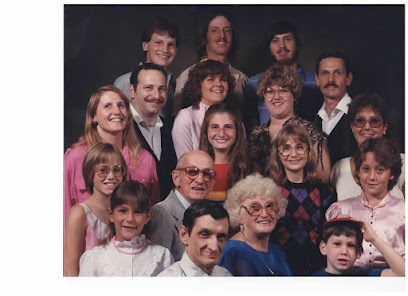
It's my mother's family, all of us except for one cousin and one aunt who couldn't come. It was a fundraiser my high school band was holding and we took the opportunity to get a family photo of ALL of us. The photographer had trouble getting us all in frame…maybe in part because we ranged in height from three foot to six and a half feet, or maybe because there were just so darn many of us. But it was a fun evening. We laughed so much, which is maybe why it's actually a pretty good picture with some genuine smiles in it. 

Two of my uncles, one of my aunts, and both of my grandparents are now gone, and I'm wondering how that can be, since I can remember this day so clearly, as if it were last week instead of three-going-on-four decades ago. 

2021 felt that way, too. As I write this, there's one more day in the year, and that doesn't seem right. 2021 never really felt like it started; it was more like 2020 just kept on going. So if 2021 never started, how can it be ending? 

So, I'm looking back at the year, because that's what we do at this time of year, right? Or maybe it's because I just read Mrs. Dalloway, by Virginia Woolf, a book about nostalgia, at least in part. Or maybe it's because one of the things I did in 2021 was turn 50, and that's what us middle-aged ladies do. I don't know. 

But here's my year that was: 

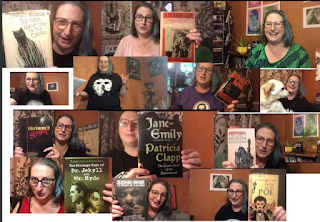
image source
Teaching:
I started 2021 teaching from home. My middle school had gone virtual starting in March 2020, like so many did. And we stayed that way until February 2021. 

It was a time of mixed blessings. I worried about my students, but was grateful for a way to keep teaching and still feel safe, in those pre-vaccine days. 

I had the best work-life balance I've ever had, and was really there for my family more completely than I've ever been able to manage before. Being home meant that my dog, O'Neill, who was losing a cancer battle, got to end his life with all of us at home to love him and care for him. 

I've always been a teacher who enjoys using tech tools to support my practice, but I became extra adept with learning management systems, video lesson presentation, and teaching via Zoom. Learning was different than it had been before, but it still happened, and some kids thrived on it. 

February-June 2021 were the hardest months of my teaching career (and I've been at this for 27 years in a variety of places and settings). I never considered quitting as often I did during the months where I did two jobs at the same time (as an online teacher and in-the-classroom teacher at the same time), under constant stress of uncertainty and threat of severe illness. Everyone who taught during this time should get double credit towards retirement. 

When the school year ended, everyone lost their minds panicking over "learning loss" (as if you only get one chance in life to learn 7th grade math concepts and the world will end if you didn't get it on the usual time table) and teachers were strong-armed, pressured, and bribed into working various summer programs. 

I knew how burnt-out I was, so I didn't take that work. I'm still glad I didn't, though the extra money would have been nice. Because when school started up in August, I hadn't recovered from the 2020-2021 school year yet. I was still crispy around the edges. It's rough to start a school year only a step away from burnt out. 

This school year has been strange in all new ways. So many people quit. So what felt like half the staff was new, and throughout these first four months (August-December 2021), lots more people have quit, taken early retirement, or suffered medical consequences that kept them out on leave. 

We had two teaching positions at my school that went unfilled until early December and were covered by long-term subs. Often, when a teacher was absent, there was no sub available to cover their classes, so safety precautions and policies were thrown the wind, putting two classes in together and giving up all possibility of social distancing, or taking non-teaching staff (librarians, counselors, teacher's aides, etc.) and taking them out of their own work to cover absent teachers. 

At least I work somewhere that is trying to find a balance between safety and learning. Some of colleagues have not been as fortunate. I'd have to quit if they didn't. But they have a vaccine mandate for staff, mask requirements for everyone, and keep us stocked in air filters and disinfectant spray. So far, I've stayed healthy, despite having one to five students a week who go on isolation or quarantine.   

I've found some joy with my students in person again, even with all the restrictions we have to work within, and most of them, now that they've seen what school is when it's not in-person, are cooperative and grateful and trying hard. But it's still challenging, given that kids disappear for days and weeks at a time and information sharing is sketchy, making it hard to know when to give grace and when to push for productivity (not that it's ever easy to know). 

I haven't quit yet, but I have submitted some resumes for non-teaching jobs. We'll see what happens in 2022. 
Writing
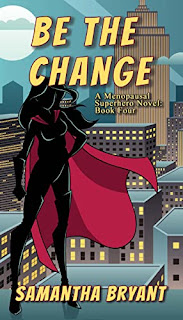
: I began 2021 with a big deadline: the fourth Menopausal Superhero Novel, Be the Change (which released on December 16, 2021), was due to my publisher on January 1, 2021. 

I missed that deadline, the first time I've missed a deadline in my writing life. I turned it in on February 1. Considering how screen-burnt I was in 2020 and how difficult it was to write during that time, I'm proud that I finished the book even CLOSE to on time. 

As soon as I turned it in, I turned my attention back to the Gothic Romance I've been working on these past two years (working title: The Architect and the Heir). I was hoping to finish it by the end of summer, before I had to put it aside to work on the fifth and final Menopausal Superheroes novel, due (under renegotiated deadline) in April 2022.

I didn't finish it in time. I've always been a slow writer, compared to many of my friends and colleagues, and that became a serious frustration in 2021. 

Now, as we finish the year, I've got 20,000 words in on that fifth (as yet untitled) novel. It's proving difficult to write. Since I intend it to the be the last, there's a lot I need to wrap up from the entire series, while still making sure the book has an individual story of its own. 

Because teaching life left me so crispy I'd be a hit at Kentucky Fried Chicken, I didn't have a burst of productivity in my writing life over the break like I usually do. I'm hoping that the rest I gave myself during these two weeks will allow me to begin seeing good progress again in January. 

Still, it was not a year to sneeze at for new words written: According to my writing tracker (I use Jamie Raintree's Writing and Revision Tracker and highly recommend it), I wrote 394,333 words in 2021 (on various projects) and revised 278,544 words. My daily writing chain is now eight years long. 

I had two short stories published in paying markets. "Poison" in Enchanted Conversation and "Boy Chick" in Apex & Abyss. I saw another novel through publication. It wasn't the kind of success that lets a girl quit her day job and write full time, but it wasn't bupkis either. 

image source
Getting Out Into the World: 
In 2020, I dug into life as a Hobbit, and came to appreciate going slower and being home. 

But in 2021, vaccinated and caffeinated, I ventured forth again, taking some opportunities for my writing life, and taking a couple of small trips. Not as many, and with more caution than before, but I got out there. 

In 2020, I attended one convention, MarsCon in January, before conventions started shutting down, cancelling, or even folding. After building up a schedule of appearances and events over the past few years, it was weird to suddenly stop doing that. 

Since my day job involved so much screen time, I wasn't thrilled about zoom events for my writing life, but I did a few. (Con-Tinual gave us all a chance to connect with readers that way, as did Strong Women, Strange Worlds. A pretty complete list of my video appearances can be found here.) Video appearances are easier in some ways--no travel, mitigates geographic distance, potential wider audience--but they are not the same as the energy of an in-person room and the kinds of connections made that way. 


In summer 2021, convention life opened up a bit again, and I attended Con-Carolinas, Con-Gregate, Galaxy Con, and a library Pop-Con. It was really good to see my writing friends again in person. I'd missed them terribly. I have become more cautious about my energy, though, and plan to do fewer conventions and more single-day events in 2022. 
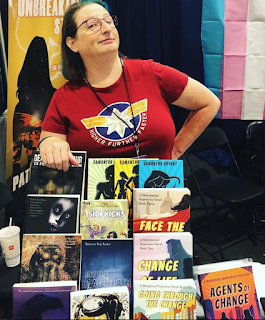

I also managed a visit to Kentucky for my mother's birthday, and she and my dad managed a visit down here for mine. Sweetman took me on a trip to the mountains to celebrate my fiftieth birthday. My long-time writing critique group (which had moved to Zoom), began meeting in person again after we were all vaccinated, and we took a short retreat to Lake Gaston in the fall. 
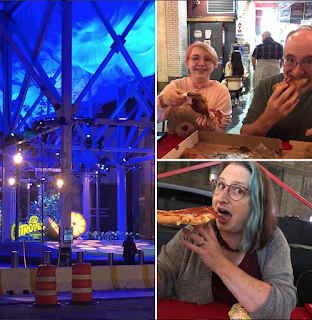

The big trip was a visit to New York City in October, when Broadway re-opened. I had never been and really enjoyed my few days there, though it solidified my understanding of myself as a rural girl at heart. 

We ate lots of good food, saw iconic sights, and really enjoyed the production of Six: The Musical. We haven't had that many cool travel opportunities with our youngest child, so it was great to spoil them with this trip. 
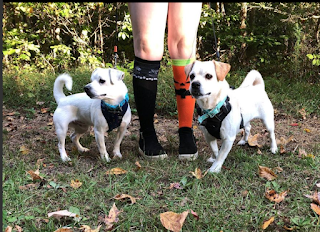
Throughout it all, I continued to walk in the woods, finding stress relief and solace in walking among the trees. 

Starting in July, two new friends joined me for those walks, when we adopted two new rescue dogs: Ghost and Pumpkin. 

They are wildly different than O'Neill was, but they have brought a great deal of joy to our lives. 

Our holidays were quiet, but lovely and we took our time away from school and work restfully and gave ourselves time to recuperate and recharge. 

So, that's my year that was. Not bad for my fiftieth one on the planet. I hope 2021 brought you joy as well, and that 2022 will give us all more reasons to smile. 


Wednesday, December 15, 2021

Finding my Holly Jolly This Year

 Normally, it's pretty easy for me to build up a head of steam and some excitement about Christmas. What's not to like? Pretty lights, time off of work with people and dogs I love, an excuse to spoil those people and dogs with gifts and food. It sounds lovely.

But when you're the mom of the family, it also sounds like a lot of work--those lights, gifts, and special moments don't happen without some preparation and planning and this year . . .well, I'm pretty darn crispy. 

image source

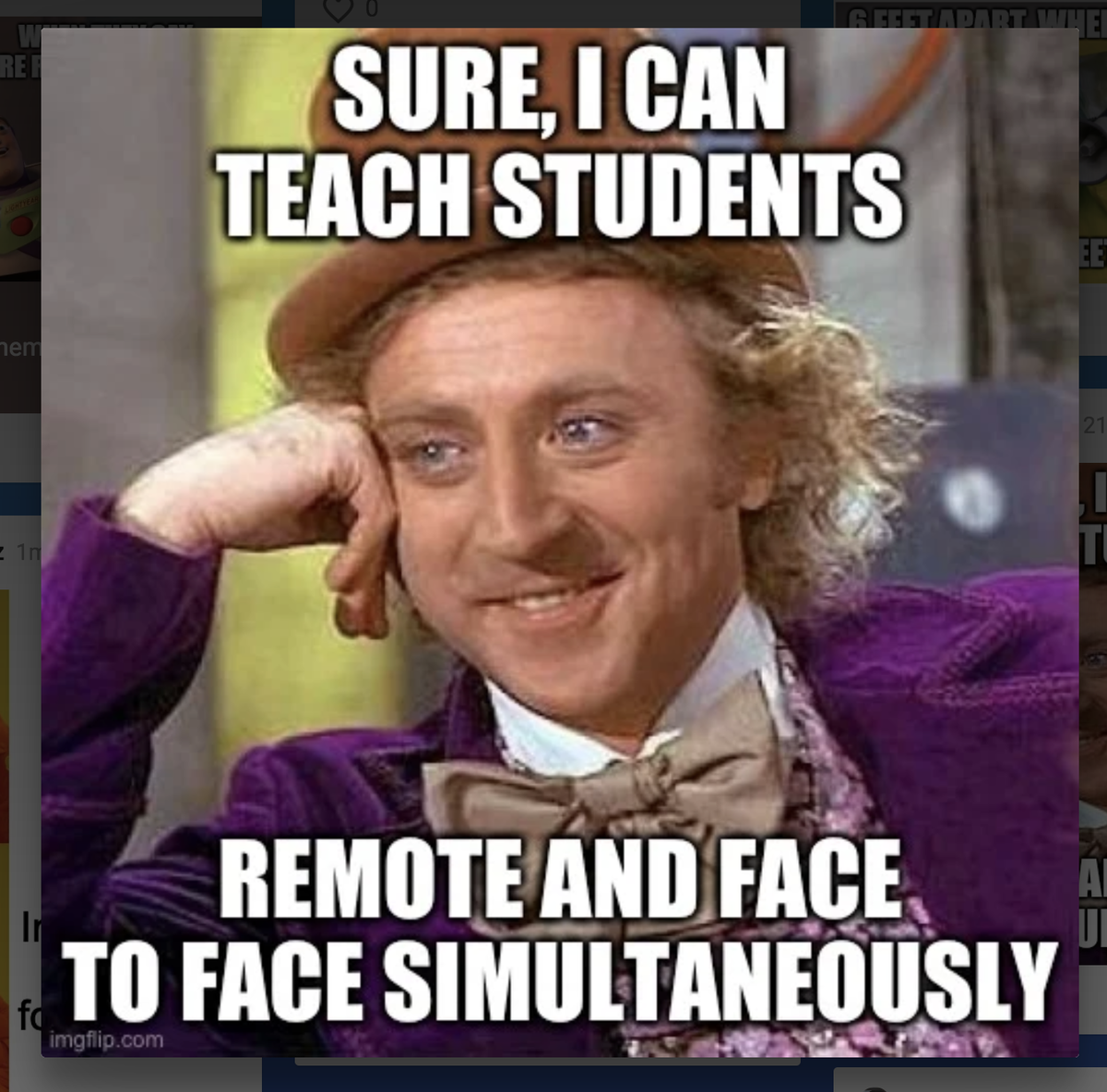
See, last school year, I worked two jobs at the same time because my school district decided that one teacher could teach both children physically in the room and children attending class from home via zoom at the same time, with no change in pay or other responsibilities. People left the profession in hoards. 

But I didn't. I'm back in the classroom this year, but I'm a shell of my self and struggle with energy and empathy exhaustion. 

I did my best to give myself recovery time. I didn't take any summer teaching work despite HUGE pressure to do so, and I kept my writing life low-commitment, too. But seven weeks off didn't do it, and I started the school year still burnt-out from last year. 

So, as holidays approached, my feeling about them was more exhausted-before-I began than excited. 

Chanukah helped. 

Years ago, we decided that instead of nightly gifts, we'd do nightly family activities, sitting by our candles and remembering what we do this for.  The eldest was able to join us for first and eighth night this year, quite a coup in her final year of college crazy-times. We baked, drew, listened to music, played games, and watched movies. One night though, we had to declare "introvert night" where we spent time ignoring one another and going to our separate corners. 

My latkes were perfect this year, and we started a new tradition of JFC (Japanese fried chicken). The prayers and candles still brought me a peaceful contentment. 

Then, we started making the shift into Christmas, and . . . I just wasn't feeling it. Even as I ticked things off my list in anticipation of all the good times (Christmas Eve pajamas, stocking stuffers, once-a-year treats), it felt like stress management more than joy. 

So I decided to turn to books to save me. Up until Christmas, I'm reading only holiday-themed books. Here's what I've read so far: a mix of nonfiction, classics, and romance. 


A Christmas Carol read by Tim Curry was perfection itself, and on a scale of zero to holly jolly, The Christmas Hirelings by Mary Elizabeth Braddon gave me all the right feels. The light romance approach of The Dreidel Spin made me feel like I'd just watched two deserving friends find one another, and the magic of food and kindness made the Moonglow books a delight. There are seven of those, and if I don't fit more of them in this year, I'll come back for them next Christmas. 

I'm in the middle of two more right now: 


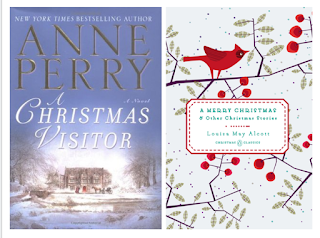
A Christmas murder and some sweet morality tales. Quite a contrast.  Still in my Kindle are a few Christmas reads written by friends and colleagues as well that I'm hoping to read before the 25th arrives: 


I'm grateful that my winter break starts a few days ahead of Christmas this year, giving me time to sit by the fire reading and continuing to try to stoke the fire of my holiday spirit, so I can really enjoy the gifts the season brings. I'm grateful, too, that my family understands how tired and crispy I am and doesn't expect me to travel or host guests, but just to rest and recoup. 

Are there any stories or activities that help put you in the holiday spirit, even when your candles are burning low? Tell me about them in the comments! I'd love to know. 


Wednesday, November 11, 2020

What is it about superheroes, anyway?

I was talking with some superhero-writer-friends online recently (my colleagues at superhero-fiction.com are the bomb!--you should totally check out their work). 

We were trying to identify the essence of the appeal of superhero stories. Superhero fans can be pretty hardcore--consuming all the superhero stories the world offers gluttonously and still wishing for more. 

So, why is that?

Is it just the wish fulfillment? The wonder of imagining other possibilities for humans beyond what it's actually possible for us to do?

That's certainly part of it, but I don't think that's the heart of it. At least not for me. 

image source
When I try to find the core of my attraction to superhero stories, I find it wrapped around feeling small and powerless as a child and longing to be able to do something big--something that would really make a difference. 

When I found Peter Parker, I felt like I had found myself. 

Underdogs for the win! 

Like young me, Peter was physically small, smart, kind of shy, and from a family that struggled just at the border of poverty, but loved each other and took a "we're in this together" "can-do" attitude to the lemons life threw them, without becoming completely saccharine. 

He also had a heart to help and an overdeveloped sense of responsibility. He might as well have been raised a Dunaway!

The things that drew me to Spiderman, and, to a lesser degree to other superheroes, are the same parts of myself that drew me to teaching as a career choice, where I have the opportunity for quiet heroics every day, making a difference for hundreds of children. 

As I've gotten older, I've remained interested in and excited by superheroes, though the type of hero that appeals to me has shifted. 

I find I'm drawn to reluctant heroes these days--heroes who say they just want to be left alone, but someone still get pulled into the fray just in time to save the day. This probably shows my own struggles with remaining engaged and hopeful in a world that gives me a lot of reasons to become cynical and disengaged. 

Fighting burnout is half the struggle of this stage of adulthood for me--keeping going even when I can't see the difference my actions make. 


Maybe that's why Patricia took the driver's seat in the latest Menopausal Superhero novel. 

I just finished a draft of Be the Change, which will become the fourth novel in the series, coming out in 2021. 

Right now, it's with my critique partners. 

The part of me that comes out in Patricia is the part that fights off burnout by staying connected with young people, being inspired by them (and sometimes being grumpy about that). 

Check out this excerpt: 
"Suzie made her want to be a better woman, to find her inner hero and do the right thing, even when it hurt. Suzie had been the impetus for her first foray into heroic action, pushing her to save the beauty queen at the mall. She’d also been a large part of the reason Patricia had agreed to sign on with the Department and work with the UCU.

Even coming to Indiana had been as much to please Suzie as out of worry for her missing mother. Would she even be here right now if not for her? Maybe not. That was the awful thing about young people—they cared. And they thought you should care, too. Exhausting."

Maybe that's the heart of superhero for me: they are characters that keep going, even when the going gets tough, the pay is bad, and the results might be unpopular. They fight for right, and I'm always up stories about that kind of heroism. 

How about you? What kinds of superheroes speak to you? Is there a type of story or character that you're always up for? 

Wednesday, August 5, 2020

IWSG: Recovering from Writer Burnout


Welcome to the first Wednesday of the month. This month you get two posts in one: It's the Insecure Writer's Support Group blog hop AND it's the blog tour for Chrys Fey's Keep Writing with Fey

The awesome co-hosts for the August 5 posting of the IWSG are Susan Baury Rouchard, Nancy Gideon, Jennifer Lane, Jennifer Hawes, Chemist Ken, and Chrys Fey! Please check out their posts and others in the IWSG blog hop when you finish here!
_______________________________________________

Image source
When writer's burnout hit me, it came as a real shock. Up until that moment, writing had been how I coped with other kinds of burnout, how I found my fun and kept in contact with my creative spark. While I had felt burnt out in many other aspects of my life (parenting, teaching, housekeeping, adulting) I had *never* lost the joy in writing. But that's exactly what happened to me in 2018. 

The direct cause was publisher trouble. I won't rehash the details here, but you can read about it in this old blog post if you're interested. Other causes were more internal--I'd put a lot of pressure on myself to produce a book every year, and I'd done it, releasing a book in 2015, 2016, and 2017. But come 2018, I faltered, my confidence shaken.  

I felt exhausted at a soul level. I had to fight anger and pessimism within myself as never before--I am usually, by nature, an optimist with a good layer of scotch guard that lets bad moments wash over me without sticking. But I took any small setback to heart, and started to feel like I'd overestimated myself. The self-talk got ugly and damaging sometimes. Doubt is mean. 

I tried a lot of things during this time:
  • pomodoros instead of word count to track my progress
  • crying
  • switching up my projects often
  • going for more walks
  • taking a hiatus from my critique group
  • coloring
  • journaling
  • chocolate
  • doing more "play writing" in the form of writing prompts
Despite my good fortune in making a relatively smooth transition from one publisher to another, I felt like my writing career had barely gotten started and then got the wind kicked out of it, I felt desperate to make progress…and we all know how attractive desperation is. 

Still, I did start to come out of it after a few months. 

The most important thing I did was to talk to other writers, sharing what I was feeling and listening to
image source
their stories and advice in turn. Across the board, they assured me that everything I was feeling was normal, that burnout happens even in work that brings you joy. They told me about what they liked about my work, reassuring me that my work had value and interest to the world. 

In short, they were good friends. Offering me counsel, support, a listening ear, and chocolate, in whatever proportions were needed. They cared about me and pulled me through to the other side. They reminded me to give myself the patience, grace, and compassion I would have offered to anyone else in the same situation. 

One of those writing friends was Chrys Fey. And now she's collected some of her experiences and advice on coming back from burnout in a new book!  


Catch the sparks you need to conquer writer’s block, depression, and burnout!


When Chrys Fey shared her story about depression and burnout, it struck a chord with other writers. That put into perspective for her how desperate writers are to hear they aren’t alone. Many creative types experience these challenges, battling to recover. Let Keep Writing with Fey: Sparks to Defeat Writer's Block, Depression, and Burnout guide you through:


        Writer's block

        Depression

        Writer's burnout

        What a writer doesn’t need to succeed

        Finding creativity boosts


With these sparks, you can begin your journey of rediscovering your creativity and get back to what you love - writing.


BOOK LINKS:


Amazon / Nook / iTunes / Kobo


Goodreads


ABOUT THE AUTHOR:

Chrys Fey is the author of Write with Fey: 10 Sparks to Guide You from Idea to Publication. She is also the author of the Disaster Crimes series. Visit her blog, Write with Fey, for more tips on how to reverse writer’s burnout. https://www.chrysfey.com/

Monday, April 20, 2020

FOMO or JOMO?

Image source
April is normally such a busy month in our family. 

We have two birthdays and our dating anniversary to celebrate. 

My parents usually come to visit, which usually means taking on a home improvement project (it's DANGEROUS to leave my dad very long without a project). 

Depending on where Spring Break falls, there might be a trip. 

I often attend a convention for my writing life. 


We usually pack a LOT into those four weeks. 

Needless to say, this is not our typical April. 

And you know what? 
I'm glad. 
Relieved. 
Recovering. 

FOMO (fear of missing out) is a big source of anxiety for a lot of folks during this time. What does it mean to our relationships and careers if we don't do all the things we're "supposed" to be doing? This is probably why every organization I have any connection to is inundating me with invitations to video meetings and "live online" events. It's more difficult to feel connected if we don't see one another and that's harder for some folks than for others. 

image source

I, on the other hand, am happy to have more limited interaction with the world. I get a little restless here and there, and there are some events that I have been truly sad to miss out on during this time, but really the quiet has been good. It's been YEARS since I had a proper introvert recharge time--I mean a *really* long one, that refilled my well completely. I probably haven't had one in my entire adult life.

Image source
When I talk to people about my teaching life, they often express jealousy about my "summer vacation"--my weeks of not working. That time away from the classroom to recover really is essential to my ability to keep coming back. 

And each year, I find that I come back a little bit less charged up. Maybe two months used to get me back up to 90% of normal me, but these days? I get back maybe half the energy I lost (and how much I lose seems to grow each year, too) and the build-up pushes me into dangerous burnout territory. 

My running joke is that I've been teaching for 26 years and that the necessary recovery period from that is…26 years.

I've been reading a lot about how this time is helping the earth recovery--people staying home is reducing the strain on the environment and wildlife and air quality are thriving. So, in my next month at home (at this point, I know I have at least one more to go), I'm looking for the JOMO--maybe I'll see a me I haven't seen in years thanks to the slower pace and recovery time. Here's hoping!

Wednesday, November 6, 2019

IWSG: Lowered Expectations


Welcome to the first Wednesday of the month. You know what that means! It's time to let our insecurities hang out. Yep, it's the Insecure Writer's Support Group blog hop. If you're a writer at any stage of career, I highly recommend this blog hop as a way to connect with other writers for support, sympathy, ideas, and networking.

If you're a reader, it's a great way to peek behind the curtain of a writing life.

The awesome co-hosts for the November 6 posting of the IWSG are  Sadira Stone, Patricia Josephine, Lisa Buie-Collard, Erika Beebe, and C. Lee McKenzie! I hope you'll check out their blogs as well as some of the others on this blog hop after you see what I have to say.
____________________________________________

My insecurities are beating me up right now.

I finally have to admit I bit off more than I can chew.

I'm not good at that. I think I can do everything.

That can-do stubbornness serves me well on some fronts, keeping me from caving to pressure or giving up just because something is difficult, but it's a two-edged sword that cuts back sometimes, too.

And Stories from Shadow Hill has been postponed, which breaks my heart.

I planned to release my first all-indie project for Halloween. It's a collection of thirteen weird tales called Stories from Shadow Hill, set in an imaginary suburban neighborhood with suspicious similarities to the one I live in, but with more interesting (and supernatural) causes for the weirdness.

I thought I had planned it out well. I'd done a lot of research and had what I thought was a good understanding of what exactly I needed to do and what it would cost.

I hired an editor for proofreading, found a book cover designer, and taught myself the layout software (Vellum is super easy, at least at a base level, by the way).

But then I ran into two problems: money and time.

Indie publishing can be expensive, especially for your first project, when you don't already a system in place.

My expenses:

  1. Buying layout software: Vellum $249.99 for unlimited ebooks and paperbacks
  2. Hiring a cover made: $100 from a freelancing friend who gave me her "friends and family" discount
  3. Hiring proofreading: $620 from a freelancer who approached me through Facebook some months ago. 
  4. Getting a logo made for my imprint: $25 from a freelancing friend, giving me a "friends and family" discount again
  5. Buying ISBN numbers: $295 for 10 (they're a better deal the more you buy at once, and I intend to put out more indie projects in the future, so I thought I'd start with 10). 
I managed 1-4 over the course of a few months by living spare and robbing Peter to pay Paul. But when it came time for #4, I was out of money. My hot water heater needed sudden replacement, my summer teaching paychecks were light, and there went my Bowker money. My parents gave me my holiday money early (thanks Mom and Dad!), but I needed most of that to get copies of my already-published work for my fall and winter author events. 

Couple this with my time problems, and you see my dilemma. 

I was trying to keep my regular writing life going. Doing my October tradition of writing one piece of flash fiction every day as part of the Nightmare Fuel Project AND processing my edits from that proofreader was just too many hours work for the hours I was able to devote (I can get 1-2 hours a day for writing life during the school year, tops). 

And I was stubborn, not wanting to let anything go. Maybe I could have done it if I had given up Nightmare Fuel, but I *love* Nightmare Fuel. Maybe I could have let that Instagram October Author Challenge go, but I was enjoying it and it was increasing my reach on social media. Maybe I could have given up my day job, but I like eating and having a roof over my head. I tried giving up sleep and just ended up with a crick in my neck from falling asleep in my chair.

In the end, I had to admit I couldn't get the project ready by October 31. Especially since I had only a basic understanding of Vellum and might still need to seek advice and help from more experienced colleagues if I run into snags. 

So, now I don't know exactly when I am going to get this project out. October came and went and I still have a distressingly long to-do list: 
  1. Process the other half of the edits (complicated by grammar differences between my Canadian editor and my American writing style--lots of second guessing and researching whether what she marked is an error or a national preference)
  2. Format the book in Vellum (which has subset jobs of #3 and #4 below)
  3. Finalize the print version of the cover
  4. Finalize the imprint logo
  5. Buy ISBNs
  6. Learn to navigate uploads to Amazon
  7. Make my decisions about exclusivity to Amazon or going wide
  8. Promote the book

November is supposed to be for NaNoWriMo, finishing the first draft of the Gothic romance I started writing this summer, so I can get it out in 2020.

I'd love to hear from other creatives about how you manage all the demands of indie creation, especially if you, like me, manage it with a day job and keep your sanity. How do you keep heart when you have to lower your expectations?

Wednesday, June 26, 2019

Sometimes I feel I've got to run away: Writer's Retreat!


I love my family and my teaching life, but sometimes they feel like they're going to squash me. At the worst of times, it's like people are grabbing chunks of me and carting them off, and at the end of the day, all that remains is a pile of vibrating nerves that no one else wanted.

All my life, writing has been where I run away to when there's too much. It's solitary, but creative and productive: at the end of it, I've created something. It's personal and self-expressive even when it's fiction. It satisfies something deep within me that can't be soothed by any other means. It's why my daily writing time matters so very much. Even when my writing feels stymied, it's still a selfish little moment that is only about what I want to create. It really is a mental health release valve for me, even more than walking (and walking helps me immensely, too).

This past weekend I was lucky enough to get run away from my regular life for three days for a writer's retreat. I spent those days in a lovely mountain house with six other writers, writing, talking, walking, reading. I didn't make a meal, wash a dish, wash anything, or give ANY of my time to something that wasn't about my writing life.


I'm discovering that short bursts of focused time like this are essential to my writing life. I can't always take a trip and surround myself with like-minded folks, but at least during summer vacation, I'm fortunate that I can arrange a few days during which I am only a writer, during which I can bring the full force of my considerable concentration to my current creation and push the rest aside, just for a little while.

I send the youngest to camp or to visit Grandma. I tell my family that I'm off the grid. I cash in all those gift cards I received for teacher appreciation day on take out meals. I prep ahead with snacks and tea so I don't have to go anywhere. I don't answer the phone.

I don't think I'd fare well if this was my life all the time. I am a writer, but I'm also a teacher, a mother, a wife, a friend, a sister, and various other kinds of human and even though I run towards introverted, I'm not willing to give up all my other loves JUST for writing. Even Emily Dickinson had people visit and wrote letters, after all. I do need and want people. I'm not really a hermit, even though the idea is tempting sometimes.

But as a respite, it's wonderful to run away from everything else for a little while and give myself over completely to my life of words. May you all find a respite like this when you need it, an oasis that lets you refill your well and gives you the wherewithal you need for harder times.

Wednesday, June 19, 2019

Summer Writing


Summer is here! As I write this, I've been on summer vacation for (checks watch--remembers I don't have one and checks phone) 1.5 days!

As a teacher-writer-mother, I look forward to summertime all year for the control over my schedule and ability to focus more on my writing life instead of shoehorning it in around school demands. And I've made it! I'm a full time writer, for almost two months in a row.

As a 21st century woman though, I always want more out of my time than I can actually get, so here are my tips for managing a mother-writer summer schedule.

For context, my kids are currently 12 and 19, with the 19 year old living forty-five minutes away from home, near enough that I can see her often, and be there to help her when needed, but not part of my daily dinner plan.

1. Chunk your time: I'd love to have all day every day of summer for my writing life, but that's not realistic given the parameters of my life, so I just snag *part* of each day for writing.

I tend to think of my day in three chunks: morning, afternoon, evening. Because my tween will sleep as late as I let her, it generally goes: morning for me, afternoon for house/daughters, evening for family. This keeps things from bleeding into my writing time too much, but still leaves me pretty flexible during each chunk of day.


I get up when my husband gets up for work even though I could probably get away with sleeping later. I'm a total wimp about the heat, so I get outside for my exercise first: a walk or a run with my dog immediately before the summer sun is fully awake and trying to bake us alive. This has the added benefit of waking up my brain in a pleasant environment.

Then, I start all the appliances, so clean dishes and laundry (and sometimes even lunch: go rice cooker and instant pot!) happen while I'm not looking, and it's breakfast and writing time. I try to stop at lunch time.

Afternoons are for running errands and making sure the tween has some fun and doesn't turn into a total lump of lazy. Often I can write during this time as well, jotting down thoughts in the notes app on my phone and handling the social media commitment of a writing life during the waiting moments. If there's a playdate or mom couch time and my interaction level is lower, I steal that for writing, too.

Evenings are for managing home life aspects that require all of us (after the husband gets home from work) and for enjoying time together: games, movies, outings, etc. Sometimes I sneak extra writing time during this time, if there's dad-daughter time going on.


2. Make arrangements for a few ONLY writing days:

For me, that means sending the youngest away (camp, visiting Grandma, overnights at someone else's house, etc.) or sending me away (writing retreat!). I can usually only manage about two weeks of full time writing life across a summer, but they are heaven on earth when they come.

It requires being strict about protecting that time. If the youngest is at camp, I AM NOT filling that time up with errands, even pleasant ones like lunch with my sister. I grab those hours with both hands and hold on tight, refusing to let anything shy of an actual emergency wrest them from my grip.

I also have to be strict with myself about using the time well when I get it. I set priority lists of what to write in what order and am careful not to let myself fritter the time away on social media or writing the wrong things.

My rules for prioritization are: passion level, publication expectations, promises made, and watching out for burnout. Just like every other part of my life, choosing how to spend my writing time is a balancing act, too.

3. Planning ahead helps.

Generally, we plan and shop on Sunday for the entire upcoming week, making note of al the "extra" (not in the usual schedule) things we need/want to do, and making meal plans.

This really helps, because I don't have to spend time on Monday-Friday deciding on meals or shopping them. Those decisions have already been made; all I have to do is follow the plan. That frees up brain space for more fun things like deciding why my male lead's secret twin was a secret.

I plan ahead for my writing time as well, figuring out which day will be spent writing a blog post, which a short story, which focused on the current novel, which on promotion, and so on. I can't do all those things every day, and it helps me to compartmentalize them, promising each task its spotlight moment in turn.

After all this time, I'm good at figuring out what kind of writing I'll be able to do given the constraints of a day: how much time a row I can get, likelihood of interruption, need to devote extra time to other parts of life, etc.

So, there are my ideas for managing a writing life among the other demands I've taken on. How about you, kind readers? Any tips that work for you? How do you protect and arrange time for your creative endeavors?

Wednesday, May 1, 2019

IWSG: Overwhelmed


Welcome to the first Wednesday of the month. You know what that means! It's time to let our insecurities hang out. Yep, it's the Insecure Writer's Support Group blog hop. If you're a writer at any stage of career, I highly recommend this blog hop as a way to connect with other writers for support, sympathy, ideas, and networking.

If you're a reader, it's a great way to peek behind the curtain of a writing life.

This month's wonderful co-hosts are Lee Lowery, Juneta Key, Yvonne Ventresca, and T. Powell Coltrin!

Be sure to check out their blogs (and others on this great blog hop) when you're finished here!
_______________________________________

I forgot to post this morning. That's how overwhelmed I am. I mean, I can give you a list of excuses, but I really look forward to this post every month and it completely slipped my mind. That's not like me.

Obviously I'm juggling too much. But what can I drop?

I did say no to a few things this spring, trying to help find a better balance. I didn't apply for any conventions or author events in February, March, or April, giving myself back several weekends of time for other things. I also left my long time critique group, deciding to be a little more selfish with that time as well.

But then I said yes to other things, helping to organize a few events for my Friends of the Public Library group, and taking on teaching a new class for a local community college.

I think I'm still suffering from what I complained about last month: the demands of a full time writing life squashed into part time hours leaving me feeling a day late and a dollar short all the time.

I'd love to hear tips from others who manage a writing life while holding down a day job. How do you make it work without driving yourself crazy? What do you let drop?

Wednesday, April 3, 2019

IWSG: When part-time isn't enough, but you can't afford full time


Welcome to the first Wednesday of the month. You know what that means! It's time to let our insecurities hang out. Yep, it's the Insecure Writer's Support Group blog hop. If you're a writer at any stage of career, I highly recommend this blog hop as a way to connect with other writers for support, sympathy, ideas, and networking.

If you're a reader, it's a great way to peek behind the curtain of a writing life.

This month's wonderful co-hosts are J.H. Moncrieff, Natalie Aguirre, Patsy Collins and Chemist Ken!

Be sure to check out their blogs (and others on this great blog hop) when you're finished here!
_______________________________________

This month, I'm feeling the crunch of time.

Since I began to see my work into print (my debut was in 2015), I've been building a writing life that involves public appearances, judging contests, teaching classes, keeping up a social media presence and--oh yeah--writing!  I love nearly every aspect of it.

These little tastes of fame, like appearing as a guest on a talkshow or speaking as an expert on a panel, when they come are validating and invigorating. Coupled with my innate desire to help (it's in my DNA, and why I'm also a teacher), it's a beautiful thing.

A beautiful and exhausting thing.

I could easily fill all my working hours each day with my writing life. Unfortunately, I can't yet also fill my bank account with full time pay for that work. I don't yet earn minimum wage when you average it out as hourly pay.

I'm not a trust fund baby and my "sugar daddy" husband (whose support I'm very fortunate to have) isn't one either.

We have children, which turns out to be a very expensive hobby, especially when one of them grows up and goes to college.

So, I'm holding down a demanding (and underpaid) day job (teaching middle school in "Right to Work" North Carolina) for half what my husband makes for the same education level and half my experience, while also trying to build up my second career and occasionally play with my dog, talk to my children, or date my husband or something.

I was patient with getting this far, and I'm trying to be patient still, trusting that the balance will skew in my favor given focus and hard work. But it's hard, when it feels like I lose opportunities for my writing life because there are simply not enough hours I can devote to it each day.

So, that's my insecurity this month: trying to hold on to the hope that I can make my passion into a paying proposition that justifies the hours and effort I put in.

I'm starting by being more intentional and regular about submitting my work. After all, no one can read it and decide to pay me for it if I don't submit it!

How do you hold onto your dreams when they're seeming to take too long to come true? I'd love to hear your advice!

Wednesday, January 16, 2019

Marketing for Introverts

Hi! I'm Samantha, and I'm an introvert. In fact, I'm really happy that we're having this little talk here on the Internet, where I don't have to actually talk to you.

It's not that I'm not friendly. I bet I'd even like you. It's that I'm still recuperating after participating in a fan convention this weekend for my writing life.

Being a writer might seem like a natural job choice for an introvert. In some ways, it's an excellent fit.

Doing the work requires spending copious amounts of time alone.

The work itself is usually pretty quiet (just some keyboard clicking or pen scritching noises).

You can do the work wherever you are most comfortable.

On the other hand, if you want to make a career of writing, you can't *just* write. You have to put your work out there for others to read.

Then, there's the marketing, that second job of garnering attention for your work and being discoverable. That can be pretty painful for a introverted person, but I'm here to tell you that it can be done.

At Illogicon last weekend, I participated in a wonderful panel on this very topic with some talented introverts: Gray Rinehart, Claire Wrenwood, Patrick Dugan, and Fraser Sherman. We all agreed that you can make a career as a writer without undergoing some kind of alchemy and becoming an extrovert, and that in some ways, introverts might be especially well suited to it.

So, here are a few things to consider if you're an introvert and trying to promote yourself and your work.

1. Take it slow: A lot of people seem to think that building a writing career and support network is a sudden quick movement, like sweeping the legs in a kickboxing match.

It's not.

Not even for extroverts.

Building contacts and relationships is the work of years, and luckily, it's the kind of work introverts are good at! We may not be comfortable standing behind the megaphone and calling for the attention of everyone in the room, but we're great one-on-one and when we get to know someone, we usually get to know them well. Our relationships are deep and strong and lasting.

When you are meeting new people, be reasonable in your expectations for yourself. I'm happy if I make one or two new initial contacts at any given event. I'm not trying to go home with my pockets bursting with business cards. I'm trying to make a few meaningful connections.

2. Pick your poison:  There are a lot of ways to put yourself out there as a writer. You can give readings, participate in discussion panels, teach workshops or classes, hand sell books from a table or booth at an event, make videos about your work, tweet cleverly, blog, etc.

Some of these things will scare the heck out of you, and some may only make you nervous. Pick something you feel like you can do and try it. You can push yourself a little at a time, and you don't have to put yourself out there on every possible platform.

Look at events carefully, think about your comfort levels, and plan accordingly. I enjoy doing fan conventions, for example, but I tend to stick to small and medium sized ones relatively near my home base.

I take my sister with me whenever I can because it's good to have someone more outgoing with you and someone who will help you take care of yourself when you need it. Even better if that someone loves you and understands your needs and limits.

I like panel discussions because they have a clear structure and don't require me to "make the first move" like approaching someone at a booth or table does. Someone will call on me when it's my turn to talk.

I ask convention organizers not to schedule me for late night programming because it's harder for me to be entertaining and clever and "on" when I get tired.

Over time, this has gotten more comfortable for me because I've gotten to know more and more people, so often attending an event means I'll be among as many friends as strangers. I find that VERY comforting.

Though Dragon Con is the BIG con near me, I have yet to apply, because I know how stressful I would find it to navigate the halls of such a large free-for-all event. Maybe I'll get there someday, or maybe I won't. We'll see.

For now, I'm feeling good about how much more comfortable I feel with what I'm doing now.

3. Self-Care! Everyone needs self care, but introverts may need to tend to themselves a little sooner and more specifically than other folks (I wouldn't know; I've never been one of those other folks).

For me, that means being as careful as I can be with my schedule: making sure there are adequate meal breaks and quiet time, packing some good snacks.

That might mean that I skip some networking opportunities and don't go to the bar with the other writers after an event, or decide to spend time alone in my hotel room instead of sitting at my table or booth for two more hours (even if I miss a chance to sell a book that way).

If I don't give myself space to recoup my energies, I'm not going to make a good impression or make good use of those opportunities anyway.

It also means that I try to give myself decompress time after an event.

I'm writing this on Monday night and I got home from a convention on Sunday night. I had three different social invitations this evening, but I turned them all down in favor of sitting here quietly at my laptop. It was the right choice, especially since I'll have to be "on" again next weekend for the college class I'm teaching.

So there are my thoughts on how to make a go of this if you're an introvert. By the way, that panel? It was the most laid back and polite panel I've ever been on. I don't think anyone talked over someone else or interrupted even once. And we left plenty of wait time for questions from our audience. :-)