Welcome
to Open Book Blog Hop. You can find us every Monday talking about the
writing life. I hope you'll check out all the posts: you'll find the
links at the bottom of this post.
Who is your favorite visual artist? ______________________
Sorry, y'all. I can't pick. My favorite on any given day is the one that feeds the part of my soul that was hungry, and that's different on different days.
So far as big, museum-famous artists, I love Francisco Goya, Frida Kahlo, Johannes Vermeer, and Auguste Rodin, among others. I'm more likely to get stuck on a particular work than all the work by a particular artist. For example, my favorite Van Gogh isn't any of his most famous ones, but a strange one that is part of the Cincinnati Art Museum's collection: Undergrowth with Two Figures.
That's my "hometown" art museum, so I've spent a lot of time staring at this particular wooded scene trying to decide if the people are ghosts, or if their semi-transparent appearance is more an optical illusion created by the lush undergrowth and the trees. I like that I never could decide.
There are also quite a few artists in my life. People I know personally and love, whose work adorns my walls. From my father-in-law, who made his living as an artist, to my mother who studied photography, to neighbors, to convention buddies, to a college friend (Mark Davis) who sold me his cool octopus painting at a bargain rate because I wanted it badly, to a local guy (Wes Flanary) who painted The Gill Man and sold the work to my husband as a holiday gift for me.
Honestly, I need more walls. I'm running out of space to hang the art that charms and inspires me.
So, no, I don't have a single favorite artist, but I'm grateful they're all out there making wonderful things. Who's on your list?
Welcome to Open Book Blog Hop. You can find us every Monday talking about the writing life. I hope you'll check out all the posts: you'll find the links at the bottom of this post.
People are like a box of crayons. Which crayon would you say that you are?
______________________
This seems like one of those Barbara Walters interview questions. Do y'all remember her? I might be dating myself…
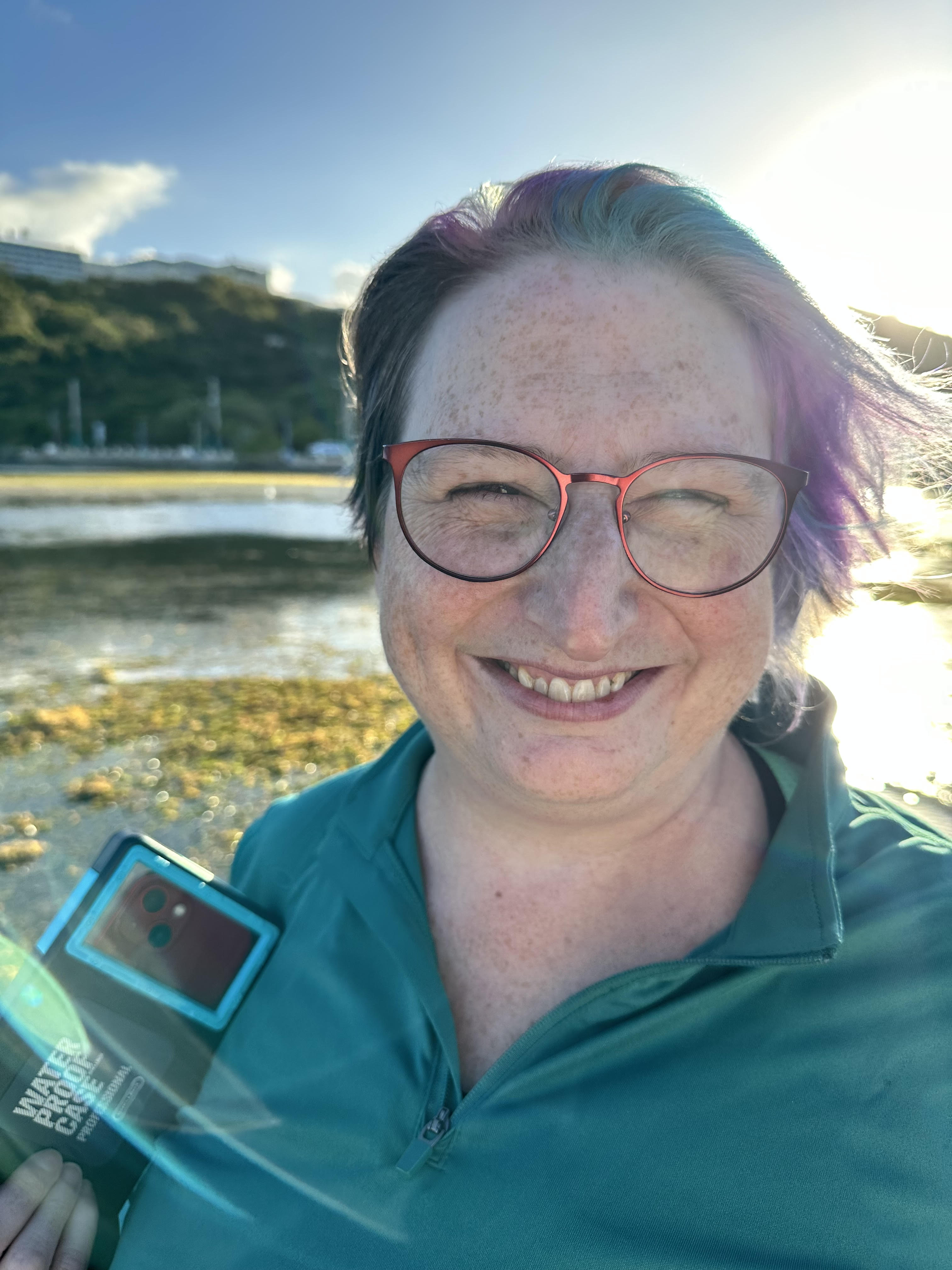
I have trouble choosing a color. I mean…this is what I look like:
Photo by author's husband, on a trip to Puerto Rico, March 2023
See? I can't even choose a single hair color! So if I'm a crayon, I'm one (at least one, maybe more) of the bright ones. Maybe a nice green or purple, maybe a blue or magenta.
I'm probably also one of the crayons in the box with the wrapper mostly missing, a little misshapen from having gotten too warm at some point, pointy still, but slanted because it had gotten dull and someone "sharpened" it by coloring for a long time on one spot.
I'm no pristine crayon still perfect in the box. I've seen use. I've been loved. But, I've still got beauty left to make.
So there you go, Barbara Walters, I'm an old magenta crayon with most of the wrapper missing, bent at the middle in the shape of the hand of the kid that loves me. How's that?
Welcome to the first Wednesday of the month. You know what that means! It's time to let our insecurities hang out. Yep, it's the Insecure Writer's Support Group blog hop. If you're a writer at any stage of career, I highly recommend this blog hop as a way to connect with other writers for support, sympathy, ideas, and networking.
If you're a reader, it's a great way to peek behind the curtain of a writing life.
September 2 question - If you could choose one author, living or dead, to be your beta partner, who would it be and why?
I've been fascinated with Shirley Jackson's work since I first encountered her book We Have Always Lived in the Castlein my library when I was weird thirteen year old kid.
I've returned to her work over and over since then, revisiting her work once a decade or so--re-reading favorites and finding new pieces I've missed. Even though my own writing is not disturbing in the same vein as Shirley's, I feel a connection to her, as if she speaks something inarticulate from deep inside my own consciousness.
Recently, I watched the quasi-biopic of her, based on the novel by Susan Scarf Merrell, and that feeling of connection was only strengthened. (The book/movie isn't accurate in a biographical sense, BTW, but it evokes a feel that I believed).
Like Shirley, I am ill-suited to be a housewife, even though I love my husband, my home, and our children and sometimes revel in taking care of them--and sometimes wish they weren't there, so I could focus on my life of words. We'd have that push and pull in common.
I, too, have a creative bent, and though I look pretty darn normal on the outside, it's more than a little weird inside my brain. Sometimes my mundane life and the worlds within my mind don't mesh well.
It's probably why her horror works so well for me. We both see the weird in the seemingly ordinary.
Luckily, I'm living my adult years in a different era than she did--she died six years before I was born. The expectation that I would marry and devote my life to only the work of household and children still lingers in the corners of my experience with other misogynist mumbo-jumbo, but no one is terribly shocked to learn that I work full time, or that I write. Those limiting views of femininity and a woman's role in the world have lost cachet and are no longer the norm, at least not that in my peer group.
I don't face social censure for the kinds of things that I write either. Not like she did. I also have a better husband than she did (at least as far as you can judge someone else's husband from what you see from the outside of the relationship).
I don't know that Shirley would have liked my work. She might accuse me of being too light or fluffy. But I suspect that if I could thicken my skin enough to take her criticism, my work would be the better for it. She would call me on it when I try to pull back from hard emotional moments or take it too easy on characters I've grown attached to, even more than my real-life critique partners do (and they don't really pull any punches--especially not Rebecca).
Would Shirley want or respect my opinion on her work? Maybe? I do have a lot of practice, as a middle school teacher, giving constructive criticism kindly and with support and compassion interlaced. And my admiration is sincere. I would mean the praise I offered.
Given the chance, I'd sit on the veranda with her and talk about the life of words, even if I had to put up with her cigarette smoke to do it. I like to think we'd get each other.
I've been working on a novel for about a year (a gothic romance, working title The Architect and the Heir). It's going well and I want to keep plugging away on it. I gave myself "until school ends" to finish a draft…and I failed to do so.
I made great progress, especially considering that I do this part time and you know…COVID, police violence, terrifying fascism rearing its ugly head everywhere. If 2020 is the year of seeing clearly, I sometimes wish I could back to being blind.
And now, I have to shelve A&H and switch gears, hard turn to starboard.
The reasons are positive. I have a contract! That's a lucky position for an author to be in: knowing I have a publisher ready and waiting for my book, willing to help bring it out there into the world.
But contracts come with deadlines--external deadlines, imposed because of schedules for editing, proofreading, cover art, etc. My next deadline is January, which means it's time to set down Devon and Victor and pick up the Menopausal Superheroes again or I won't make it.
I'm also coming back to this series after a nearly two year break during which I worked primarily on other fiction: short stories, editing for work that already been submitted, and another shelved novel before this one. So, I'm feeling a little daunted.
This is the first time in my writing career (all five years of it) that this has happened to me. I've heard other writers talk about juggling different projects and now I finally understand how wrenching it can be to slam on the brakes and screech to a halt, leaving good rubber on the road, so I can keep my promises. It's not that I don't love the other projects, too--I totally do! It's just the moment of switching gears that hurts a bit.
I'm hopeful though, that Devon and Victor will be there waiting for me when I come back to them. I've made good notes about where the story is going. I have already managed to set it aside three times in the past few months to complete edits on novellas for the Menopausal Superhero stories, and each time I fell back in within a few days.
Any advice for me on switching gears and finding my groove on the new thing quickly? The clock is running guys, so I need to get this booty moving! I'd love to hear your ideas in the comments!
Reading has always been my escape, well, as long as I can remember anyway. But like a lot of readers I've talked to recently, falling into a story has been harder than usual for me during quarantine.
That got worse here at the end of May with police violence leading to protests that became riots. My low-level restless anxiety and imagination full of what-ifs whipped into something larger and harder to ignore. I know a lot of creatives are struggling similarly, with creation as well as consumption of art. I'm managing slow forward progress on my writing still, and am hopeful I can pick up my pace again when the school year ends here in a couple of weeks.
Despite my struggles, I still read eight books in May, and I really liked six of them.
I've read other books by Alexandra, and I know from being there for some of her readings that her work is clever, sexy, and spiked with humor. Chasing the Dragon: A Sherlock Holmes Romantic Mystery was no exception. Her imagined love story for Sherlock Holmes plays beautifully in the known world of those stories while bringing Alexandra's strengths into play. I hope she writes more in this universe!
Bill and I have been on panels together at conventions for a few years now, but I hadn't yet read any of his work. Gidion's Hunt was sweet in a wholesome sort of way, especially considering that it's a story about a teenaged vampire hunter. I loved the family relationships and it looks like Bill has a great foundation for future books in the series in this first volume.
DM Taylor is a writer I know from Instagram. The Reckoning is a time travel thriller with elements of women's fiction. I enjoyed it quite a bit! It took me a little longer to read this one because I read it as a Kindle edition, and I'm suffering from screen-time overload right now, which is making me prefer paper and audiobook reading to ebooks.
I also read three graphic novels this month. Graphic novels can be read quickly, often in a single sitting, and the combination of art with narrative really works to suck me in when my attention is scattered. The Sixth Gun, Volume 3: Bound really pleased me. I read the first two in this series last month and loved the way this volume took the focus to Gord and deepened his backstory. I'm looking forward to reading more in this series!
Newprints and Endgames by Ru Xu were passed my way by my thirteen-year-old daughter who loved them. She's a huge fan of Blue, the main character, and I can see why--she's so forthright, scrappy, and determined. Unfortunately, the storytelling disappointed me in that the narration pulled back from hard emotional moments, avoiding conflict that the story really needed.
The second volume in particular felt rushed, like two books worth of story had been crammed into only one. Still, it evokes a Little Orphan Annie feel in a wonderful steampunk setting and there's a lot to recommend them, especially to younger readers.
My last two reads were disappointments. I'd been looking forward to reading The Starless Sea by Erin Morgenstern. I loved the cover and the premise of a secret society surrounding story and books intrigued me. I had positive memories of The Night Circus, so thought I might enjoy another book by the same author, but it really just didn't grab me at all. All atmosphere (gorgeous, beautifully rendered atmosphere) and no substance. Too light on plot and characterization to keep me, especially under current circumstances.
Steppenwolf by Hermann Hesse was my First Monday Classics Book Club choice for the month and it was a slog for me. I kind of had a feeling it was going to be, just remembering the kinds of people who touted its praises back in my undergrad years--almost exclusively entitled young men I didn't like all that much. But, still, I tried to go in without bias and give it a go.
I found some beauty and insight in the text, but was left with the overall yucky feeling that I get from reading literary representations of male academics having midlife crises which they overcome by having affairs with far younger women.
There's nothing for me in a story like that. I can't sympathize with the main character, and often can't sympathize with the young woman either because she's a manic pixie dream girl or a complete cypher. Maybe this one was the first novel of this type? I don't know. But it didn't feel innovative or interesting. I've seen this story many times and it's irritated me every time.
Luckily I'm finishing May in the middle of two good books I'll tell you about in June: Magic for Liars by Sarah Gailey and The Haunting of the Tenth Avenue Theater by Alex Matsuo.
What did you read in May? What's next on your list? I'd love to hear your thoughts in the comments.
Critical Read put out a call recently for short nonfiction posts about art that is seeing you through the pandemic. They rejected my submission, but were kind about it and invited me to submit something else, with a focus on an American artist. I probably will. In the meantime, I highly recommend checking out the posts on their site (and, of course, mine below).
_________________________
Shakespeare in Quarantine
I often turn to poetry when my soul is troubled, especially older, metered poetry. The rhythm soothes me while the language pulls me out of my here and now and transports me to another time and place. This time, it’s Shakespeare seeing me through the quarantine.
Shakespeare’s birthday, April 23, is also the day that my husband and I had our first date, on which we watched a movie production of one of the Bard’s plays, 10 Things I Hate About You. We’ve made a tradition of celebrating our anniversary with a Shakespearean performance every year since as near to the day as we can manage, live when possible, recorded when not.
So, it seems apropos that it is Shakespeare in a thoroughly modern context that is pulling me through right now. Each day, I wait for Patrick Stewart to upload his daily sonnet video to social media and I find a quiet space to sit and listen alone, just me and Sir Patrick and the day’s verse. As I write this, he’s been recording a sonnet a day for nearly two months.
He began with Sonnet 116 “Let me not to the marriage of true minds/Admit impediments” which of course, I already loved. I fell in love with it when I first read it as an undergrad, and again when Kate Winslet’s Marianne of Sense and Sensibility quoted it breathlessly, and yet again when Sir Patrick Stewart read it to his wife who held a phone to record the moment for us.
Words written more than four hundred years ago are performed for me by a spaceship captain in the privacy of my own home. What a gift!
__________________
What art is seeing you through quarantine? I'd love to hear about it in the comments!
I love reading. When I was less employed I read two or three books a week, and I still try for one a week even with my day job, side hustle, and children to raise.
I think in narrative, which I guess makes sense for a writer, and if I'm not getting enough story in my life (both writing them and consuming them in books, movies, and programs) I'm a hot mess. I also LOVE talking with others about books, which is why I'm a bit of a book club junkie. (The links in each will take you to my Goodreads reviews, something I reference, or to related blog posts on this blog).
So, here's what I read in January 2020. I'd love to hear from anyone else who read this books or wants to suggest other reads:
I started 2020 by finishing a book I started right as 2019 ended: Lovecraft Country by Matt Ruff. It's a book I'd heard good things about from some friends whose opinions I respect, and that I'd also seen receive criticism because it's a book written by a white man about black people.
Working from the premise that the Lovecraftian mythos is real, Ruff wrote a book that is as much about the horrors humans inflict on one another as it is about the Old Ones and mysticism and madness.
The story centers around an African American man and his friends and family in the Jim Crow United States of the 1950s and does not shy away from presenting the subtle and overt hatreds flung at the Turners. Using Lovecraft, an infamously racist writer, as the plot in such a book struck me as rather brilliant and I thought it well executed, but I'd love to hear from others who've read it.
Next up was Burial Rites by Hannah Kent. This was a neighborhood book club pick, and not one that I knew much about when I started reading. My friend Shannon Turlington suggested it. She's a very well read woman and has an eye for unusual and interesting stories, so I'm usually glad when I take her reading suggestions.
That was true this time, too. The story is set in the early 1800s in Iceland--talk about two things I know nothing about! The plot centers around Agnes Magnúsdóttir, the last person to be executed for a crime in Iceland. As her story unfolds and more details are revealed, the tension grows. Bleak and beautiful.
Well worth the read for the view into rural Icelandic life and the effects the landscape and rough conditions had on her people as well as for the fascinating imaginings of what the woman at the center of the case might have been like.
From there, I picked up The Turn of the Key, another book I'd heard quite a bit about. I'm a big fan of re-imaginings of beloved stories, the kinds of books I call "back door" or "side door" stories. The best of them do more than just change the setting--they affect how you view the original work.
This one is playing in Henry James's yard, bringing The Turn of the Screw into a more contemporary setting and bringing in some shades of Ray Bradbury with a smart house used to creepy effect.
I'm currently writing a gothic romance myself, so I'm steeping myself in works in the genre. This one does a great job utilizing the tension and possibly unreliable narrator I loved in James's book, while making it something new with the change of setting and new motivations for some characters. Quite good!
My next read was passed to me by my twelve-year-old daughter, a huge fan of graphic novels, especially those with LGBTTQQIAAP themes.
The Witch Boy by Molly Ostertag is set in a magical world that is highly gendered in societal roles--more so even than the world I actually live in, which still strikes me as heavily gendered in a lot of ways.
Aster is drawn to witchcraft, but males in his society are shifters and magic is for females only.
The story is very direct in its allegory, which made it feel a little preachy and lacking in subtlety to me, but my daughter, who is younger and less jaded, adored it. I wished the book had been longer, allowing the author space to stretch out some relationship building.
I met Daniel José Older at Illogicon in 2017. We were on a panel together recommending reading, and as you might expect from a panel featuring him (or me for that matter), we were looking for diverse reads. I added Older to my authors-to-check-out that day, and he finally made it to the top of my TBR.
I very much enjoyed the premise of Shadowshaper which involved a sort of magic that enabled an artist to imbue their work with spirit, quite literally. And for diversity points? Top marks.
Sierra Santiago is a great main character, realistically a teenager making some unwise decisions while she struggles to deal with the secrets and dangers that have newly come her way.
Sometimes the book felt a little on-the-nose to me, but it *is* a young adult novel, so too much subtlety may not be audience appropriate. The bad guy felt a little one-note and flat to me, but his minions were scary! I appreciated that Sierra still had her family around her, extended family even. I do get tired of the no-family trope in YA books, and this one had a message of reconnecting to your roots rather than escaping them that I could definitely read more of.
So that was my January in books. What did you read? Have you read any of the books or authors I mentioned here? I'd love to hear you thoughts!
To put these in perspective for my daughter, I told her that these films were new when Grandma and Grandpa were little. I'm glad we're finally back in feature length films. The shorter pieces collected in anthologies were not my jam in the same way. Most of this next slew of films I actually remember pretty well from childhood.
Even though I'm not as old as these films, they all had theatrical re-releases and at one point or another, I (or my parents) have owned them on VHS or DVD. So, since our last report, the littlest Bryant and I have watched: Cinderella (1950), Alice in Wonderland (1951), Peter Pan (1953).
My daughter thought she would like Alice, but was lukewarm on Cinderella and Peter going in. I remembered Cinderella the most fondly.
Surprisingly, Cinderella was the one we both liked best. The character gets a bad rap in some ways, being lumped in with other, more passive princesses waiting for their prince to come and rescue them.
But this version of Cinderella is a hard-working girl. In fact, you get the feeling that, even had her father lived and protected her from the harsh treatment of her stepmother, she would still have been an industrious young woman, using her positive energy to make a difference in the world.
She doesn't waste time bemoaning her lot. It's the mice who complain on her behalf (in song, of course).
Even when she expresses a wish to go to the ball, it's not about changing her lot in life permanently. As my daughter said, "She didn't ask for a prince. She just wanted to put on a pretty dress and go to a party."
The part of the story that's always been hard for me to believe is that a beloved little rich girl who is demoted to housemaid in her own home harbors no resentment or ill will towards those who abuse her. That impossibly kind "heart of gold" element was helped a little in this version.
After the stepsisters tear up the gown the mice made for our heroine, she weeps in the garden and you learn that her positive attitude has been a conscious choice, one that she's now having trouble maintaining in the face of another disappointment. That's a very real set of emotions and won the respect of two Bryant women watching. We hope the prince proves worthy of her.
Alice, on the other hand, was not very interesting at all. The cartoon still charms, with its presentation of a cast of madcap characters and crazy scenarios, but Alice herself?
Meh.
She's petulant and mostly passive, just pushed along by the world she falls into. My daughter liked this one better than I did, but her focus was on the animation--things like the playing card soldiers, the disappearing cheshire cat, and the size changing experiments.
Honestly, Alice herself is rather incidental to the story.
Still Alice was a model of fortitude and feminism in comparison with all the characters in Peter Pan. Oh my! The racism and sexism was rampant.
The over-riding view of girls in the story is that they're here to serve boys. They are petty and jealous, squabbling with each other over the affections of boys because that's all that apparently matters--not what the girls themselves might want, but who can win the attention of the best boy.
Peter himself, well, he's a jerk.
I don't understand why anyone would want him, and my daughter felt the same way. He's a show-off, and only cares about garnering attention for himself. Even his Lost Boys only seem to hold value for him as an audience for his exploits. The kiddo does say that there are several boys with this kind of self-aggrandizing attitude in seventh grade, and she hopes that they grow out of it. I hope so too! She'll have to work with those people someday.
The element that had her gasping with dismay though was the part with Tiger Lily and the "Indians." From pigeon-English to stereotypes of dress, it was horrifyingly racist.
I guess I can be glad that these kinds of depictions are shocking to younger audiences.
That shows some progress.
When my parents were children, kids commonly played "Cowboys and Indians" using these types of characters thoughtlessly.
Even when I was a kid, in the 1970s, we didn't think anything of calling someone an "Indian Giver" or by the use of actual contemporary people as mascots for athletic teams.
The lyrics to "What Makes the Red Man Red" combine racism and sexism into one ugly little tune. Yikes! I'm kind of surprised that Disney airs this one. I wonder why Peter Pan doesn't get the censure that Song of the South does?
About the only saving grace to the film was the Darling family. The children's affection for one another, the push and pull of the wife and husband, the dog who served as a nanny. All lovely and charming. We liked when dad decided that Wendy didn't have to grow up so fast after all. It was nice that he got to end the story remembering the fun and magic of his own childhood, something he had apparently not held onto as he grew up.
Lady and the Tramp is up next! Looking forward to that one. I hope it's still as charming and romantic as I remember it!
If you've been reading these posts, you already know my husband got us a subscription to Disney Plus, so my daughter (age 12) and I have taken on a project of watching all the Disney animated features in order. I'm writing about the movies and our reactions here on the blog.
Since the United States was kind of busy in the 1940s, thanks to WWII, Disney produced mostly collections of short animations during this period. Even though the release dates are largely post-war, the artists must have working on these pieces during some tumultuous times, and the Disney studio did a lot of government propaganda work, leaving less time to develop popular features.
The compilation/anthology movies don't appeal to me as much as the more extended movies that tell a single story. My daughter doesn't mind though. She's a bigger animation fan in general, though, seeking out animators on YouTube in her spare time and drawing still images in the various styles she sees there. So, she enjoyed these more than I did.
The next one on our list was Make Mine Music (1946), and I was disappointed to find that it wasn't on Disney Plus. I know I've seen it because when I read the description on wikipedia, I remembered Casey at the Bat, Peter and the Wolf, Johnny Fedora and Alice Bluebonnet, and that one with the singing whale. I'll check back for it in the future. Maybe there's a distribution rights problem or something.
On the other hand, I wasn't at all surprised that Song of the South (1946) wasn't there. That one already felt weird in terms of race depictions in the 1970s when I was a little kid. It would probably be even stranger now.
I told my daughter about it, and we both wished we could have watched it for the animation study, to see if the integration of live action and animation had gotten any better after The Three Cabelleros in 1944. I remember thinking it was pretty amazing at the time, but then I wasn't the animation connoisseur she is.
Having learned about Uncle Remus stories, though, my daughter had an a-ha moment about the reference her dad and I sometimes make to being thrown in the Briar Patch, so hey--educational moment :-)
So, we jumped to 1947 with Fun and Fancy Free, which features several famous names of the era alongside two cartoons: Bongo and Mickey and the Beanstalk. I didn't remember Bongo at all, though I remembered Mickey and the Beanstalk quite well. The retelling of Jack and the Beanstalk has been released in other forms and shown on television over the years, though, so it's entirely possibly that I really never had seen Bongo.
My daughter and I both enjoyed Dinah Shore's reading and singing of Bongo, but were more than a little perplexed at the whole "Bears Say I Love You With a Slap" thing. My daughter's reaction was pretty much: Wait? What? Still, it was a fairly charming story and we enjoyed it, even if we didn't find anything especially memorable about it. We both enjoyed seeing Jiminy Cricket again. He's a charmer, that little bug.
Edgar Bergen introduced Mickey with his dummies Charlie McCarthy and Mortimer Snerd. Now I've never found Bergen's schtick funny, but I tried to hold my tongue and let my girl decide what she thought uninfluenced by me. I guess she's my kiddo, after all, because she also wished they would just hush up with the creepy dolls and staged conversations and get back to the story.
Mickey and the Beanstalk was a charming telling and does a good job integrating the normal personalities of Mickey, Donald, and Goofy into the familiar fairy tale. The giant was such a goofball that he wasn't scary at all. We were happy to see him again at the end, pulling the roof off Edgar Bergen's house and then stomping off into the city to put on the Brown Derby restaurant as a hat.
Next we made it to 1948 and Melody Time, which was a string of music-centered stories: Once Upon a Wintertime, Bumble Boogie, The Legend of Johnny Appleseed, Little Toot, Trees, Blame it on the Samba, and Pecos Bill. I remembered Johnny Appleseed and Little Toot from childhood, and was happy to recognize The Andrews Sisters and Roy Rogers among the narrators.
My daughter knew Johnny Appleseed, too--having had a babysitter in her preschool years who showed that cartoon alongside lots of Veggie Tales to the children when she needed a break. And I'm proud to say that she knows who The Andrews Sisters were, too. She's a fan of an electro-swing rendition of Mr. Sandman, which sent her down a historical music rabbit hole, so she's now probably the only twelve-year-fan of a musical group her great-grandmother used to love.
Among the other stories, we were both mostly just annoyed by Once Upon a Wintertime and couldn't figure out why in the world Jenny and Joe were all cuddly at the end when their disastrous ice skating date should have taught them both that they are ill suited for one another. The music didn't really go with the animation either. It looked slapstick and sounded melodramatically romantic.
Bumble Boogie was fun visually and would have been at home in Fantasia, but it's good that it's short.
The Legend of Johnny Appleseed was way more overtly Christian than I remembered, but still managed to be pretty charming, even though both of us don't usually enjoy art that proselytizes too much. Johnny was just so earnest and grateful for his blessings that it's hard not to like him.
Little Toot definitely benefitted from the Andrews Sisters' talents, because the story is a bit of a muddle. My daughter that Little Toot's parents were the ones were needed a talking to, maybe something about age-appropriate expectations and child supervision.
Trees was really pretty to look at onscreen. According to wikipedia, "To preserve the look of the original story sketches, layout artist Ken O'Connor came up with the idea of using frosted cels and render the pastel images right onto the cel. Before being photographed each cel was laminated in clear lacquer to protect the pastel. The result was a look that had never been seen in animation before." It truly was striking visually! We oohed and ahed over that one, but again we were glad it was short because the poem wasn't very interesting and there wasn't really a narrative hook.
Blame it on the Samba was a repeat of The Three Caballeros in that Donald Duck and José Carioca are panting over beautiful human women again. Eye-rolling 1940s sexism. Dullest bit in the film. Who knew Donald was such a horn-dog?
Pecos Bill was the silliest piece. A tall tale story you might hear alongside something about Paul Bunyan or John Henry, it told the story of a cowboy who had been raised by coyotes, wrestled cyclones, and fell in love with a cowgirl named Slue Foot Sue.
We giggled quite a bit during this section, but its silly-ness really brought out how all over the map the tones were in this collection. It was very much a kitchen-sink production, probably having something for everyone since we threw everything in willy-nilly.
Next should have been So Dear to My Heart, 1948, but it too was unavailable on Disney +. So onward we went to The Adventures of Ichabod and Mr. Toad, 1949. Neither of us was sure why these two stories were paired for release. There's really nothing to connect them, though both are fun in their own way. I remembered both stories with some fondness from childhood. My daughter had never seen either one.
Mr. Toad is about, well, Mr. Toad. He's a madcap frog with an enthusiasm for speed and adventure that gets him into trouble. The portrayal of Toad's mania with the hypno-spinning-wheel eyes was entertaining, as was the whole frog running around the countryside dressed as a country gentleman from the turn of the century.
It was a light and entertaining story and we both enjoyed it, but thought it rather forgettable. (The introduction by Basil Rathbone delighted me, but unfortunately my daughter doesn't know who he is, so we'll have to try some old school Sherlock Holmes on her soon.)
Ichabod was a delight. Bing Crosby was perfect and we were both delighted by the portrayal of Ichabod (already a familiar character to both of us) as socially graceful despite his gangly appearance. The scene where he's dancing with Katrina at the party and stuffing himself with pie without ever missing a step and Brom is trying and failing to switch partners so he can squire Katrina around the dance floor? Priceless. So many moving parts in that scene and all so deftly handled. Brilliant.
Talking afterwards we wondered if Katrina's ploy worked and made Brom work harder to win her heart or not. We hoped that Ichabod found a warm hearth and good food in another town. He was a man of simple enough wants after all.
We're both glad to be done with the anthology pieces now. Check back soon to see what we think of Disney in the 1950s. I'm anxious to see how Cinderella holds up!
The company has created a lot of stories that I've enjoyed in my life, but they have also helped feed a narrative of women either as helpless and needing rescue or objects of censure for being anything not considered "wholesome."
Even as a little girl, I chafed at some of the underlying messages. But there's a magic about this films, especially when they get you at a young age.
I'm a sucker for a musical, and Disney has more than a few out there that made up the soundtrack of my childhood. Even if I don't always like how the "princess" narrative goes--Disney has a long history of female led stories that garnered huge audiences, crossing generational lines. The cultural significance of that can't be ignored.
Since Disney now owns Star Wars and Marvel--two fandoms that dominate our household, we got the new Disney+ service.
So, I've decided to watch the Disney animated features in chronological order with my younger daughter. She's into animation, and hasn't seen some of the older ones at all, so I think it'll be an interesting view on the body of work.
So, that starts us out in 1937, with Snow White and the Seven Dwarfs. We'll need to watch 11 films to get to 1950, the year my parents were born.
Those first five I know well. I've seen them all many times, starting in early childhood, and moving through VHS and DVD and streaming services with my cousins and friends and eventually my elder daughter. We don't think our youngest has seen any of them before, though she's seen a lot of Disney's more recent movies.
I don't remember ever seeing Saludos Amigos, Make Mine Music, or Fun or Fancy Free, at least not by title. The Three Cabelleros, Melody Time, and The Adventures of Ichabod and Mr. Toad ring only vague bells.
At this writing, the youngest Bryant and I have watched Snow White and Pinocchio.
Some thoughts:
Snow White is weird-looking. She is portrayed as neither a woman nor a child, but some sort of hybrid: adult-sized and apparently considered marriageable drawn as if she is wearing eye makeup and lipstick, but with a chubby baby-fat kind of look more like a toddler, no womanly curves, and a very childish voice.
It's disconcerting. The animation on the dwarves is more expressive than on our princess.
We noticed that sometimes when Snow turns her head, something strange happens to the planes of her face, as if it does not actually have three dimensions. It reminded us of hieroglyphic art in that the face was always to the front, no matter what. We began to wonder if there were any ears under her hair because of all the moments when her movement made us expect to glimpse them, but none were seen.
Obviously animation of human-appearing characters has come a long way since this first feature film.
The Blue Fairy has a similar plasticity, but it is less disturbing since she's a supernatural character: a
fairy who lives in a wishing star. Pinocchio only looks "real" for a couple of minutes at the end, so there wasn't time for him to pull us too far into the uncanny valley.
Story-wise it was interesting the parts of the story that weren't portrayed.
My daughter and I are very familiar with Snow White in thousands of iterations, from the Grimm fairy tale telling through hundreds of reinterpretations in books, movies, and other media.
In the Disney animated feature, we never see Snow White interact with her stepmother until the stepmother comes to the dwarves' cottage disguised as the apple peddler. That's an interesting storytelling choice that really adds to the stepmother/witch's malice.
Neither of us has read The Adventures of Pinocchio by Carlo Collodi, however. When we talked it through, we realized that the only other version of Pinocchio either of us could remember seeing is the character in the Shrek movie series. We did both feel like we already knew this character well, though, despite exploring him far less thoroughly. We must have absorbed him through cultural osmosis.
In the movie, we wondered why we didn't get to see Geppetto get swallowed by the whale. His whole adventure happened off screen. Both of us agreed that would have been more interesting than the whole Pleasure Island sequence that went on too long.
Some parts of the stories didn't age that well.
The ick-factor of Snow's awakening by a kiss from a complete stranger is alleviated by having the prince meet her early in the movie with the wishing well scene. Thank goodness. It really did help with that moment.
The evil gypsy puppeteer Mangiafuoco in Pinocchio definitely made the movie feel old, and not in a good way. Racial stereotypes like that don't play as simply as they once did and we both felt squiggy watching that part. And the cartoon logic of having a pet cat that acts like a cat in the same movie as a talking fox who acts like a human is something we don't often see any more.
Also, is Geppetto the worst dad ever? He sends a boy who was literally a block of wood yesterday off to school alone and wonders why he doesn't get there? I mean, I don't like the helicopter parenting we see these days either, but a little preparation and leading the way might have been a good idea.
"Heigh-Ho", "Whistle While You Work", and "I Got No Strings" still had our feet tapping. Those songs hold up well. The warbling love bits, less so.
I'd love to hear what you memories and experiences surrounding these films are like and hope you'll come back to talk about the rest of the project. There are more than 50 movies in the list, so it might take us a year or so to watch them all!
The new season of Wording Wednesday has begun. Fellow author Andy Brokaw collects a set of prompts and puts them out there for the world to use for inspiration. This season, the theme is weather and we begin with the impressionist artwork Sunlight Effect Under the Poplars by Claude Monet. Check out the links and play along if you'd like, or just enjoy reading.
I'm a fan of prompt writing. It helps me keep the fun and play in my writing life. Sometimes it leads to something I can expand upon and publish and sometimes it doesn't, but I love the freedom to play in a story I have no expectations for. Let's see where this one takes me, shall we?
__________________________________________
These mornings with Helene were heaven on earth. Away from everyone else, if only for an hour or two, Giselle and Helene could pretend they were still just girls, free to wander open fields expecting nothing but beauty and receiving it openly. The light on the tall grasses and flowers bloomed in Giselle's chest like hope, buoying her despite her troubled mind. Helene's skin glowed, as it had when she was young and would let down her hair so the wind could ripple through it. She used to say it felt like flying.
Their lives had gone in very different directions since childhood. Always the beauty among their group of friends, Helene had married a wealthy man despite her lowly station. He had swept her away, taking her to Paris, Rome, and Ithaca, all the places they had read and dreamed about over their schoolbooks. Her letters praised the scenery and said little of the man himself, which was commentary enough for Giselle to understand.
Life had not been a fairy tale for Giselle. Her father died suddenly when she was twelve, leaving her family in desperate straights. She'd gone into service, which allowed her to earn a little money and help keep her mother and younger siblings in food and shelter. That had been the end of her schooling and any dreams she'd fostered of a better life. On bad days, she resented it bitterly. On good ones, she was thankful that she'd at least had an option to help.
After her fifth child in as many years, Helene's health failed her. She'd never been strong, not in body, though her spirit remained robust. The doctors hoped that fresh air and exercise would enable her to recover, but anyone could see she was fading. Helene, ever a loyal friend, had taken the opportunity to bring Giselle with her as her companion, to get away from the drudgery of the city and into the light of nature again. They both knew it wouldn't last.
It wasn't right, getting her friend back just so that she could help her die. But for an hour or two, whenever the light shone, they could be girls again, pretending the future stretched bright before them. It would have to be enough.
I love my family and my teaching life, but sometimes they feel like they're going to squash me. At the worst of times, it's like people are grabbing chunks of me and carting them off, and at the end of the day, all that remains is a pile of vibrating nerves that no one else wanted.
All my life, writing has been where I run away to when there's too much. It's solitary, but creative and productive: at the end of it, I've created something. It's personal and self-expressive even when it's fiction. It satisfies something deep within me that can't be soothed by any other means. It's why my daily writing time matters so very much. Even when my writing feels stymied, it's still a selfish little moment that is only about what I want to create. It really is a mental health release valve for me, even more than walking (and walking helps me immensely, too).
This past weekend I was lucky enough to get run away from my regular life for three days for a writer's retreat. I spent those days in a lovely mountain house with six other writers, writing, talking, walking, reading. I didn't make a meal, wash a dish, wash anything, or give ANY of my time to something that wasn't about my writing life.
I'm discovering that short bursts of focused time like this are essential to my writing life. I can't always take a trip and surround myself with like-minded folks, but at least during summer vacation, I'm fortunate that I can arrange a few days during which I am only a writer, during which I can bring the full force of my considerable concentration to my current creation and push the rest aside, just for a little while.
I send the youngest to camp or to visit Grandma. I tell my family that I'm off the grid. I cash in all those gift cards I received for teacher appreciation day on take out meals. I prep ahead with snacks and tea so I don't have to go anywhere. I don't answer the phone.
I don't think I'd fare well if this was my life all the time. I am a writer, but I'm also a teacher, a mother, a wife, a friend, a sister, and various other kinds of human and even though I run towards introverted, I'm not willing to give up all my other loves JUST for writing. Even Emily Dickinson had people visit and wrote letters, after all. I do need and want people. I'm not really a hermit, even though the idea is tempting sometimes.
But as a respite, it's wonderful to run away from everything else for a little while and give myself over completely to my life of words. May you all find a respite like this when you need it, an oasis that lets you refill your well and gives you the wherewithal you need for harder times.
It's easy to get in a rut in your reading. After all, when you find something you like, you want more! But there is a such thing as too much. At some point, the sparkle is gone, the shine is off. It might still be comfortable, but it's not as exciting as it used to be. So it's time to try something new.
I know this pain as a reader. Trying something new is stepping outside your comfort zone, and it's so frustrating when you try something new and you don't like it. When you get burned like that, it is that much harder to try something new. You want to hedge your bets, to know that you're going to like the new thing.
So, how's a writer to get new people to try her work?
Well, we'll have to step out of our comfort zones, too, and try something new. As a writer in that very position, here's what I've been trying.
An "easy" thing that most people try at one point or another is social media. Whether you use Facebook, Google Plus, Tumblr, Twitter, Goodreads, Instagram, YouTube, Pinterest or some other platform, social media has several advantages for getting the word out there if you're a new author (and/or an introvert).
It's free.
It's popular.
It doesn't require that you leave your house.
But, oh dear, it can go badly when it goes badly. Cringing-ly badly.
Each of these social media platforms has their own aesthetic, their own etiquette and expectations. And a lot of excited new authors jump in with both feet, and their eyes closed, not looking around long enough to realize that they've elbowed someone in the chin flailing around like that. Hence you see feeds that have nothing but "BUY MY BOOK" or the same post with no alteration on several different platforms or worse yet, attacks or defensiveness about criticism. You make your potential readers uncomfortable or annoyed, and that can hurt not only one potential sale, but all your future potential sales to a reader.
Whatever platform you choose to play in, there are a few things to keep in mind.
1. Look around. Observe first. Make sure you understand how people typically use this platform. See what kinds of posts get positive response. Learn from what others do.
2. Do something there besides advertise. The users of all of these platforms aren't there to read ads. I mean, really, would anyone go anywhere specifically to watch ads (except maybe to YouTube to watch the clever Superbowl ads)? Don't forget the SOCIAL in social media. Make friends. Respond to what other users are doing. Post about something besides your work.
3. Always put the best version of you forward. We all have complaints, but these public forums are not the place. Save your venting for the private spaces in your life, among friends and colleagues. You don't have to be Pollyanna, but neither should you be Oscar the Grouch, hating everything. Be yourself, but with your filters on.
4. Pick a platform you enjoy. It's not necessary to be on *everything* or to drive yourself crazy trying to keep up. I probably do too many, but I'm an experimenter, and I use different platforms for different things. I like to try out new things and push myself out of my comfort zone. This will take some trial and error. You have to *try* something before you know if you like it, just like you're hoping people will give you a try as an unknown author.
For example, here's me trying video. I'm not very comfortable in the medium, but I like the idea of being able to give people a taste of what my book is like even if they can't make it to any of my events. I'm not ready to be flashy when it comes to video, but I could handle giving my phone to my sister and asking her to film me while I read at Con-Gregate.
5. Be honest. People don't like being lied to or scammed. If no one has reviewed your book yet, don't claim to have five star reviews. If you've sold ten copies to your friends and family, don't claim you're a bestseller.
That goes for your book advertising in other ways, too. Make sure your cover art and back of the book blurb give people a good idea what the book is about. People don't like bait and switch, and that's how it feels when you think you're buying a nice, straightforward romance, and suddenly a vampire descends from the ceiling. You don't do yourself any favors by getting people to buy your work under false pretences . . .they probably won't like it.
So, my author and other creative friends, what are you trying to get the word out about what you do? What's working or isn't?
I have a metaphorical cholesterol problem. I just can't get enough cheese!
No, I don't mean cheddar or muenster or gouda (though all of those are also good-ah).
I mean so bad they're good, groan-fests: cheesy movies.
Call them what you will. B movies. Cult Classics. Guilty pleasures. Misunderstood genius. Mistakes. Train wrecks. Disasters. Silly. Fun.
The "it factor" that defines them for me seems to be that in popular, general terms, these movies are not regarded as good. They wouldn't win Oscars for anything, not
even set design or soundtrack. They're melodramatic and overwrought. The plots are weak and require serious suspension of disbelief. Characters are drawn in broad strokes, not with subtlety or nuance. They don't grow or change. The journey is just surviving the adventure.
But they have heart.
I'm not as fond of the ones that are doing it on purpose, stuff like Sharknado or Snakes on a Plane. A truly cheesy movie has to be sincere, so it can't know that it's a cheesy movie. It has to believe in itself or the magic doesn't work. Sure, the costumes may be bad, the acting even worse, but there's something about the very lack of professionalism and controlled artistry that is a siren call for me. There's no distance. They *mean* it.
Especially in the summertime, when I'm in recovery from nine months of relentless, demanding classroom work and I want my escape, I turn to cheesy movies. Candy for my brain. Wonderful, possibly hallucinogenic candy.
I blame my father.
We used to watch the worst movies together after cartoons on Saturdays, so besides the attraction of the high drama and unbridled imagination or the allure of no-holds-barred who-cares-if-you're-offended transgressiveness, there's also a nostalgic comfort like Chef Boyardee and Ovaltine. Maybe it's not good for me, but it's cozy.
So, whenever I'm not busy this summer (and I'm awfully busy, considering it's summer: teaching, going to conventions, meeting deadlines, etc.), you can find me trolling the bowels of Netflix looking for the best cheese. (Or at the Carolina, where sometimes they play it for me on the big screen!).