Showing posts with label education. Show all posts

Saturday, June 11, 2022

Leaving Teaching

I've been a teacher my whole life. Just ask my cousins and my poor little sister about the days when I forced them to play school with me in the basement, when I was five and they were still toddlers. I even had school desks and a chalkboard. I made worksheets for them and corrected their letters. 

Admittedly, I was a bossy little thing, and that probably had something to do with it, but it's also about sharing an enthusiasm for learning. What can I say? I LOVE school.  Learning and books are part of my soul. 


image source

I was probably only six or seven when I started telling people that I was going to be a teacher when I grew up. I was also going to be a witch, a dancer, a veterinarian, a reporter, a writer, and an astronaut…only some of those stuck. 

Unlike most people I know who changed their minds multiple times about what to be as they grew up, I stuck to that childhood plan of becoming a teacher. The only thing that changed was what level I thought I wanted to teach (elementary, middle, high, college). 

I went to college and earned a degree in English education with minors in Spanish, Creative Writing, and a sort of Humanities add-on they called "Honors." Other than a minor gig with my college public radio station and a brief secretarial job, all my work life was teaching or education adjacent. I tutored, served as a classroom aide, subbed, and taught in my own public school classroom, in summer programs, and on college campuses. 

The work was never easy, but it was worth it. There's such power in being there at the moment of elucidation or new comprehension or boundaries being stretched and helping people gain the tools they need to make their goals and improve their lives. I felt useful, important…like I made a difference. 

Even now, after 27 classroom years, I still believe public education is the most important idea to rise out of American democracy: the idea that ALL citizens have the right to education was and is ground-breaking and represents all that is best about my country. (we can talk another day about the forces trying to kill that from within). 


image source


You knew there would be a but, right? 

The realities of choosing a teaching life can be pretty grim. Nearly always, it means sacrifice in other aspects of your life. 
  • You'll always earn a low salary, especially considering the education required, the importance of the work, and the stress and danger involved. 
  • It's the only profession I know of where people who have never attempted the work themselves (or worse yet: FAILED at it) are in charge of the system, and the whole world thinks they know better than the trained professionals how to do the work. (Well, maybe mothering--that also came with a TON of irrelevant, hateful, and unwanted "feedback" from people who don't know a darn thing about it--we can talk another time about misogyny and the value of women's work). 
  • You might as well change your middle name to scapegoat, because you'll collect ALL the blame and none of the credit.
  • The stress levels are sky-high and self-care is just two words people like to say, about as useful as sending "thoughts and prayers" during a tragedy. No one means it; no one cares. 
  • It's physically dangerous. More schoolkids than police officers have been killed in our country this year by gun violence, and their teachers die trying to save them. Between school violence, stress-related health damage, unsafe and poorly maintained work environments (school buildings), and contagious illnesses, teachers die from the work every day. Your life is on the line. 
  • You'll be overworked every single day. Schools are underfunded, which leads to being understaffed, which leads to one person shouldering a work load more appropriate for three to five people. 
  • People will call you a hero, but it's lip service they pay to avoid paying you in respect, support, or dollars (you know: things that MATTER and might make a difference). It's disingenuous at best, and often far darker than that. 
  • You'll feel helpless a lot because you can see the problems and what needs to be done, but you don't have the tools, time, or resources to fix things. It'll break your heart a little bit every day…and can eventually make you shut down out of self-protection. 

It's not sustainable. The system was built on the backs of women--something we allowed at a historical moment when it was hard for a woman to get paying work of any kind at all and have been stuck with ever since. When the entire system is predicated on the exploitation of the workers, there's something wrong. 

It's even worse in states like North Carolina: "Right to Work" states they call them. Anti-union is probably a step more honest. No protection for the worker--not even the basic protection I'd enjoyed in other states like a guaranteed lunch break every day or due process if I got fired. 

image source


I've thought about leaving lots of times. 

  • Sometimes I stayed out of passion--to try and make change from the inside.
  • Sometimes I stayed because I'd been gaslighted so much that I'd internalized the idea that the problems were about me instead of about the work conditions.
  • Sometimes I stayed out of exhaustion--too tired to put in the footwork to find something else. 
It was like having an abusive spouse in a lot of ways. You convince yourself that it's not as bad as it is. You stay "for the kids." Fear and manipulation reign over all. 

Well, reader, I left him: that abusive spouse I called a teaching career. 

Two weeks ago, I said goodbye to my last group of students and walked out into the sunlight. I'm corporate Samantha now, working as a content strategist for a large financial firm. I've had my new job for all of nine days as I write this, and it's already a world of difference in terms of stress and work-life balance. 
image source

It's telling, I think, that my primary emotion, intermixed with the sadness of leaving the children and some of my colleagues, was relief. 

Wednesday, August 18, 2021

Not a Superhero


They probably meant well. 

It seems flattering at first blush, being called a superhero. 

It implies that I'm special, someone who handles work that an ordinary human would not be able to do--jobs that require super-human strength, endurance and effort. 

But the problem with that overblown, hyperbolic, and manipulative rhetoric is that teachers aren't superheroes. We're people. 

Don't get me wrong. I'm an amazing person. I can do more with 90 non-supervisory minutes a day than some people do in entire eight hour work days. I'm a master of efficiency, and surprisingly good at improv, too, given how often the rug is pulled out from under me mid-stride. Many of the teachers I work with are as amazing as me. Some are even MORE amazing. 

But, they're not superheroes. Neither am I. I'm just a middle-aged woman who's fed up with this particular method of dodging discussion of real issues. 

I know superhero imagery is appealing, and has become a favorite metaphor for lots of overworked, underpaid public servant sorts of work. But a lot of the people using this comparison don't know superheroes. 

I, do, though. I read, watch, and write superheroes. I know them well. 


And here's something we all need to remember: 

Superheroes are fictional.

Real heroes exist. Some of them are teachers. But superheroes are imaginary. 

Only imaginary heroes can shoulder the load alone, out of the goodness of their hearts, with no thought of reward or rest. Superheroes don't need help from ordinary folk. They don't need things like reasonable workloads, safe working environments, a living wage, or even our respect. 

But if society can cast teachers as superheroes, it lets the rest of the people off the hook. We don't have to make any sacrifices for the public good, like paying higher taxes so that students can learn in buildings that aren't falling apart, or paying teachers enough money that young, passionate, talented people might be attracted to this line of work. 

When I am called a superhero, I remember James Jonah Jameson, editor of the Daily Bugle, the angry spittle-flinging man ranting about the ineptitude and untrustworthy nature of the very superheroes who continue to save his butt and the butts of all the ungrateful citizens of imaginary New York and the world beyond.

Superheroes *do* get thanked from time to time, mostly in moments of crisis like alien invasions and such. 

Real heroes get thanked under similar circumstances, like a teacher throwing herself in the literal line of fire when another problem society ignored too long walks through the front door with a gun, or dying during the pandemic because they went to work in person despite the risk "for the kids." 

Remember those five minutes at the start of the pandemic when parents all over America realized what a teacher's job actually was and expressed gratitude? 

Yeah, that was over as soon as it went on "too long." When the superheroes were revealed as all too humanly vulnerable. A grateful public turns into a resentful public very quickly when the superheroes stop saving them. 

If teachers stumble--regardless of why (or even if they don't stumble, but someone manages to spin the story just right)--those teachers we were just praising as superheroes are suddenly on the front page again, but this time as the recipients of blame, anger, and ire. We're called selfish or incompetent, accused of indoctrinating students when we try to teach them to think for themselves. All from people who have never done our jobs (and honestly probably couldn't handle the job if we got them to try it). 

So, instead of throwing empty compliments like "superhero" at teachers, how about working to increase the likelihood of success? Remember that teachers are ordinary human with ordinary limits. If the job truly requires a superhero, no wonder we're going through a giant teacher shortage. Superheroes don't exist and ordinary people trying to be superheroes can die trying. 

I don't need flattery, and I'm not accepting more than my share of the blame. Instead, I want to see a world where success is possible and the work is sustainable. It's possible . . .it's just expensive. America has gotten off cheap on education so far, and we're starting to see the truth in "you get what you pay for." 

But, for now, what I really want to say is: take that cape and shove it. 

Thursday, August 12, 2021

Summer's Over and I'm Not Ready for School to Start


I still love teaching. Helping kids find their way in something they're trying to learn, getting to know the future generations as people . . . these are deep joys. Still. After 26 years of classroom life. That's saying something. 

But here, four days before my first teacher workday of the new 2021-2022 school year, I am absolutely not ready to go back. 

Teaching is always exhausting. Getting through to kids requires huge emotional investment, and the system is set up to undercut teachers at every step of the way: paying us so poorly that we struggle to make basic ends meet, trying to legislate things that should be professional decisions, piling on extra documentation requirements without providing time in the schedule to do the work, blaming us for every problem a child faces without giving us the corresponding credit when a child succeeds. 

Luckily, 90% of the time, it's just me and kids in my classroom. Their parents, school administration, and politicians may try, but they cannot really intrude on that relationship . . . not at the level of spending they're willing to do anyway (spies, whether digital or in person, are expensive). They're simply not there when the rubber hits the road. The kids and I are on that journey alone. 

Last year, teaching was a whole new kind of exhausting. 

One thing I value about the work is the predictability. Kids, of course, are not predictable, but generally, my classes meet at the same time every day with the same people in them studying the same things. I know when I can go to the bathroom and if I'm going to get to eat lunch or not (yes, that is often an "if"). I need those parameters to work within. 

Starting in March 2020, there was no predictability. I was sent home from school with directions to prepare for 3 or 4 weeks of asynchronous teaching and didn't start working in a classroom again for a year (and even then, it wasn't "normal" since I had to teach kids at home via zoom and kids in my room at the same time, with all new health precautions and the rules changed roughly every three days about what was and was not allowable). 

And 2021-2022 promises more of the same. 

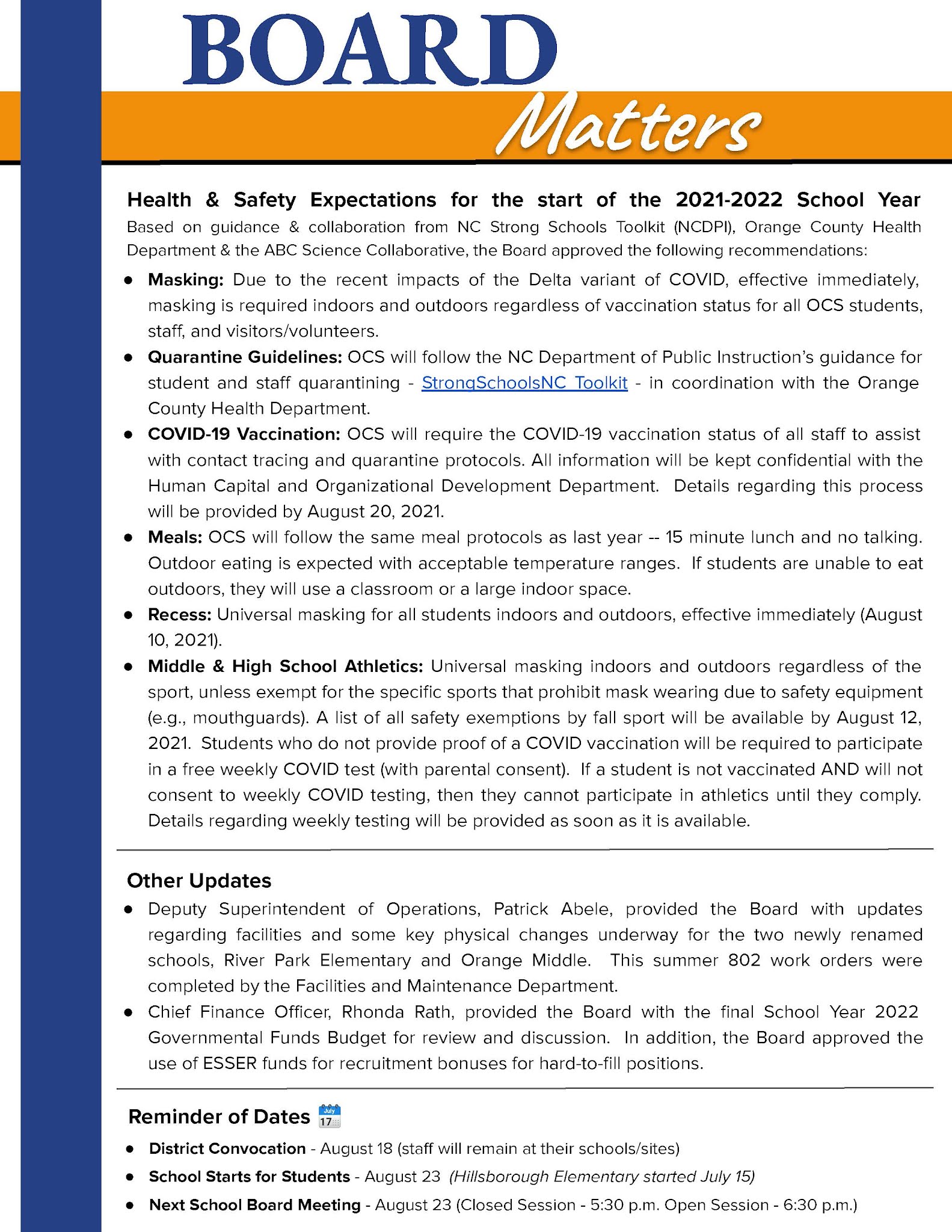
I've been handed a set of parameters for 2021-2022. Who knows if these are the rules for three minutes, three months, or three years? 

Twitter Link

I'm glad, at least, that it appears I will no longer be asked to teach in two environments at the same time (online and in person). Just just looking at this list of restrictions depresses me. 

I'm trying to trust that my immunization will keep me from becoming too sick (like hospitalized, life-threateningly sick), but I have little doubt that I or my child (starting high school this year) will catch it this year. 

There are roughly 600 kids in my school building, 200 of whom do not qualify for immunization yet. There are roughly 1020 students in my kid's high school, all of whom are eligible for immunization. If county stats average out among children, 78% of them are immunized (Hurray! Last I heard, we only need 60-70% for herd immunity to help, if it's going to help with this).

Our district's year-round elementary school has already had several cases (I'm vague on numbers because there isn't very good transparency: the district is trying to ride that line between sharing information to allow people to protect themselves and avoiding causes panic). A colleague who just put her baby back in day care so she can return to work just found out that her baby (not old enough to be immunized) has caught it (thankfully, a mild case, so far). 

I'll do the best I can, of course, to give my students a good experience within these limits, but it's challenging. Finding a spark of joy and enthusiasm is difficult. I already feel snowed under and I haven't started. 

I took my summer as slowly as I could, trying to balance taking some rejuvenating opportunities (like seeing my family and attending author events) with self-care. But eleven weeks wasn't enough to find my balance and recharge. I can't even imagine how my colleagues who took on summer work must be feeling (luckily, my husband gets paid better than me, and funds my nasty teaching habit, letting me stay unemployed during summer hiatus). 

So, to all the teachers out there, take care of yourselves. Push back when the world pushes too far--you know they'll eat us alive if we let them. Keep working on the balance between dedication and burnout.

To all the kids and families of school children, remember that teachers are people, and when you feel you need to advocate for your children, do so with kindness and a heart to help, not blame. 

For everyone else, pray for us, if you're people who pray. Vote for us and policies that support us, if you're people who vote. Remember that these kids will take care of you in your old age--don't you want them to grow up whole, hale, and educated? 

Friday, December 11, 2020

Repost: "We Value Teachers" and Other Lies

Note: This post first appeared on my teaching blog a week ago, but I felt strongly enough to seek a wider audience for these thoughts. Apologies to anyone who follows me both places. 

Image source

I lost another colleague yesterday. Thankfully not to death (though I worry about this daily now), but to retirement. That makes three already this year and I don't blame them a bit. I've looked at retirement myself, though it's complicated for me because I don't have the optimum number of years (having spread my career across four states) to get full benefits yet and I'm too young. The calculus of life vs. livelihood is complex when you have others to support by your work. 

Besides the three who retired, I know of one who is leaving the profession and another seeking a transfer, in hopes that another school will value her work and treat her better. I've thought about both of those options, too. I love teaching, but I also love being able to protect myself and those I love from infection and death. 

Lots of us are in the crisis decision moment right now, as our district is sending staff back to the buildings on Monday and students back in January (don't get me started on the lack of faith in us this shows). I expect to see more and more talented educators making the hard choice to leave the work they love. 

I keep getting messages from my district, my state, and my country playing lip service to the idea that they value teachers. But I don't see it. Saying thank you is easy; showing actual support and appreciation is much more difficult. 

If we were valued, our voices would be at the forefront of conversations about how to handle education under the current crisis. Instead, there's barely even performative attempts to include teachers--the workers with the most expertise and most at risk--in the conversation at all. 

I fill out all the surveys I am sent and participate in all the meetings, but there's no evidence so far that it is worth my time. The results send a clear message, one that is ignored in favor of what's easier for the institution. Though we allow our students' families to choose to stay home and continue virtual education, teachers will not be afforded the same right, even though we are more at risk than our students, especially the veterans. You don't become an experienced teacher without getting old, and you rarely get old without developing some underlying conditions that put you at additional risk.  

If we were valued, the communication from above would show that those above me in the hierarchy know what I am doing and are looking for ways to make it easier and more sustainable. Even though I work in a small school district, where you would think it would be easier to keep track of who is here and what we're doing, there's little sign that anyone who isn't a direct parallel colleague understands what I actually do. It's like being a baker whose supervisor last used an oven when you had to stoke an actual fire inside to bake.   

And this is America, after all, so if we were valued, our country would put their money where their mouth is. Money would have flowed towards resources to make safe education from home tenable--providing infrastructure and tools as well as paying attractive salaries to bring our country's brightest and best to the fight. Internet access would have become free and fast for any household with a student in it. You can always tell what a capitalist REALLY values, by looking at the bottom line, and education is far too near the bottom across the board. 

So, thanks for saying you value me and my work. But if you really do, then prove it. 

Wednesday, January 8, 2020

IWSG: Setting Sail on the Literary Seas


Welcome to the first Wednesday of the month. You know what that means! It's time to let our insecurities hang out. Yep, it's the Insecure Writer's Support Group blog hop. If you're a writer at any stage of career, I highly recommend this blog hop as a way to connect with other writers for support, sympathy, ideas, and networking.

If you're a reader, it's a great way to peek behind the curtain of a writing life.

The awesome co-hosts for the January 8 posting of the IWSG are T. Powell Coltrin, Victoria Marie Lees, Stephen Tremp, Renee Scattergood, and J.H. Moncrieff! I hope you'll check out their blogs as well as some of the others on this blog hop after you see what I have to say. 

____________________________________________

January 8 question - What started you on your writing journey? Was it a particular book, movie, story, or series? Was it a teacher/coach/spouse/friend/parent? Did you just "know" suddenly you wanted to write?

My first inklings (ha!) that I might be a writer came very early.

First grade. I had this teacher (so many great stories start that way, don't they?): Mrs. Asdorf or maybe Alsdorf.  I remember thinking she had a weird name.

To my memory, she was very short. She had to be because she didn't seem tall to me, and I was in first grade! 

I also thought she was very old.  I have no idea if she actually was or not. This is a kid's eye view after all.

When I try to picture her, her face is all mixed up with my great-grandmother's face, in the way that many childhood memories are mixed up and distorted. She might have been all of thirty. She might have been eighty. I don't know.

Mrs. Asdorf loved poetry. We had this project where we copied poems neatly (we were still learning the mechanics of writing after all), and made illustrations for them, then collected them in a folder made out of wallpaper scraps.  My first blank book.

I loved this project.  I'd always been drawn to poetry. Before I even went to school, I memorized my Mother Goose book and, thanks to my mother and all our hours in the library, had a love for Amelia Bedelia and Dr. Suess, children's books in love with the sounds of words.

I loved writing. I liked the feel of the pen or pencil on paper. I'd get this urge I thought of as "itchy fingers" and have to draw or copy something. (It still happens, though now, mostly I type).

At some point, Mrs. Asdorf came by to check my work. I'd picked poems by William Wordsworth and Emily Dickinson and was dutifully copying them down.

I don't remember exactly what she said, but I walked away with the realization that I could write poems myself, that it was okay to make up your own! So, I did.  I wrote a little set of rhymed couplets about Beauty (capital B Beauty; very high-concept). Here are the ones I remember:

Beauty is in the great, tall trees
Bending over in the breeze
Beauty is in each butterfly
That just happens to flutter by

It ended with one about "smile" and "while" that I can't remember fully anymore.  It was very well received and I began my first career as an occasional poet.   I wrote poems for birthdays, holidays, seasons, thank yous.  They were published in little school newsletters and once or twice in the teeny tiny local newspaper. I read them over the announcements for the school to hear.

After that I always wrote. I kept journals. I wrote poems and stories. After reading Little Women, I thought I could be Jo March and earn money to help my family with my stories. Of course, no one pays children for their stories, but I did get lots of positive attention. In high school, I even wrote most of a novel about a tennis team romance.

By college though, I had been doused with enough realism to know that I needed to do something else for a living. So, I trained to become a teacher. 

English of course. And Spanish. 

I still wrote. I just didn't think that writing was something I could do for a living. Especially not since my form of choice was poetry. I figured I could still be a writer, on the side.

Then I was off into the world, making my way as a teacher, learning what it meant to be an adult, finding new people, places and things to love.

As many women do, I hit a lull in my public writing when I became a mother.  My first daughter was absorbing and most of the writing I did at that time was about her.  Teaching and mothering were my top priorities, so writing took a decided backseat, though I still managed to create a few essays and poems and even see them published. Life went on, as it does. I divorced, moved, lost people I loved, moved, remarried, moved, became a mother again, moved.

I wrote my way through all of it.   The writing was all very personal.  It was how I worked my way through whatever I was working my way through.  How I made decisions. How I cherished things. How I grieved and how I celebrated. It was how I found out what I was feeling and thinking. The thoughts and feelings just whirled around unformed until I recorded them, sorting them out, pinning them down and analyzing them.

Then, after the birth of my second child, when I was going through postpartum depression, my husband encouraged me to reconnect to my writing and I joined a group of writers.  All of them were writing novels, so I decided to give it a try.  It was hard, writing something so long.  In fact, it took me four years (not counting the abandoned first novel) to write the first draft of my first novel, another year after that to shape it into something readable, a few months after that to make it good.

That book is not published, though I'm hoping it will be someday. Currently, it's shelved for revisions. I've learned a lot since then, so I know I can make it better and then I'll shop it around again.

But I've written more since then. Three of them have been published. You can get them at bookstores and everything! I'm writing another one right now.


I am a woman who writes every day, who sees the world through the filter of her art, who doesn't know what she thinks until she processes it in words. I'm making a writing life, and my work is published and read. I'm working towards someday earning my living from my words alone.

So, thanks, Mrs. Alsdorf. In a way, this was all your idea. I'm so lucky to have had you as my teacher. Your nudge took :-)

Tuesday, April 23, 2019

A to Z: Letters to Dead Writers: Sojourner Truth


This month I'm writing one post for each letter of the alphabet, all on the theme of "Letters to Dead Writers." You can see my theme reveal post here and learn more about the blogging challenge here.

Today's writer is Sojourner Truth
_____________________________

Dear Ms. Truth,

For the longest time, I thought poetry was supposed to be decorous and calm.

The classic poems I'd been shown in school as a child were probably selected for their inoffensiveness above any other criteria.  Not to put down Mr. Wordsworth, but "I wandered lonely as a cloud" is definitely on the sweeter side of things.

But then, I found you. I wish I could remember the context more fully. But I do remember that I heard your famous spoken word piece "Ain't I a Woman?" performed by someone costumed as you. It must have been at some kind of history event.

It blew me away.

It was raucous. Loud. Funny. Angry. Sarcastic. Definitely not decorous.

Completely new to me. I was enthralled.

Since then, I've become a fan of good spoken word poetry. There is something special about poetry that is performed (not read) by its creator, where the voice and rhythm, appearance and movement, and words all combine to create the experience. I wish I could have heard you speak.

Reading about you later in my life, I was amazed by all you had overcome and how tirelessly you worked for social reform. Truly you were a woman. I'd love to become half the woman you were.

-Samantha


Wednesday, January 23, 2019

MLK: Poet of Justice

We had a school holiday on Monday for Martin Luther King, Jr. Day. There are only a few Americans who stand high enough in our country's esteem to warrant a day away from work and I hope enough of us stop to consider the reason for the observation.

There's a lot to admire about this man and the lasting good he helped usher into our country.

It's worth remembering, too, what it cost him.

But when I think about Martin Luther King, Jr., it is his words that echo in my heart and mind.

When my daughter was in 5th grade, I went with her class on a trip to Washington DC. I've been several times to see that fair city, but I had never before visited the Martin Luther King, Jr. Memorial.

It does him proud. The statue is grand, and striking. Visually, the way the man seems to be emerging out of the unformed stone behind him speaks to strength and struggle, the unfinished nature of the work of justice, and of dignity.

The best part, though, is all the quotes.

The walls are lined with many of his words.

It was a joy to stand there listening to 5th graders reading them aloud to each other and nodding with the truths that echoed in their own hearts.

The man had wonderful ideas, but more important to his legacy, he expressed them well: memorably, poetically, powerfully.


Some of my favorites:

"Darkness cannot drive out darkness, only light can do that. Hate cannot drive out hate, only love can do that."

"I have the audacity to believe that peoples everywhere can have three meals a day for their bodies, education and culture for their minds, and dignity, equality, and freedom for their spirits."

"The ultimate measure of a man is not where he stands in moments of convenience and comfort, but where he stands at times of challenge and controversy."

"True peace is not merely the absence of tension; it is the presence of justice."

“We should never forget that everything Adolf Hitler did in Germany was legal.”

Wednesday, June 14, 2017

Teachers are Superheroes

Ah, another year over and what have you done? Well, I completed my twenty-first year as a teacher, and, is often the case when I'm finishing a school year, I've got mixed feelings about the sustainability of this as a career choice.

While I watched students take state and federally mandated tests for days on end and tried not to the let the rage and heartache of all that wasted energy eat me alive, I considered the idea that teachers are superheroes.

Now, I don't mean anything very touchy-feely by that, though, of course, we do change and save lives. But I'm at the cynical end of the year, and will need to spend summer recapturing my optimism and faith. Right now, I'm just thinking that you *have* to be a superhero to do this work.

There are so many similarities!

Teachers need secret identities. Remember that time you saw your second grade teacher at the grocery store and just about had a heart attack thinking that teachers might go shopping? There's also the way people FREAK OUT if it turns out that a teacher (who is old enough) drinks a beer in public, or is photographed wearing a bathing suit (at the beach) or cusses in a social media post.

It's changing, and is definitely better from the days when you couldn't teach if you had a husband and being a teacher was akin to being a cloistered nun in the public eye, but many of us still build a protective persona and keep our private life as separate from the work as possible. It's not quite a cool domino mask and a cape, but there is a whole separate me hidden from my work life.

It's a job, but it's also a calling. Just like being a superhero.

Teaching is also one of the few professions where people who have no qualifications, expertise, or experience beyond having attended school themselves feel free to pass judgment on how the job should be done. I try not to be bitter about this and dwell on the idea that this is because teaching, at least through high school, is a female-dominated field.

Like superheroes we are vilified or lauded in the press and public discourse with very little in between, and we are expected to do the job for very little material gain because we're supposed to have a nobler, higher calling (which apparently matters more than whether you are a college educated professional who qualifies for food stamps).

So, if get the vitriol and criticism of superheroes, do we get the powers? Here are some of the superpowers you need to handle this job.


Endurance: Depending on what's going on in your school building on any given day, you may have to go as many as six hours in a row without any kind of break--bathroom, food, coffee, silence, and personal time are for wimps! You also have to be "on" for six hours a day, responding with grace under serious pressure and dealing with every curve ball thrown your way.


Speed: Teachers in my building get 90 non-supervisory minutes a day (if you don't have any meetings
taking up that time) in which to prep 2-7 lessons (depending on your course load), complete any assessment and correspondence, research and collaborate with colleagues, eat and see to personal needs. I can get more done in 90 minutes than many people can do with an entire day.


Extra-sensory awareness: Alone in a room with 30 tweens? You'll need eyes in the back of your head AND a sixth sense for trouble. A little ability to foresee the future wouldn't hurt either. I'd stay away from mind-reading though. You *don't* want to know what they're thinking.


Bullet-proof flesh: Kids are mean. Adults are worse. You'll need that bulletproof flesh to protect you
from attacks of all kinds. (Sadly, some of these bullets are literal, but we'll keep the focus metaphorical for this blogpost).

Reflexes. Emergencies, real or imagined, abound in buildings full of children. A teacher has to be able to jump in with no preparation and build a functional airplane before we hit the ground, all while calming panicking people.


Flexibility. Make all the well-constructed lesson plans you want. They WILL change, usually at the last minute. Resources will fall through, disaster will strike. The wifi will fail.


Wealth. Okay, this one's a pipe dream, but you'll have to teach with fewer and fewer resources every year, because this country likes to SAY it values education, but if you go by where our dollars are spent, we value LOTS of things more highly than education. So, it would help to be independently wealthy, so you can afford to buy all the clothing, food, and school supplies your students come to school without. If I *were* Bruce Wayne or Oliver Queen, you can bet my students would be spoiled rotten with all the best equipment, trips, and experiences.

Wednesday, April 26, 2017

V is for Vermont: A to Z Blogging Challenge

It's April and you know what that means: The AtoZ Blogging Challenge! For those who haven't played along before, the AtoZ Blogging Challenge asks bloggers to post every day during April (excepting Sundays), which works out to 26 days, one for each letter of the alphabet. In my opinion, it's the most fun if you choose a theme.

My theme this year is Places in my Heart, all about the places I've been and loved and that have mattered to me in a lasting sense.

For my regular readers, you'll see more than the usual once-a-week posts from me this month. I'm having a great time writing them, so I hope you enjoy reading them, too.
_________________________________________

V is for Vermont


Ah, Vermont. That liberal little pocket of up East that the rest of the United States envisions as full of Robert Frost worthy scenery, curmudgeons, hippies, and well-educated lesbians. 

Having spent a few summers there, I have to say there's some truth in that. 

I earned my Master's Degree from the Bread Loaf School of English arm of Middlebury College. That meant I got to spend four summers on Bread Loaf's campuses (I spent three in Vermont, and one at Oxford). Vermont in summer really is idyllic. The weather is lovely. The land is lush. It's the home of farmer's markets full of artisan craftspeople and organic foods, restaurants that pioneered the whole "buy local" mentality, and more bookstores than you can shake a stick at. 

If you have liberal leaning sensibilities politically, and want to limit development and growth to protect the green spaces around you, Vermont might be for you. Almost every place I went in the state (and since it's small, geographically speaking, I saw a lot of the state in three summers' studies) is just really really nice. Well kept, cared for, with a feeling that it will endure for generations. 

In fact, I often felt clumsy and a little dirty, like a Greaser at a Soc party. I worried I might knock over a cup. 

That's not to say the people weren't welcoming. They really were. I'd love to get back and spend a summer afternoon in the shade in a small city square, trying a new flavor of Ben and Jerry's. 


Wednesday, January 25, 2017

Getting Poetry Back Into My Life

I'm a goal-setting sort of gal. I'm motivated by lists, challenges with specific outcomes, daily habits. They are promises to myself that I will continue to grow and build and get "better" (however I'm defining "better" just now). I'm my own team of mad scientists making me into Steve Austin:


And it works for me. I challenged myself on Goodreads to read 52 books (one a week) and I did. I'm going to do it again this year. I challenged myself to write every day and I've done it for 1200+ days now and plan to keep on trucking along. I challenged myself to do the Couch to 5K and I did it, sort of (I still can't run every step of it, but I am doing a run/walk combo three miles two or three times a week now).

I can't explain the psychology of this and why it works so well on me. Maybe I'm still just that good girl who wants all gold stars on her chart. Maybe it's a career in education making me appreciate measurable goals and progress. Maybe I just appreciate the orderliness of it in an aesthetic sense.

But it clearly does work for me. I do things I wouldn't have done otherwise when I've taken on a challenge.

So, for 2017, I picked two new challenges: one weekly and one daily. The weekly is to try a new recipe every week. (If you're interested, you can view the collection of posts about that here).

The new daily is to read (and write about) one poem every day.

Poetry used to be my thing, from about age six to about age thirty-five. I wrote a lot of it; I read even more of it. But I drifted away from it in my writing life when I made the switch to prose and began writing novels.

Prose writing scratches a similar itch for me in writing, but I'm finding that I really miss reading poetry. The elder daughter found Walt Whitman recently in a high school class, and when we talked about his work, quoting favorite lines and interpreting them, it sparked a longing in me to get back to poetry.

Poetry touches me as a reader differently than prose. I love the immediacy. The gut-punch of a line or the mind expanding image. The extreme that feels more true than truth. The beauty is more beautiful, the ugly uglier, the pain more painful, and the joy more ecstatic. The best of poetry is words on drugs without the life-destroying side effects.

Getting poetry back into my life has been even better than I thought it would be. I'd forgotten how wonderful it is to find a poem that speaks to you, that says what you are feeling, that makes you see the world differently. It's like falling in love, making a new friend, holding a baby and looking into her eyes. It expands and contracts the world all in the same moment, to the most universal and the most specific at once.

So, get thee to a library. Reading a poem doesn't take long, typically. But it can change your day, or even your life.

Monday, April 13, 2015

K is for Knowledge: A to Z blogging challenge


It's a running joke in my writing critique group that the NSA or anyone else spying on us would think us very dangerous people indeed, if they looked at our search histories. Any large writing project involves looking up information about something or another, and this book had me researching some very interesting things! Here's some of the highlights from my search history during the writing of Going Through the Change


  • bioluminescence 
    http://news.bbcimg.co.uk/media/images/
    65311000/jpg/_65311446_01349158.jpg
  • Chinese emeralds
  • crystals
  • diving weights
  • effects of smoke inhalation
  • explosive chemicals/lab materials
  • factors in flight
  • fire proof glass
  • how to fireproof clothing
  • lots of Mexican and Mexican-American foods
  • lucid dreaming
    http://rippedmusclex.info/wp-content/uploads
    /2014/05/benefits-of-testosterone.jpeg
  • metabolism
  • oophorectomy procedure and recovery
  • ovarian cancer
  • puberty
  • relaxation techniques
  • Spanish slang
  • testosterone in the female body, and the male body
  • traditional Chinese medicine
  • truth serum
  • why helium balloons float

  • ___________________________________________________
    This posting is part of the A to Z blogging challenge, in which bloggers undertake to post every day in April, excepting Sundays, which amounts to 26 postings, one for each letter of the alphabet--preferably along a theme. My postings will all be about my debut novel and my experiences writing it and seeing it published.

    Blogging A to Z is a great opportunity to connect with some excellent bloggers and interesting people. I encourage you to check out other participating blogs, too!
    ____________________________________________
    click the image to preorder on Amazon!

    Friday, February 20, 2015

    #1000Speak: 1000 Voices for Compassion

    I've been feeling that compassion is sorely lacking in the world around me of late, so I was thrilled to learn of this hashtag movement for #1000Speak. Check it out on all your socials--you'll find some great writing about the idea of compassion.

    Compassion is probably the one lessons I truly want to hammer home for my children (including the ones I only claim when they are at school with me).  The idea is simple enough: consider the other person.  Think about what that person might be feeling. Consider that there is history you are unaware of that might make a small thing more painful than it seems on the surface.

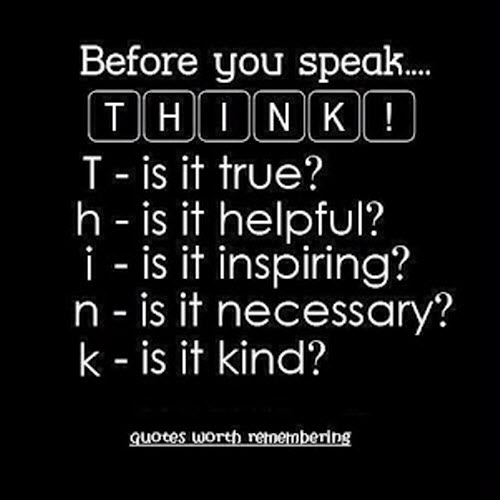
    Around the middle school I teach in are several versions of the idea, hanging on posters outside various teachers' classrooms. In middle school, we have to fight the blurt factor. Kids this age have a thought and say it without considering the consequences or the effect on others. They often don't have ill intent at heart; they simply didn't THINK:

    https://alanonmama.files.wordpress.com/a/05/imagesthink-before-you-speak.jpeg
    Now the kids at my middle school are just that: kids. So when they blurt something hurtful out, we, the adults, step in and try to mitigate the pain caused, rebuild the bridges burnt, and encourage kids to learn from the teachable moment. 

    But what happens among the adults out there? The ones who value their own zinger of a joke over the heart of a human being, or who have simply never outgrown their adolescent narcissism? For me, I've started to call them on it. Bullying among adults is just as large a problem as it is among children. Larger, maybe, because the kids are more likely to learn and outgrow it. But bullies will keep bullying as long as they get away with it. So, when you see it, speak up! It's not as small as it sounds. 

    https://judgybitch.files.wordpress.com/2013/10/first-they-came.jpg


    Wednesday, January 21, 2015

    Goya in Urdu and Spanish

    http://beben-eleben.tumblr.com/post/101757992388

    This word came across my tumblr feed via my lovely daughter. It was one of a list of 11 untranslatable words from other languages. You've probably seen others of this sort. I am now in love with this word and may have to learn Urdu. 

    I'm a big fan of cross-language connections. I'm a Spanish teacher by day and a novelist by night, so I guess it only makes sense that I'm also a huge word nerd. Bilingual puns make me giggle ridiculously.

    Goya, which we are told above means "the transporting suspension of disbelief that can occur in good storytelling" in Urdu, is also a word in Spanish, or, more accurately, a name. It's the name of one of my favorite Spanish painters: Francisco Goya. I first learned of him when I was a college student studying in Spain for a summer. It was 1992, a big year for España--they had the Olympics and the World's Fair. I never made it to Barcelona for the Olympics, but I did make it to the World's Fair in Segovia. 

    Goya was featured as part of the Spanish art exhibit. Many of his most famous paintings were collected all in one room. I had no idea how special that was at the time. Thinking about those paintings now, I think that the man is accurately named, even in Urdu. His paintings are transporting in the same way that the best storytelling is, even if he didn't tell his stories with words. 

    Some of his paintings have lingered in my imagination, telling their stories and making me weave my own: 

    http://behostels.com/wp-content/uploads/lamaja.jpg
    La maja desnuda is one of my favorite paintings ever. Back when I had my very first public email account, on The Well (showing my age to mention it, I know), I was maja@well.net (or whatever the tail was--I think I've forgotten).

    I think the appeal for me lies in the rich details--the way the sheet is folded under the legs. The expression on the woman's face, which can be read a hundred different ways. The demure position of her thighs revealing only what she chooses to reveal. The way her breasts roll out to the sides in just the way that real breasts do. The directness of her gaze, with no shame or shyness evident.

    It has a sister painting: La maja vestida (very similar, but the woman is dressed). The existence of the dressed painting has led to some interesting theories about the history of this painting. I'm no art historian and don't know the true history of this painting, but I've always liked the legend that the clothed version was done for the lady's husband, and the nude for the painter himself.

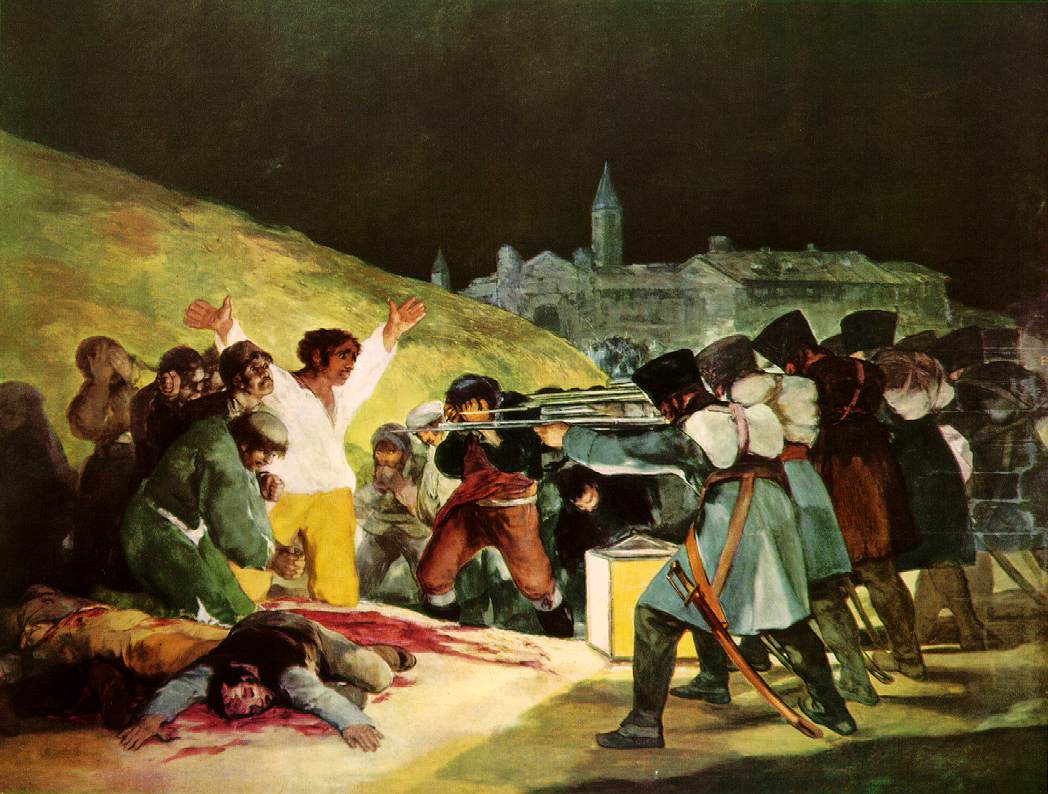
    Another favorite is Tres de Mayo, 1808.
    http://www.ibiblio.org/wm/paint/auth/goya/goya.shootings-3-5-1808.jpg

    This one has very specific history behind it, which I am somewhat familiar with thanks to my college professors. It depicts a firing squad punishing Madrileños who were part of an uprising against Napoleon's army and French occupation of their city and country. 

    It's very easy to tell whose side Goya was on. The light guides your eyes to the man in white and yellow and his sad, but not frightened or cowed face. In contrast, the French soldiers are a faceless line of men, almost indistinguishable from one another. 

    Want another kind of story? View "Saturn Devouring His Son,""The Colossus," or the collection of etchings called "Los Caprichos" (especially El Sueño de Razón). 

    Goya was quite the storyteller. If I could paint something half as good with my words . . . .


    Wednesday, October 22, 2014

    Growing When You're Not a Beginner

    I have a lot to learn.

    Sure, I've learned a lot in my first forty-odd years here on planet Earth, but in any endeavor that matters, I can still grow.

    The problem is finding ways to do that.

    When you're new at something, it's easy to find a mentor. There are a lot of people who are better than you and can help you move forward. There are very basic things that you don't yet know.

    But, the further you get, the harder it becomes. Eventually, when you're truly top-level, you have to become your own teacher, setting for yourself what the next level is and figuring out what exercises will stretch you and get you there. Our needs as learners become more and more individual and it's harder to find a "group solution" that includes you.

    I'm not there yet. But I am far enough along in some endeavors, teaching and writing especially, that I'm having trouble finding things that move me forward. Where's the training for intermediates?

    I went to a teaching conference recently and found that 90% of what was being offered were sessions I could have taught. Frustrating. I've found the same thing at some writing seminars and conferences.

    As a teacher, I've learned to use reflective practice to help me grow. I analyze a lesson in terms of how well my students engaged and how much they retained. The next time I teach the same topic, I make adjustments accordingly, trying to figure out how to engage more people and help them retain more knowledge longer term. It's a struggle, as reflection requires time and I only have 90 minutes per workday in which I am not actively teaching. Reflection often gets shoved down the list in favor of things like providing training to others, performing secretarial tasks necessary for lessons, and keeping up with communication streams, or, you know, using the bathroom and eating lunch.

    At least in writing, I set my own pace. Reflective practice is trickier. My writing is more personal than the Spanish lessons I provide. It's harder to view objectively. So, reflective practice, for me, is a matter of finding an appropriate peer group, in putting my work out there and listening to the feedback with a heart to learn. I am fortunate in my local critique group, which includes writers in a similar part of the journey as me, as well as some who are more skilled than me, and others that I can help along. I also participate in a few online critique groups and response is varied. Not everyone is there with a heart to learn.

    One of these opportunities for reflective practice, for me, is the #saturdayscenes movement on Google+. The work I present there is much more raw than the work I am sending to magazines, anthologies and other publishing venues. I value the interactions I have in this community because nearly everyone is there with a heart to learn and grow. Pontification and defensiveness are at a minimum.

    So, I guess the key is, once again, community. A community of learners, all with a heart to learn.

    Thursday, October 9, 2014

    Don't Be Afraid to Get Your Hands Dirty

    Education is a messy business, and I'm not just talking about the paint smears and glue incidents. 

    No. Education is messy in that it's hard to define. It's hard to know in any immediate sense if teaching has been successful. It's about gut instincts and intuitions, inspiration and leaps of faith. 

    It can take many years for the effectiveness of a classroom experience to become clear. So many factors converge into the experience and success of one child, that assigning credit and blame becomes meaningless. 

    That makes a lot of people uncomfortable. They want "objective" measures of progress of students and quality of instruction. They invent new systems of testing, grading, and evaluation. They insist that we have to codify and measure by "objective" standards what we do in the classroom or it is not learning.

    "They" are usually not teachers. Some of them mean well, others have an agenda to push.

    But really, it comes down to discomfort with the squishy, emotional nature of learning. Research is so afraid of data that it is anecdotal or about how things feel. The longer I teach, the more that kind of data is the only kind I find meaningful.

    Learning is an interaction between people--teachers and students, students and students, communities of learners. And people are emotionally motivated critters, not lab rats. A child's success in the classroom isn't about what textbook the teacher had, or what specific pedagogical approach she used. It's about relationships. When you find the right teacher for you, your learning skyrockets. And, with one who is wrong for you, the whole climb up the educational mountain just gets that much harder.

    But no one wants to hear that "it's complicated." Or that what is successful in one place with one group of children and a certain teacher may fail miserably in another setting. But the truth is, it might.

    Think back on your schooling. What do you remember fondly? Was it that your math teacher had the newest and greatest set of manipulatives you had ever seen? Was it that the lessons were available on a website for your later perusal? Did you even know what kind of educational philosophy your teachers espoused?

    If so, you had a very different experience than me.

    When I look back on the brightest spots in my education, they were all about relationships and connections. That long conversation with the elementary school librarian about why I found Little House on the Prairie books unsatisfying and why I might enjoy Louisa May Alcott more. The teacher who clipped poems out of a magazine to show me, telling me that the words reminded her of some I had written for her class. The one who listened when my heart was broken and I didn't want to tell my mother because I knew she never liked that boy anyway.

    Good teachers aren't afraid to get their metaphorical hands dirty--they ask the tough questions, listen to the hard stories. They support and love their students. Sure, these teachers also taught me chemistry, algebra and literature. But you know what? I listened to them and learned well from them because they tried to know me as a person. Not because of how they taught, but because of how they made me feel.

    I only hope I can do the same for my students.

    Monday, June 30, 2014

    Summer Reading: Week Four

    For a week when I wasn't working, I was working a lot this week, so I didn't read as much as I would have preferred.

    I did read a couple of graphic novels, including Bone, which is one that a lot of middle schoolers enjoy and I've been meaning to check out for a while. It was light, and a quick read, but clever and enjoyable as well. I can see why it's popular with middle school readers.

    Most of my reading time was focused on another beta read for another writing friend. We're going to have to talk about the ending, but otherwise, it was a really amazing book. She's a very talented writer.

    NJ, on the other hand, has read up a storm! We picked up an audio book of Cornelia Funke's Ghosthunters series. We'd already listened to The Incredibly Revolting Ghost and The Gruesome Invincible Lightning Ghost sometime this past year. This one is #4: Ghosthunters and the Muddy Monster of Doom! Like all the books in this series, it features Tom and
    his ghosthunting partners Hetty Hyssop and Hugo (an Averagely Spooky Ghost). I enjoy listening to these audiobooks, too. They are longer and more in depth stories, and are well performed by John Beach. I like how important knowledge is in the series. Tom and Hetty always figure something out through research and applying past knowledge rather than by luck.

    The series is the right kind of spooky for my seven year old, too. She feels like she's hearing a scary story, but she won't have nightmares. There's plenty of comedy in the series as well. It's also nice that the main pair of ghosthunters are an eleven year old boy and a woman old enough to be his grandmother.

    Besides Ghosthunters, Norah has begun to enjoy Diary of a Wimpy Kid by Jeff Kinney. She found book one in her sister's discard pile and snatched it up. Just like her mama, NJ enjoys a good graphic novel and Kinney's school situations make her laugh a lot.

    She also returned to an old love this week: Mo Willems. NJ loves Mo Willems books, especially Elephant and Piggie books. Currently nearly all our library's collection is in our library book basket. She loves to read them aloud with someone, taking turns playing the part of Pig and Elephant.  There are great fun to read, with wonderful positive messages about friendship without being preachy. And if you read with expression, you'll find plenty to smile about.

    M bought something at Barnes and Noble last week, but since she is still with the bio-Dad for her summer visitation, I don't yet know what it was or how she is enjoying it.

    So, that's our summer reading this week. I can't believe it's already been a month!