Showing posts with label superhero. Show all posts

Monday, April 13, 2026

A to Z: Going Indie: Knowledge


Welcome to Blogging A to Z! My theme this year is Going Indie. I hope you enjoy it. Don't forget to check out the other participating blogs

Knowledge is power, right? At least that's what Schoolhouse Rocky taught me, back in the day. 

It's definitely been true in my pursuit of indie publishing. One reason I didn't do it the first time I thought about it was because I was daunted by how much there was to learn. I thought writing the books was hard! But, learning how to manage all the systems to make this dream a reality? Not *that's* hard!

Luckily, there are a lot of ways to learn these days. I already posted a couple of books I found helpful back on my B is for Books post, but I also learned a lot from actually taking classes and training opportunities. 

A big one for me was a Business Boot Camp from Women in Publishing. Making that shift into thinking of my writing life as a business and making sound business decisions regarding it was a tough one for me, so I really appreciated this kind and supportive group of women willing to share their experience and take questions. 

That community was so valuable that I ended up buying a full membership, and I continue to learn from them all the time. 

There's also the in-person route. My public library was a great source for "how to" information. In fact, that's how I met James Maxey, now a good friend, and the guy who introduced me to superhero novels, so is indirectly responsible for my entire Menopausal Superheroes series

Every time I spend time with other writers, I learn something. As a group, we're a generous lot. If you've got questions, ask them! Most writers will do their best to help you. 
 

Tuesday, July 8, 2025

Bringing my Heroes Home

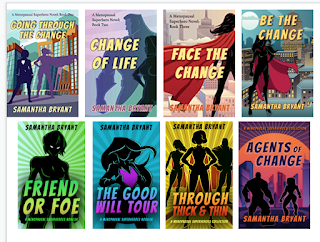
 It's official, y'all. With the release of the fifth and final novel, the menopausal superhero series is now complete!


This has been the work of a little more than ten years, and there's a lovely symmetry in that the first book came out in 2015, and the final in 2025. 

Origin story: This series started because I watched an X-men movie with my husband, and we were talking, as we often do, while we walked the dog afterwards. I was joking that the underlying message of X-men stories is always that hormones cause superpowers, and if that was the case, menopausal women should have the corner on that market!

image source


 He laughed and told me to write it down. So I did. 

And to my surprise, it was more than just a little joke--it was the opportunity to create a group of female characters finding community, purpose, and love while they deal with the changes wrought in the life by changes in their bodies. Metaphorical AF, right? 

The journey: Writing them was cathartic, joyful, and sometimes heartbreaking, bringing together my personal struggles and fears surrounding aging, friendship, and what perimenopause was doing to my body, my brain, and my life alongside my lifetime love of superhero stories. 


The shirt says "what doesn't kill you, mutates and tries again" 

I LOVE how I ended the series, and can't wait to share this with readers. 

The whole series is available direct from the publisher as an ebook bundle: 

buy here
 

You can also get it a book at a time from the Big River site, or request it from your favorite bookseller in paperback or hardback. 

The series in order:


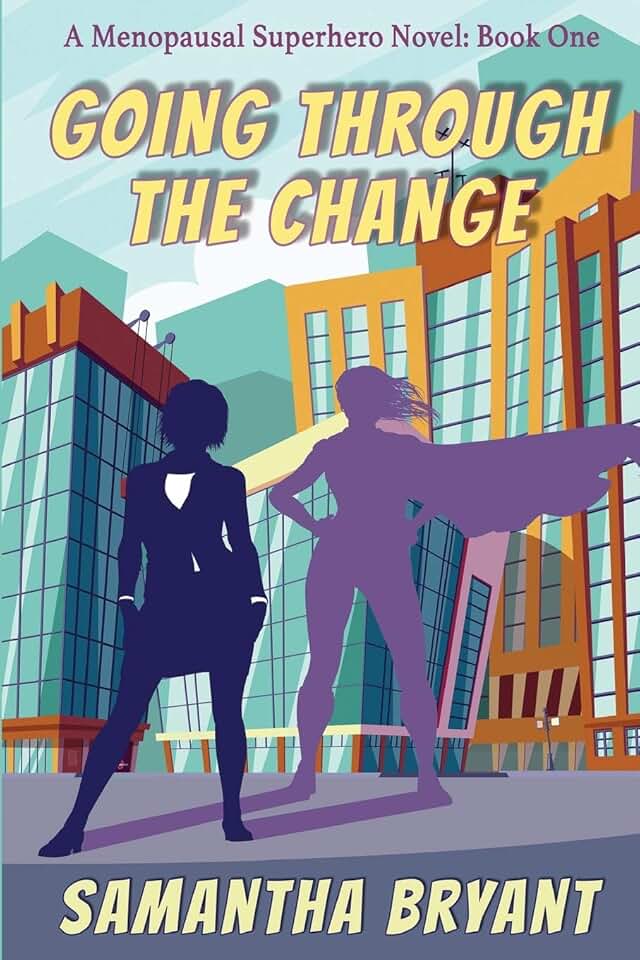
Going Through the Change, where it all begins. Meet Helen, Jessica, Patricia, and Linda/Leonel and laugh and cry with them as they struggle with the sudden development of unusual abilities amid their busy lives, and find each other along the way. 

Part of what I wanted to explore is what a heroic life might look like for a woman with a grown-up life: a career, children, a household, a partner. Responsibilities. This book was the start of all of that.  


Friend or Foe, a novella, serves as a bridge story between the first and second novels, and a peek inside the mind of the mad scientist who caused all this trouble in the first place, Dr. Cindy Liu. 

This novella is also included in Agents of Change, which collects the novellas and short stories in a single volume.  


In Change of Life, the second novel in the series, all the characters are dealing with the aftermath of the events of book one: the affects on their relationships, families, jobs, and psyches. The plot centers around Patricia, the Lizard Woman of Springfield, and her quest for answers and vengeance. 

This book introduces Daniel Price, one of my favorite creepy villains. He's been body hopping for a hundred years in a a quest to extend his own life, with no regard to who gets hurt (or killed) along the way.  


 In Face the Change, our heroes come together to work for the Unusual Cases Unit of the mysterious Department run by the Director and learn about hero life in the spotlight. As they fight The Six, a mysterious group of psychic villains, they deepen their personal connections, finding strength in each other.  

An unexpected romance came into play in this one. I LOVE it when my characters surprise me. 


The Good Will Tour is another novella, which works pretty well as a stand alone if you want to try the series at low investment.  Jessica "Flygirl" Roark and Leonel (formerly Linda) "Fuerte" Álvarez set out to build community good will with a celebrity visit to the local hospital and end up needing to save the day when a desperate earthquake causing woman shows up demanding experimental treatment for her wife. 

This novella is also included in Agents of Change, which collects the novellas and short stories in a single volume.   


Just when our heroes thought they had things figured out, a mysterious power spike challenges their control of their abilities in Be the Change. 

I had a wonderful time expanding on Patricia's backstory in this one, introducing her mother, stepfather, and some information on her siblings and half-siblings. And Daniel Price is back because he was too good not to bring back. 


And here's the new girl in town: the series ender: Change for the Better. Readers will probably have noticed that Jessica "Flygirl" Roark has been…odd. Things escalate in this book and the menopausal superheroes have to scramble to save one of their own, while they face down enemies within and the return of Daniel Price and the shadowy mystery man, Bertrand Dietrich.  

I'm really proud of that final fight scene and that last chapter will hit you right in the feels. 


Through Thick & Thin is a collection of side-stories for the menopausal superheroes. It’s confession time in "Coming Out as Leonel." Join Patricia, the Lizard Woman, as she unravels the puzzle of Dr. Cindy Liu's disappearance in "The Right Thing," and then see her softer side (and her "better half," Suzie) in "Underestimated." Get ready for a wedding, and a heroic rescue, in "Flygirl's Second Chance."

These can be read separately of the novels, but I think you'll enjoy them more if you've already read at least books one and two. They're also all included in Agents of Change


 This anthology collects the novels and short stories into a single volume. 

  • Friend or Foe
  • The Good Will Tour
  • "Coming out as Leonel" 
  • "The Right Thing" 
  • "Underestimated"
  • "Flygirl's Second Chance"  

(this might be my favorite cover in the series, combining the silhouettes we used for the novels with the stripes or rays we used in the short work) 


I have some readings from all this work available on YouTube or in the Menopausal Superheroes slideshow on the "Read My Work" link in this website.  

And if that's not enough Menopausal Superheroes for you, you can also read another short story, "Intervention", exploring the background of Patricia and Cindy Liu in Theme-Thology: Mad Science or read a couple of free holiday stories I created for my newsletter subscribers: O Scaly Night (Patricia's version of Santa Claus is…violent) and (Flygirl's son gets to see her in action) Max's Mommy

If you find me or my publisher, Falstaff Books, at a convention or other in-person event, you can also get the very cool omnibus edition (second volume coming soon), and I hope to be able to share links for audiobooks in the near future.  

I'm working on a book tour this fall and winter to celebrate the completion of this series, so you may have a chance to come see me in your neck of the woods!  

Thanks to all of you who came along with me on this journey. Writing is great, but we need readers to make it worthwhile and I am so pleased that so many of you have connected to my characters and found escape and expression with me in these stories. 

May you find strength when you need it, joy in friendship, and love in one form or another.  

Monday, February 10, 2025

Fact-finding missions, an open book blog hop post


Welcome to Open Book Blog Hop. You can find us every Monday talking about the writing life. I hope you'll check out all the posts: you'll find the links at the bottom of this post.

How do you find the facts that inform your work?
 ______________________

You end up needing to know a lot of strange little things when you're writing a book. Sure, you're making things up, but your story still needs grounding in reality, especially if your work is set in a realistic or near-realistic setting. 

For my Menopausal Superheroes series, there's obviously a lot of "hand-wave-ium" about the science of how things are possible. Jessica "Flygirl" Roark can fly and there's some exploration as to how and why, but I'm not trying to make this impossible thing realistic, so I was free to be playful and imaginative in making that part up. 

Still, I did research about buoyancy and flight, trying to decide if I'd pull more from bird, balloon, or machine in my decision-making about how Jessica's flight works. I enjoy that reading, finding facts to extrapolate from and play with. In fact, I enjoy research so much, that if I'm not careful, I can fall down a research rabbit hole and get distracted from actually writing my story. 

For many things, I pull from my own experience and from stories I've heard all my life from other people. I know what it feels like (at least from my own experience) to fall in love, to be ill, to become frustrated, etc. So, I can use my own experiences and what I've observed as a baseline.

image source
 

On the other hand, I don't know what it feels like to be shot by a gun (and I hope I never find out), so when Leonel "Fuerte" Álvarez took a bullet wound in Book 2, Change of Life, I did a lot of reading and asking questions in online groups about the medical aspects of that, making sure he was shot in a way that he could recover from, and that his recovery could be reasonably realistic. 

For some of my other work, I've needed historical details of dress and legal status, so I read nonfiction books, look details up online (always corroborating with more than one source because the Internet lies), and ask questions of experts. I'm in a couple of Facebook groups where writers can ask lawyers and doctors legal and medical questions and that's SUPER useful as those kinds of things come up in fiction all the time. 

Those little details add veracity to a story and make it easy for the reader to stay engaged in a story, so they really do matter. I know I've been frustrated by books I've read that got details wrong that conflict with own knowledge and experience. If there's enough of them, I stop reading. So, I try not to do that to my own readers. 

How about you? What do you do to make your own work feel real? Where do you learn what you need to know? What kinds of details throw you out of a story you're reading? I'd love to hear about it in the comments!

You are invited to the Inlinkz link party!

Click here to enter

Wednesday, December 4, 2024

Leave 'Em Wanting More…But Don't Leave 'Em Hangin': an IWSG post


Welcome to the first Wednesday of the month. You know what that means! It's time to let our insecurities hang out. Yep, it's the Insecure Writer's Support Group blog hop. If you're a writer at any stage of career, I highly recommend this blog hop as a way to connect with other writers for support, sympathy, ideas, and networking. If you're a reader, it's a great way to peek behind the curtain of a writing life.

Our Twitter handle is @TheIWSG and hashtag is #IWSG. The awesome co-hosts for the December 4 posting of the IWSG are Ronel, Deniz, Pat Garcia, Olga Godim, and Cathrina Constantine!


December 4 question - Do you write cliffhangers at the end of your stories? Are they a turn-off to you as a writer and/or a reader?
__________________________________________

The only series I've written so far (recently finished! hurray!) is the Menopausal Superheroes. In writing it, I used some tropes, abandoned others, and tried to twist still others. I wanted the books to feel like what they are--superhero stories--but to also be their own thing, so that was sometimes a delicate dance. 

Cliffhangers are bread and butter in superhero stories--going as far back as the oldest comic books and movie serials with superpowered characters. 

image source


I know some readers hate cliffhangers, feeling that they are a manipulation designed to pull them into the next book. That can be true, but sometimes, they are genre expectation and the best way to tell a story. 

The end of the first book has been described as a cliffhanger by some (usually by folks who don't like cliffhangers).  If you read my reviews of that first book, people who don't love it almost universally complain that it ended in a cliffhanger. 

I don't think it exactly is…my heroes had met their primary goal, and the next problem presented itself immediately. That fits the comic book feel of it to me. True that it wasn't all wrapped up…but no was left in the middle of an immediate crisis. Heroes seldom get to enjoy or celebrate their wins for long--there's always another fight looming. 

That said, the second, third, and fourth books end more fully than that first one. So maybe I came around to what some of my readers were saying. We'll find out next summer if they like what I've done with the fifth and final book in the series--coming to you in summer 2025 from Falstaff Books!

For myself as a reader, it's a case by case scenario. Some cliffhangers feel organic to the story and others just feel like tacked-on manipulations. So some I love, and some frustrate me. I don't think there's a right answer to this one. You gotta do what's right for each story. 

And, yes, a cliffhanger is a tactic to drive readers to pick up the next book in a series. Done well, it's no more manipulative than writing engaging characters, leaving a question unanswered, or showing an assumption about what's happened might be mistaken. I don't think writers are doing anything wrong if they work some curious and tension-building techniques in to pull a reader through a whole series. That's just good story telling (and a little business sense). 

So, what do y'all think? Cliffhangers, yea or no? Why? 


Monday, November 13, 2023

The origin of a superhero series, an open book blog hop post


Welcome to Open Book Blog Hop. You can find us every Monday talking about the writing life. I hope you'll check out all the posts: you'll find the links at the bottom of this post.

Do you have an "origin" story for any of your stories? Where do your ideas come from? 

 ______________________

Appropriately enough, the Menopausal Superheroes series, among all my work, is the one with an origin story. 

I've told the story before, but never in this blog hop, so here goes: 

My husband and I were out taking a walk after watching one of the X-men movies. (If anyone reading this isn't familiar with the X-men, they are a group of superheroes, specifically mutants, and most of the characters are very teenagers, all attending a special school superintended by Professor X.)

I didn't like the movie very much. Too much teen drama and not enough of the superpowers and moral dilemmas that draw me to superhero stories, so I was venting while we walked about how the secret message of all the X-men stories was that hormones, puberty in particular, cause superpower. 

"If that's true," I said, "then menopausal women should corner the market on that one!"

My husband laughed, and we spent the rest of our walk riffing on the idea. By the time we got back home, he said, "You should write that down." 

And I did. And I still am, four novels, two novellas, and a collection of short stories later. I'm hoping to finish the series concluding novel before the end of 2023 and bring it out in 2024. 

My series, so far

You are invited to the Inlinkz link party!

Click here to enter

Wednesday, July 5, 2023

Where do your stories come from? An IWSG post


Welcome to the first Wednesday of the month. You know what that means! It's time to let our insecurities hang out. Yep, it's the Insecure Writer's Support Group blog hop. If you're a writer at any stage of career, I highly recommend this blog hop as a way to connect with other writers for support, sympathy, ideas, and networking. If you're a reader, it's a great way to peek behind the curtain of a writing life.

Our Twitter handle is @TheIWSG and hashtag is #IWSG. This month's co-hosts are:  PJ Colando, Kim Lajevardi, Gwen Gardner, Pat Garcia, and Natalie Aguirre!

June 5 question - 99% of my story ideas come from dreams. Where do yours predominantly come from?
__________________________________________

image source

I don't think I've ever written anything that came directly from a dream, at least not that I knew I was doing. 

My dreams don't usually make enough sense to be of any service in fiction, other than perhaps for imagery. 

But, it's an intriguing question all the same. Ideas are an essential part of a writing life. My problem is not usually coming up with them, but finding time to develop them all into finished pieces! 

But still, where do they come from?

I think most of my ideas come from juxtaposition.

By this I mean: there are lots of little thoughts and bits of information and observations bouncing around in my brain all the time, some pingponging around like high bounce balls dropped from a great height, others floating gently by on some unseen current. 

Sometimes a couple of them bump off each other and there's a spark, like one was flint and the other tinder. And boom! There's a story idea. 

For example, the idea of the Menopausal Superheroes was probably a combination of my apprehension about getting older and having just watched an X-Men movie where the characters were just so-very-teenagery that I found them frustrating. I thought something like: 

What is it with teenagers and superhero stories? If hormones cause superpowers, then menopausal women should have these pubescent kids beat!

When I'm not working on a particular project already under contract, I also really love to play with writing prompts. A fair amount of my short horror fiction got its start as a noodle from writing prompts in Bliss Morgan's Nightmare Fuel challenge held each October. I've written more than one piece after reading the call for a themed anthology and thinking the idea sounded like a fun one to explore. 

Other times, it's as simple as thinking, "What if?" and following that question where it takes me. A recently finished horror story (not yet published) came about because I'd gotten a new car with all kinds of fancy sensors and warnings and my brain asked some weird questions about that. 

Getting from idea to story sometimes comes from noodling on my own, but a lot of times, it comes from conversation. I've hashed out many a plot line in conversation with my husband or with one of the members of my critique group. 

How about the other storytellers out there? Where do your ideas come from? I'd love to hear about it in the comments!


Monday, April 17, 2023

Any Place, Any Time, Any World: An Open Book Blog Hop Post

A globe and the Open Book Blog Hop logo

Welcome to Open Book Blog Hop. You can find us every Monday talking about the writing life. I hope you'll check out all the posts: you'll find the links at the bottom of this post.

If you could live in any place, any time, any world, where would you want to live? 
______________________

Well, if I can really live in any place, any time, any world, then why would I limit myself to one? Even just the question has my wanderlust aflame. Even with the limits of time and space I currently live within, I want to go everywhere!

But for the sake of discussion, let's pick a few options. 

1. Any Place: New Zealand

a lake surrounded by snowcapped mountains and verdant green hills
image source

I first became enamored of New Zealand as a child. My family and I attended the World's Fair in Knoxville in 1982. I was 11 years old. We wandered into the exhibit on New Zealand, and images like the one above adorned the walls. Already a fan of wild vistas, I gasped. This attracted the attention of one of the workers, a lovely woman who had been well-selected for her job for her winning personality and ability to wield that charming Kiwi accent to make sure that visitors fell in love with the idea of visiting the place she was from. 

Later, in the early 2000s, the Lord of the Rings trilogy was filmed in New Zealand, and watching those films reignited my interest in visiting. I haven't made it there yet, though I still hold out hope. I want a Hobbiton movie set tour as well as time exploring some of the exciting scenery, like volcanoes, geysers, and glaciers. 

2. Any Time: late Victorian England and between-the-wars America

Time travel is a tricksy proposition. But we'll assume that I can do so safely, and that my life won't be at risk because of my inappropriate clothing or because I was a woman or a Jewish person in the wrong place and time. I'd also want to avoid any Ray Bradbury situations, where I destroy the world by stepping on a butterfly. 

An English Victorian street showing thatched-roof houses.
image source

Since I've got two back-burnered projects that are back-burnered because I need to do more research about the time periods before I can continue, I'd be interested in the period between WWI and WWII in Indianapolis (for my historical fiction trilogy based on a family legend, working title Cold Spring) and 1890s rural England (for my Gothic romance, working title The Architect and the Heir). 

Visiting would be way more immersive (and probably more fun) then trying to glean the details I want from nonfiction books and internet research. 

3. Any World: Wakanda!

If you've been reading this blog, then you already know that I'm a superhero fan. 

There are a lot of cool worlds in superhero stories: Themyscira, home of Wonder Woman; Atlantis, home of Aquaman; Krypton, home of Superman. But my very favorite is Wakanda, especially as portrayed in the recent Black Panther movies. Sleek and sophisticated, efficient and beautiful, a utopia of artistry and industry interwoven. 

Cityscape of Wakanda, as seen in Black Panther.
image source

In the films, we don't see much outside the main city, but that city is spectacular. Even a confirmed small-town girl like me would love the chance to explore it. 

So, there you go, given the chance to go somewhere, the hardest part would be choosing. I want to go everywhere! 

How about you? With all barriers removed, where would you choose to live? I'd love to hear about it in the comments. 

You are invited to the Inlinkz link party!

Click here to enter

Monday, April 10, 2023

What do superheroes eat? An Open Book Blog Hop post

A loaf of homemade bread and the Open Book Blog Hope logo


Welcome to Open Book Blog Hop. You can find us every Monday talking about the writing life. I hope you'll check out all the posts: you'll find the links at the bottom of this post.

What does the food your characters eat reveal about their personality?
______________________

Food comes up surprisingly often in the Menopausal Superheroes novels. Maybe this is just because I lean towards being a foodie myself, or maybe it's because I like to show my heroes in domestic settings and food is a part of that. 

But let's take this hero by hero. 

Jessica "Flygirl" Roark: Even before she became a superhero, Jessica had no interest in cooking. 

Her bestie, Leonel, despairs of the beautiful kitchen in her fancy house "going to waste." 

In her first marriage, she and her husband bought a lot of pre-prepared foods or picked up takeout when they were out. During her cancer treatments, they used a meal service. 

In her single-mom years, she tried to do a little better, but it was hard to develop kitchen skills and save the city in her new role as Flygirl, so her boys had their favorite pizza place on speed dial. 

Things are looking up now that she's remarried. Walter is a scientist, and cooking is a science of sorts. He's got a penchant for pancakes and other carb-heavy meals, but superhero work requires a fair number of calories, so it's working out well!

Leonel "Fuerte" Alvarez: The foodie of the group. 

Before the mad-science changes that gave him super-strength and changed his gender, Leonel was abuelita to several grandchildren, spoiling them with tamales, biscochitos, conchitas, enchiladas, posole, and countless other Mexican-American masterpieces. 

That hasn't changed, though the fancy meal prep happens a little less often now that he's on call to rescue the citizens of Springfield when the need arises. 

He still loves to spend the morning in the kitchen and the evening watching everyone he loves enjoy his creations. 

His husband, David, has learned that sometimes a tres leches cake means there's bad news coming, but it doesn't stop him from digging in. Bonus! Their house nearly always smells of coffee and cinnamon.

Patricia "Lizard Woman" O'Neill: Patricia likes the finer things in life. Designer bags, expensive travel, theater tickets, visits to the spa, and fine dining. 

Overcoming her humble beginnings as the eldest daughter of an often-married and just as often divorced mother, she worked hard and made personal sacrifices to get to a position where she could afford to indulge. 

She is proud of making her way up to Vice President even though she started her career in the later 1970s, when the glass ceiling was definitely still firmly in place. 

Her condo is provisioned with the basics and she can whip up an omelet like nobody's business, but after spending her younger years flipping burgers and slinging milkshakes, she thinks her time is better spent on something other than cooking. 

Sometimes she and Suzie, her girlfriend and sometimes sidekick, like to stay home and get takeout Chinese, but they're definitely first in line when a new restaurant opens in Springfield, ready to find out if the fuss is worth it. 

The other characters in the series have some opinions about food, too, but I'll save them for another day. Does food play a big role in books you write or like to read? I'd love to hear your thoughts in the comments! 


You are invited to the Inlinkz link party!

Click here to enter

Monday, September 12, 2022

Fame and Fortune Await: An Open Book Blog Hop Post


Welcome to Open Book Blog Hop. You can find us every Monday talking about the writing life. This week, we're talking about what would happen if our books took off tomorrow, with enormous worldwide interest and sales.  I hope you'll check out all the posts: you'll find the links at the bottom of this post. 

That's a favorite daydream of mine. Somehow someone with a huge following stumbles across my work, falls in love with it, and uses that big megaphone of theirs to proclaim to the universe how witty, inspiring, entertaining, and life-changing my Menopausal Superhero novels are and boom! I'm there! 

image source

Now the question today asks if I'm prepared for that dream to come true. And honestly, probably not. I've spent my life somewhere between poverty and middle class with dips back and forth. I've never had "big bucks" in my life and have known very few people who do in any kind of personal way. 

But you know what? I can learn. 

I've managed being a "Greaser" among "Socs" before--I was that one public school scion among private school graduates in grad school. I stuck it out in the Chapel Hill Mom's club for nearly a year, even though they didn't know what to do with a mom with a day job and no nanny. 

The key is pretending that it's not that you can't afford better, it's that you choose what you have. No, I don't have a beach house, but it's because I like visiting different beaches every time I go. No, I don't wear designer brands, but it's because I'm socially conscious and won't wear brands that use exploitative labor practices. 

See? I can fake it! 

Could I handle the "fame"? I think, yes! Being a famous author isn't like being an actress or politician. Very few people know what their favorite authors look like or where they live. There are only a handful of living writers I would recognize if we passed one another on the street.  

Unless I start behaving badly and tweeting obnoxious things to get myself cancelled, I could quietly enjoy the bigger royalty checks, slip away from my day job, spoil my children a little, and travel more. 

So, yeah. I think I can take it. So feel free, people of the Internet, to spread the word and make me a social media darling. I promise to do more good than evil with the money, and keep on writing books!


Want to see how other writers feel about fame and fortune on the horizon? Check out the other posts in this blog hop at this link: 

You are invited to the Inlinkz link party!

Click here to enter

Wednesday, September 7, 2022

Not the Genre for Me: An Insecure Writers Support Group Post


Welcome to the first Wednesday of the month. You know what that means! It's time to let our insecurities hang out. Yep, it's the Insecure Writer's Support Group blog hop. If you're a writer at any stage of career, I highly recommend this blog hop as a way to connect with other writers for support, sympathy, ideas, and networking. If you're a reader, it's a great way to peek behind the curtain of a writing life.

Our Twitter handle is @TheIWSG and hashtag is #IWSG. The awesome co-hosts for the September 7 posting of the IWSG are Kim Lajevardi, Cathrina Constantine, Natalie Aguirre, Olga Godim, Michelle Wallace, and Louise - Fundy Blue! Be sure to stop by and see what they have to say when you finish here.

September 7 question - What genre would be the worst one for you to tackle and why?
_______________________________________________

I like trying on new genres. Trying something I've never done before is part of the joy of writing for me. It's part of why I love writing for anthologies: it's like being invited to play a new game.

image source

Mostly, I like to stay under the speculative fiction umbrella, writing something with unrealistic elements--creatures, magic, made-up technologies, superpowers, wild settings, etc. 

I guess I don't like limiting my imagination to just what is actually possible. Part of the joy of playing with my imaginary friends is asking: "What if?" And I like to leave a broad range of answers open. 

I've tried a lot of the subgenres that more broadly are known as science fiction and fantasy. 

In fact, when I look at this list of subgenres, there are only a few I haven't at least dabbled in. And the others are things I am likely still to try in the future. 

Maybe not military or space opera? I don't read much of it or watch much of it, but you never know. I didn't expect to write horror, but now I have more horror stories out there than superhero ones. 

I haven't written a mystery yet, but I had an idea for one recently. 

I think the genre I am least likely to take on at this point is literary fiction. 

Although…

I do have a realistic historical novel on the back burner, just waiting for me to make research time so I can finish it, so maybe even that isn't a solid no. 

Hmmm. Maybe the truth is that there isn't anything out there under the writing sky that is a hard no for me. I'm open to the stories that come to me, whatever they turn out to be. Some would require some more learning than others, but I'm open to growth to building new skill sets to be able to do justice to a new concept that inspires me.

How about you? As a writer, and as a reader, are there genres that you're not drawn to? I'd love to hear your thoughts in the comments!

Saturday, January 15, 2022

Five Favorite Fight Scenes in Film

I like violence…well, in my fiction. 

In real life, I like things nice and tame, non-life-threatening, and calm. But in books, media, and maybe especially movies, I love a good fight. 

Now, what makes a good fight? That can be hard to define, and is definitely all about one's personal tastes. 

Myself, I like what I term "creative" fights. By this I mean, fights that surprise and delight me by unusual moves, out-of-the-box choreography, and use of interesting props or settings. 

So here are five fairly recent favorites. I hope you enjoy. 

Bus fight in Shang-chi


Shang-Chi and the Legend of the Ten Rings (2021) had LOTS of fight scenes, as one would expect in a a Marvel superhero story about a young man with a mystical origin and epic fighting skills. For me, the big set-piece fight at the end with all the monsters was the least interesting fight in the film. I felt the stakes much more strongly in this moment, when Shang-Chi has to choose to reveal his single biggest secret to save his best friend (and all the other people on the bus). 

I love a good close-quarters fight, which the bus definitely delivered. I loved the nod to Jackie Chan with the "my own jacket is a weapon" move. Awkwafina's performance as Katy really gave the viewer an "in" to the moment as well: her shock, how impressed she became, and her willingness to jump into the fray herself and exhibit some really impressive driving skills. 

Speaking of Jackie Chan: Rumble in the Bronx (1995), punks' hideout fight


This was the first Jackie Chan movie I ever saw, so it has a special place in my heart. Of course, the most awesome thing about watching a Jackie Chan fight is knowing that the man is actually doing everything you see. In this scene, it's the way that everything became a part of the fight: pool table, chair, refrigerators, skis, televisions, even a grocery cart. If you watch the flick, make sure you check out the end blooper scenes. It's amazing to think he filmed parts of that film with a broken foot. 

Speaking of cool props, how about the umbrella fight in the pub in Kingsman: The Secret Service (2014)?


The charm of this scene is in the unexpectedness of it, that this very calm and collected, polished and posh British man would fight so capably. It certainly surprised everyone else in the room. The umbrella was cool even before it's extra elements (like built-in projectiles and bulletproof cloth) were revealed. I also appreciate that the one fighter versus several attackers trope came across more believably. The bad guys didn't just take turns for no reason--they were surprised, or temporarily decommissioned and jumped back into the fight the second they could. 

Speaking of one fighter against many, how about Black Widow's chair fight in The Avengers (2012)? 


Like the scene in Kingsman, reversal of expectations is everything in this scene. Natasha looks helpless, tied to a chair in her evening wear, but of course, she is anything but. A skilled fighter turn a seeming disadvantage into a weapon made for some fun choreography, and Natasha made short work of the group of men who thought they were winning that interrogation. 

I'll finish with the rollerskating chase/fight scene from Birds of Prey (2020): 


You'd think a woman on roller skates would be no match for a car, but when that woman is Harley Quinn? All bets are off. That basic premise allowed for such marvelous athleticism and unexpected movement. That same creativity came into play in the big group fight at the amusement park. 

I can only hope that if my Menopausal Superhero series ever makes it to the screen, the fight scene coordinators come up with something as visual striking and wow-inducing as these filmmakers did. 

How about you? Are you a fan of creative fight scenes? What are some of your favorites? I'd love to hear about them in the comments! 

Friday, October 1, 2021

September Reads

Generally, I try to read a book every week. Of course, it doesn't always line up that way. Sometimes a book takes me longer than a week to read, but it generally balances out to help me meet my goal of 52 books a year. 


That was definitely the case this month. I started reading The Count of Monte Cristo in early August and only finally finished that sucker last night!  

For those unfamiliar with this classic by Alexandre Dumas, it's a VERY long book. 1200-1600 pages depending on what edition you're reading, or 52+ hours as an audiobook. It's got an intricate plot and some really fun moments, but is, in my opinion, three times as long as it needed to be to tell the story effectively. 

A few months ago, I read The Three Musketeers also by Dumas, and liked it much better. Finishing Monte Cristo felt like an accomplishment though. One of those books that ought to earn me some kind of trophy, like when I read Les Miserables or War and Peace. These tomes are the reader's equivalent of running a marathon. 
Despite its length, though, Monte Cristo reads well. The prose feels modern and it's engaging, but I think it's one of those books I'm glad I read, but would never read again. Once is good. :-)

Because Monte Cristo took so long to read, I didn't get to read much else at all!


I finished only two other books, both short. 

Domino: Hotshots is trade collection of a run of comics. My coffeeshop carries comic books and I often buy one with my Friday treat coffee.  I got the first issue of this one and LOVED it, so I bought the rest of the story. I wasn't already all that familiar with Domino, but I still was drawn right into this story of unlikely allies learning to work together to defeat the big bad. Bonus points for a story that shows a young woman learning to accept and use her own power. Natasha Romanov (Black Widow) makes a guest appearance and really facilitates a nice mentoring/meeting your heroes arc. 

2,000 to 10,000 is a practical writing advice book that had been recommended to me several times, when I complain that I am a slow writer and would like to be faster. I appreciated the friendly, encouraging tone of the book and am planning to try some of the advice when I begin my next book (I'm too superstitious to change tactics in the middle of the book I'm writing now). I'll report back as to whether it works for me. 

Given that I write alongside a full time job, I probably won't get to 10,000 words a day, but I would settle for moving faster than my typical 250-800 words a day and be happy about it! 

How about you? Did you read anything wonderful in September? I'd love to hear about it in the comments. And of course, if you read anything *I* wrote, then I love you even more :-) 

Wednesday, August 18, 2021

Not a Superhero


They probably meant well. 

It seems flattering at first blush, being called a superhero. 

It implies that I'm special, someone who handles work that an ordinary human would not be able to do--jobs that require super-human strength, endurance and effort. 

But the problem with that overblown, hyperbolic, and manipulative rhetoric is that teachers aren't superheroes. We're people. 

Don't get me wrong. I'm an amazing person. I can do more with 90 non-supervisory minutes a day than some people do in entire eight hour work days. I'm a master of efficiency, and surprisingly good at improv, too, given how often the rug is pulled out from under me mid-stride. Many of the teachers I work with are as amazing as me. Some are even MORE amazing. 

But, they're not superheroes. Neither am I. I'm just a middle-aged woman who's fed up with this particular method of dodging discussion of real issues. 

I know superhero imagery is appealing, and has become a favorite metaphor for lots of overworked, underpaid public servant sorts of work. But a lot of the people using this comparison don't know superheroes. 

I, do, though. I read, watch, and write superheroes. I know them well. 


And here's something we all need to remember: 

Superheroes are fictional.

Real heroes exist. Some of them are teachers. But superheroes are imaginary. 

Only imaginary heroes can shoulder the load alone, out of the goodness of their hearts, with no thought of reward or rest. Superheroes don't need help from ordinary folk. They don't need things like reasonable workloads, safe working environments, a living wage, or even our respect. 

But if society can cast teachers as superheroes, it lets the rest of the people off the hook. We don't have to make any sacrifices for the public good, like paying higher taxes so that students can learn in buildings that aren't falling apart, or paying teachers enough money that young, passionate, talented people might be attracted to this line of work. 

When I am called a superhero, I remember James Jonah Jameson, editor of the Daily Bugle, the angry spittle-flinging man ranting about the ineptitude and untrustworthy nature of the very superheroes who continue to save his butt and the butts of all the ungrateful citizens of imaginary New York and the world beyond.

Superheroes *do* get thanked from time to time, mostly in moments of crisis like alien invasions and such. 

Real heroes get thanked under similar circumstances, like a teacher throwing herself in the literal line of fire when another problem society ignored too long walks through the front door with a gun, or dying during the pandemic because they went to work in person despite the risk "for the kids." 

Remember those five minutes at the start of the pandemic when parents all over America realized what a teacher's job actually was and expressed gratitude? 

Yeah, that was over as soon as it went on "too long." When the superheroes were revealed as all too humanly vulnerable. A grateful public turns into a resentful public very quickly when the superheroes stop saving them. 

If teachers stumble--regardless of why (or even if they don't stumble, but someone manages to spin the story just right)--those teachers we were just praising as superheroes are suddenly on the front page again, but this time as the recipients of blame, anger, and ire. We're called selfish or incompetent, accused of indoctrinating students when we try to teach them to think for themselves. All from people who have never done our jobs (and honestly probably couldn't handle the job if we got them to try it). 

So, instead of throwing empty compliments like "superhero" at teachers, how about working to increase the likelihood of success? Remember that teachers are ordinary human with ordinary limits. If the job truly requires a superhero, no wonder we're going through a giant teacher shortage. Superheroes don't exist and ordinary people trying to be superheroes can die trying. 

I don't need flattery, and I'm not accepting more than my share of the blame. Instead, I want to see a world where success is possible and the work is sustainable. It's possible . . .it's just expensive. America has gotten off cheap on education so far, and we're starting to see the truth in "you get what you pay for." 

But, for now, what I really want to say is: take that cape and shove it. 

Monday, May 31, 2021

May Reading


I felt as though I had no time for reading in May, but I did manage to finish six books. Now to be fair, three of them were quite short, as in one-hour-or-less time investment. But sometimes short and sweet (or short and kickass, the in the case of Carol Danvers) is just what I need. 

I started with The Iceman Always Comes on Tuesday by James Masse. It was suggested to me by a friend who is also an audiobook enthusiast and I welcomed it. Quick, and heart-string pulling, with an old movie kind of feel about it, about a literally ice man (as in the guy who delivers ice to keep your icebox cold) and his quest for justice. Especially nice if you're a fan of underdog heroes. 

After that I dived into Main Street by Sinclair Lewis, the book my First Monday Classics Book Club will be discussing next Monday. At the beginning, I thought I was going to love it, but in the end, I was ambivalent. Some moments that shone and a lot that started to feel like a slog. The main character was, in the end, too passive for my liking. 

I picked up Rift by Nancy E. Dunne because she and I will be sharing a table at ConCarolinas here in a few days, and I like to know something about the work of authors I'm going to be working with. I really enjoyed her take on "what if the game is real" and will definitely be checking out more of her work in the future!

The short works helped keep me going during a tough month, with ENDLESS end-of-grade testing in the day job (we have to give each test 3 times this year because of restrictions in place for the pandemic).  The Sprite and the Gardener and The Reluctant Dragon both pleased me for their kindhearted sweetness. 

I revisted Carol Danvers, AKA Captain Marvel recently for a panel discussion about the character, and re-reading Higher, Further, Faster, More put me in the mood for more of this character as written by DeConnick, so I bought myself volume 2: Stay Fly.  Really delighted me. Perfect for my mood. 

How about you? What did you read and love this month? I'd love to hear about it in the comments!