Monday, February 16, 2015

Guest Posting: Christine Campbell, Author of Searching for Summer

 It's my pleasure to introduce you to Christine Campbell, a new novelist friend of mine, and someone who understands balancing family and a writing life. Enjoy her guest post! Love, Samantha.
_____________________________________


In my latest book, Searching for Summer, Mirabelle, the main protagonist discovers at a young age that writing has power:

Learning to read and write turned lights on for Mirabelle: the realisation she had such an awesome tool of communication shone brightly for one so young. Stories in her childish printing lined the classroom wall, interspersed with those of her classmates, although praise and recognition had dried up at home since her fathers departure.
Writing made her feel good.
She instinctively knew she held in her hand the ability to reach other people, even her father in his distant home. She had looked at the map in the classroom, standing on a chair, her little finger tracing the distance from Scotland to Jamaica, her young brain computing, if the whole island in which Edinburgh was a tiny speck, smaller than the full stop shed learned to put at the end of her sentences, if the whole island of Great Britain was narrower than her finger, then the large expanse of ocean wider than both her hands put together meant Jamaica was a world away. Out of reach of her presence but, thanks to the postal service she had learned about at school, not out of reach of her pencil.

In that respect, at least, I have something in common with the character I created or, perhaps it would be more accurate to say she has something in common with me. Like Mirabelle, learning to read and write turned lights on for me.
From very young, I used books as a refuge, a place to escape the harshness of reality, and writing as a way to express the effects of that reality.
As I grew up, married and had a family, reading and writing still played an important place in my life, but it had to play a lesser part to the day to day needs of my children, so I wrote short stories and an occasional column for the Womens page of a weekly newspaper. But there were novels bubbling away inside my head, stories that couldnt be told in a mere 1,000 or 2,000 words. They needed a bigger canvas. So, as my children became less dependent on me for filling their needs, I started writing novels.
I have been richly blessed in my life because I met and married my best friend, and he has always understood my need to write in order to make sense of the emotions and stories that swirl about inside me that can only be expressed that way. He is an enabler and he has always tried to give me space and time to write.
Still, it is a balancing act. Everyone has obligations to fulfil, whether they be work, children, older parents or dependent spouses. Whether we have meals to prepare, books to balance, shelves to stack or boards to sit on.
Writing, for most people, has to be balanced against these other responsibilities. And thats not always easy. There are those whose work is their writing, and perhaps the rest of us envy them, thinking it would be luxury. I doubt it. If writing is their work, then it, in itself, becomes an obligation.
But the lights turned on by learning to read and write have never dimmed for me. Reading and writing give so much joy. I am passionate about them both. Now that the children are all married and having children of their own, I have so much more time to indulge that passion, to feel that joy. My days now would feel empty if I was prevented from tapping out my novels.
Just as learning to read and write turned on lights, so too did discovering the power of the author. As creator of our characters, we have the power to dump our negative emotions on their shoulders: There you are! Get out of that one! We can allow them to sample pleasures we may never have time or opportunity to sample ourselves: There you are. Is that not wonderful? And we can give them the comeback lines we wish wed said.
Such power. Such pleasure. Such joy.
There are many things in my life that I juggle with, many things I love and want to do well, but I hope writing will always be one of the clubs twirling up there in the stratosphere of my imagination, falling neatly into my hand and onto the page.

~~~

Searching for Summer is my latest novel, and the first in a new series about Mirabelle, a very reluctant detective.
It is set in Edinburgh, the capital city of Scotland.

Mirabelle loved living in Edinburgh: loved the atmosphere created by a city whose main shopping street looked across the road to a castle, Edinburgh Castle standing guard over Princes Street, its severe faรงade softened by the gardens skirting it, the gardens themselves cocooned from the bustle and noise, folded into their own tree-lined valley, with paths dipping into and out of its depths.
She knew the adage, Edinburgh was all fur coat and nae knickers. She was well acquainted with its underbelly, its darker side, saw its dirty linen, but loved it anyway.

And, as the blurb on the back of the book says:

Mirabelles daughter, Summer, disappears one Friday night, and Mirabelle would dearly love to rewind that day and live it differently. Instead, she is left not knowing if Summer is alive or dead, went of her own accord or was taken against her will.
Casting all other concerns aside - food, sleep, work, relationships - in her desperate need to find the answers, she takes to the streets of Edinburgh in search of Summer.
Searching along wynds snaking behind old buildings, through ancient doors and tiny spiral stairways, showing Summer's photograph to everyone she meets in shops, museums and nightclubs, Mirabelle becomes a reluctant detective, gathering clues, trying to make sense of them in order to find her missing daughter.

So Mirabelle leads us through the streets of Edinburgh, up hills and through wynds, into parks and garden, and hidden courtyards. We get to see Edinburgh and Mirabelle at their best and worst as Mirabelle searches for her daughter and keeps finding other people.

Searching for Summer
Available to buy now
on Amazon


or to order in bookstores
ISBN 9781785104879


Wednesday, February 11, 2015

Cautiously Optimistic

Guys! Do you know it's only 70 days until my superhero book comes out?

https://kumquatwriter.files.wordpress.com/2011/11/kermit-flail.gif

Yep, Kermit gets it. That's exactly how I feel, excited and freaking out all at the same time. What I'm learning is that putting a book has a weird arc.  There's this very exciting part at the beginning of signing a contract, dealing with edits, etc.

Then there's this very-long-feeling part in the middle where lots is happening, but you're not the one doing all that stuff (this is a traditional, small press publication). People at the publishing house are working diligently, but you're just kind of waiting, hoping someone will send you news or images of your book cover, promotional opportunities, etc. If the publishing process was a novel, this is the messy middle and the editor would have me trying to liven it up!

Now, I'm in the tail--where I have a lot to do again. I'm reading the galleys, finding any last minute errors that survived the process so they can be corrected before print. All those promotional things I've been lining up (interviews, guest blog posts, etc.) are now due!  My correspondence time commitment is crazy-high.

My goodreads page went active, my amazon author page went up, and my book is up for pre-order at least in Kindle format. And all of that happened in the space of a week.

So, if you see me looking a little lost, turn me around and send me back home--I've got a lot of tasks on my plate; I shouldn't just be wandering around like that!

Wednesday, February 4, 2015

IWSG: Things are Getting Real


It's getting real, folks. As of today, it's 78 days until my book is released. 81 days until my book release party. This past Sunday, I got my galleys, which means I can start sending them to people for reviews (if you're a reviewer and want to read my book, ping me--my media contacts are in the sidebar).

Getting those galleys sure made things feel real. I'm reading my own book on the kindle app on my phone, and it looks just like any other book I've ever read on my kindle--as in LIKE A REAL BOOK!

Of course, feeling real is also scary as all-get-out. When I saw that cover show up in my library on
http://i1.kym-cdn.com/photos/images/
original/000/552/692/aa2.png
the kindle app, I whooped happily, and then immediately felt sick. This is that scary kind of real, scary because it matters so much. Scary like getting married, having kids, buying a house, taking a job. Big, life things.

Right now, I'm oscillating like some kind of fan, spinning from excited to scared with little plastic clicks of my neck (probably time to call the chiropractor about that).

All the preparations I've been making for months have been leading here. And now there are only 78 days left to do anything else I'm going to do "before the book."

Holy Freaking Schmoley!
______________________________________________

This posting is part of the Insecure Writers Support Group blog hop. To check out other posts by writers in a variety of places in their careers, check out the participant list. This group is one of the most open and supportive groups of people I have ever been associated with. You should check them out! (BTW IWSGers--you'll find yourself in the thank-yous of my acknowledgments page of this book. Your support helped get me this far!)


Wednesday, January 28, 2015

Cover Reveal: A Curse of Ash and Iron by Christine Norris

It's my pleasure to participate in the cover reveal for A Curse of Ash and Iron by Christine Norris. Click here to enter the giveaway over at YABC!


Benjamin Grimm knows the theater is much like real life. In 1876 Philadelphia, people play their parts, hiding behind the illusion of their lives, and never revealing their secrets.

When he reunites with his childhood friend Eleanor Banneker, he is delighted. His delight turns to dismay when he discovers she has been under a spell for the past 7 years, being forced to live as a servant in her own home, and he realizes how sinister some secrets can be. She asks for his help, and he can’t refuse. Even if he doesn't believe in ‘real’ magic, he can’t abandon her.

Ellie has spent the long years since her mother’s death under the watchful eye and unforgiving eye of her stepmother. Bewitched and hidden in plain sight, it seems no one can help Ellie escape. Not even her own father, who is under a spell of his own. When she sees Ben one evening, it seems he is immune to the magic that binds her, and her hope is rekindled along with her friendship.

But time is running short. If they do not find a way to break the spell before midnight on New Year’s Eve, then both Ellie and her father will be bound forever.

Publisher: Curiosity Quills Press (www.curiosityquills.com )

Release date: May 21, 2015

Author website: www.christine-norris.com
Author Twitter: @cnorrisauthor
Book Trailer link: http://youtu.be/x1HcaJt2Owg


Wednesday, January 21, 2015

Goya in Urdu and Spanish

http://beben-eleben.tumblr.com/post/101757992388

This word came across my tumblr feed via my lovely daughter. It was one of a list of 11 untranslatable words from other languages. You've probably seen others of this sort. I am now in love with this word and may have to learn Urdu. 

I'm a big fan of cross-language connections. I'm a Spanish teacher by day and a novelist by night, so I guess it only makes sense that I'm also a huge word nerd. Bilingual puns make me giggle ridiculously.

Goya, which we are told above means "the transporting suspension of disbelief that can occur in good storytelling" in Urdu, is also a word in Spanish, or, more accurately, a name. It's the name of one of my favorite Spanish painters: Francisco Goya. I first learned of him when I was a college student studying in Spain for a summer. It was 1992, a big year for Espaรฑa--they had the Olympics and the World's Fair. I never made it to Barcelona for the Olympics, but I did make it to the World's Fair in Segovia. 

Goya was featured as part of the Spanish art exhibit. Many of his most famous paintings were collected all in one room. I had no idea how special that was at the time. Thinking about those paintings now, I think that the man is accurately named, even in Urdu. His paintings are transporting in the same way that the best storytelling is, even if he didn't tell his stories with words. 

Some of his paintings have lingered in my imagination, telling their stories and making me weave my own: 

http://behostels.com/wp-content/uploads/lamaja.jpg
La maja desnuda is one of my favorite paintings ever. Back when I had my very first public email account, on The Well (showing my age to mention it, I know), I was maja@well.net (or whatever the tail was--I think I've forgotten).

I think the appeal for me lies in the rich details--the way the sheet is folded under the legs. The expression on the woman's face, which can be read a hundred different ways. The demure position of her thighs revealing only what she chooses to reveal. The way her breasts roll out to the sides in just the way that real breasts do. The directness of her gaze, with no shame or shyness evident.

It has a sister painting: La maja vestida (very similar, but the woman is dressed). The existence of the dressed painting has led to some interesting theories about the history of this painting. I'm no art historian and don't know the true history of this painting, but I've always liked the legend that the clothed version was done for the lady's husband, and the nude for the painter himself.

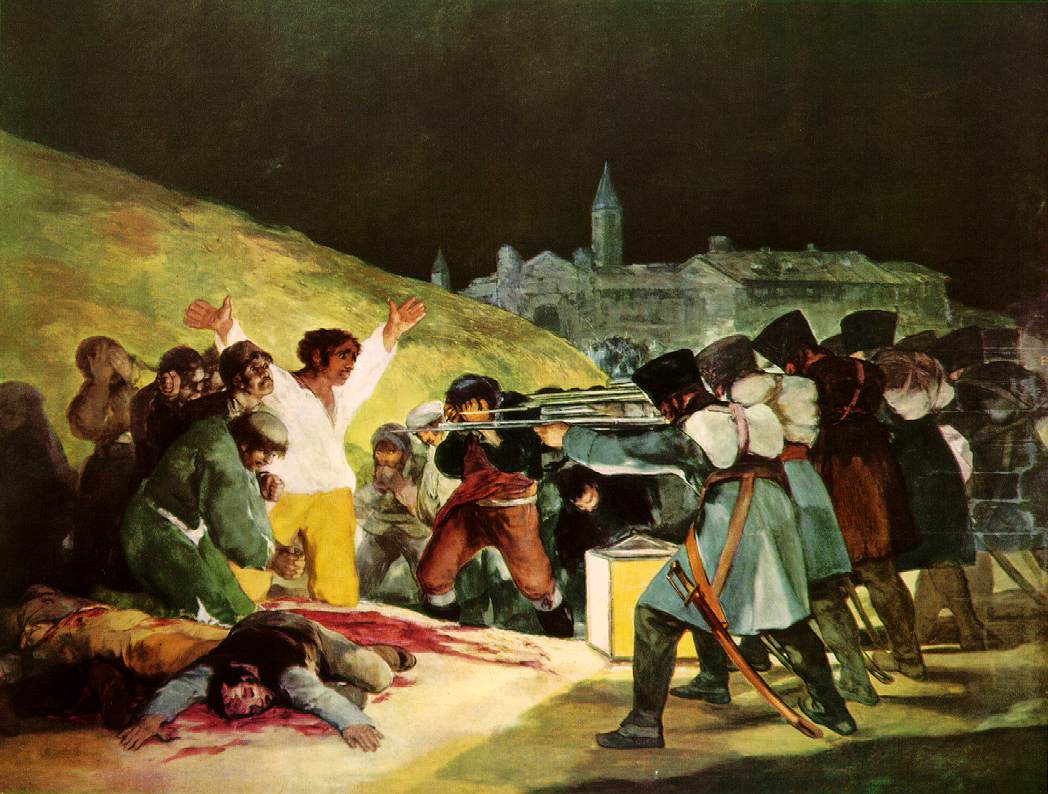
Another favorite is Tres de Mayo, 1808.
http://www.ibiblio.org/wm/paint/auth/goya/goya.shootings-3-5-1808.jpg

This one has very specific history behind it, which I am somewhat familiar with thanks to my college professors. It depicts a firing squad punishing Madrileรฑos who were part of an uprising against Napoleon's army and French occupation of their city and country. 

It's very easy to tell whose side Goya was on. The light guides your eyes to the man in white and yellow and his sad, but not frightened or cowed face. In contrast, the French soldiers are a faceless line of men, almost indistinguishable from one another. 

Want another kind of story? View "Saturn Devouring His Son,""The Colossus," or the collection of etchings called "Los Caprichos" (especially El Sueรฑo de Razรณn). 

Goya was quite the storyteller. If I could paint something half as good with my words . . . .


Sunday, January 18, 2015

The Hobbit: A Defense

So the trilogy of Hobbit movies have gotten a lot of flack. Some of it is probably deserved, as obvious padding. Other detours from the original book really pleased me. Since I finally made it to a movie theater for the third installment, it's my turn to weigh in.

First the complaint I agree with: 

http://www.quickmeme.com/img/69/692c1056ce4b5e008a5ad248cb8e8cf955f4f8758abea545c09484cc6a445cd5.jpg
1. The overt references to the Lord of the Rings trilogy were ham-handed and unnecessary. In my writing critique group, we call this a failure to trust your reader. All the groundwork was already there for fans to make the connection to events in the other movies. A jab in the ribs and a "Do you get it?" was clumsy storytelling. We knew that Gandalf suspected the nature of the ring Bilbo had found and had his own reasons for not taking action. We knew that Legolas, in his wanderings, would meet up with Strider/Aragorn. The people who didn't know that probably still didn't get it when they were poked roughly in the ribs because they must not know the books or movies. 

Now the complaints I'm willing to defend: 

http://upload.wikimedia.org/wikipedia/en/4/49/EvangelineLillyAsTauriel.jpg
2. The added material. In more than one review, I read that the whole Tauriel storyline was unnecessary. I disagree. Tauriel did a lot for the story. She provided the reason that Legolas becomes a wanderer who does not live among his own people in LOTR. It was a great, complicated mesh of emotions in that particular love triangle. She helped viewers distinguish among the dwarves. She was a much needed strong female character (Tolkien didn't write women much at all, let alone well) that helped engage female audience members. She helped us understand what was wrong with Thranduil, the father of Legolas--he was driven half mad by the loss of love in his life. She was the way in for the allegorical discussion of points about race and loyalty and honor. It would have been a poorer story without her. 


3. Legolas's agility moments: I have a feeling this is one of those you-love-it-or-you-don't moments
http://www.fangirlmag.com/wp-content/uploads/
2014/07/keep-calm-and-love-legolas-52.png
and neither side will win the other over. I loved Legolas's amazing moves in the original trilogy and I loved them again here. In the same way that I admire Jackie Chan's ability to use his environment to his advantage in a fight, I enjoy Legolas's daredevil risks. It makes even more sense when you come to view him as a man in love with someone who loves someone else. Only Legolas would jump out into space and grab the legs of a giant evil bat just as a means to get from one place to another more quickly. Only Legolas views all things in terms of how he can ride them--steering a giant beast with the blade he has jammed into its brain, turning a tower into a bridge, and climbing it while it crumbles. I'm not interested in straight warfare--sword vs. sword gets dull to watch over time. I can count on Legolas to do something crazy-cool to keep me engaged in the scene.
http://static2.hypable.com/wp-content/uploads/
2012/09/hobbit-dwarves-poster-full.jpg?324e9a
4. The indistinguishable dwarves: The writers had quite a task here, trying to make thirteen white men, nearly all the same height and build, distinct enough for us to know them in the story, when they are all in decidedly secondary or tertiary roles to the main story lines. So we have the love story, which we all knew would end badly. The father figure. The king. Other than that, they are primarily distinguishable by their beard affectations (and one of them by being really really fat). So, yes, I agree that, at the end of the story, I don't know many of their names or their backstories. But I also think that isn't necessarily a flaw. For those complaining about length of the movies, imagine how long they'd have been if we had fully realized each and every dwarf! Thorin needed a band of trustworthy followers around him, but the group can essentially function as one character. Does anyone know the names of Robin Hood's Merry Men beyond Little John? Captain Hook's pirates beyond Smee? It doesn't matter to the overall story.

So there you go. Was it a flawless trilogy? No. But was it a really enjoyable romp? Yes, indeed.

Friday, January 9, 2015

Watch Me Burn!

Hooray! It's finally here! Book 2 in The December People series, Watch Me Burn, is now available for purchase. Re-join the Vandergraff family as they navigate the delicate balance between dark magic and family.


Buy on AMAZON

Barnes and Noble & Kobo links should be available soon.


David Vandergraff lost his home, his job, and contact with his oldest son, but remains determined to be a good husband and father despite being a dark winter wizard.

His resolve is tested when a flyer for a missing girl--who happens to be a summer witch--begins to haunt him. David believes a spell needs to use him to save her, so he follows the magic's command and looks into her disappearance. His teenage daughter Emmy resents him for caring so much about a random stranger. But when she uncovers some disturbing evidence close to home, she begins an investigation of her own.

David and Emmy quickly learn that the mystery is not only about a missing girl they barely know, but a deeply personal story that impacts everyone they care about. As their world crumbles, they fear the warning may be true—never mess with summer wizards, because the good guys always win.

A little taste...