Wednesday, October 6, 2021

IWSG: Drawing the Line


Welcome to the first Wednesday of the month. You know what that means! It's time to let our insecurities hang out. Yep, it's the Insecure Writer's Support Group blog hop. If you're a writer at any stage of career, I highly recommend this blog hop as a way to connect with other writers for support, sympathy, ideas, and networking.

If you're a reader, it's a great way to peek behind the curtain of a writing life.

Our Twitter handle is @TheIWSG and hashtag is #IWSG.

October 6 question -In your writing, where do you draw the line, with either topics or language?

The awesome co-hosts for the October 6 posting of the IWSG are Jemima Pitt, J Lenni Dorner, Cathrina Constantine, Ronel Janse van Vuuren, and Mary Aalgaard! Be sure to check out what they have to say, and visit other writers in the blog hop!
________________________________________

There are definitely places I haven't gone in my writing, but I haven't drawn any conscious lines. I believe in giving each story what it needs, so I wouldn't rule anything out so far as subject matter or language. It all depends on what that story needs. 

I have, however, stopped writing a story because it was taking me down a dark road I didn't have the wherewithal to travel at that time. Thursday's Children was a dystopian fantasy I was writing a few years ago, which I finally shelved because the real world was feeling too dystopian for me just then and I needed to go somewhere else in my fiction. 

I hope to get back to it someday though, so that's more about timing than about a hard no. I'll put myself through emotional struggle for the sake of a story, but there are limits. 

image source

I have more limits as a reader, because I'm reading for my personal entertainment and enlightenment, and I'm not interested in reading anything that drags me down or fills me with fruitless anger. 

I have made exceptions, but it's hard for me to read Holocaust or Slavery literature anymore. I've read a lot of it over the years, and no matter how good a books is, it's a hard sell for me if it's set in American Slavery times or during the Holocaust. 

I also don't like to read books that include rape anymore. I've read too many where it was handled badly, with no respect or sensitivity for victims or revealing limited thinking about what might traumatize a character or motivate other characters who love them. So, if I know going in that a story features rape as part of the storyline, I'm looking for a lot of reassurance that it's handled well, and doesn't venture into glorifying violence (which is probably part of my problem with a lot of Holocaust and Slavery literature, too). 

I would *never* suggest that my personal preference means that other people shouldn't read or write those kinds of stories. You should do what you need and want. I just might not agree to travel some roads by your side. 

Part of why I write is because story is how I process the world, and it can be helpful to me to write stories about things that worry, frighten, or anger me, so I will always leave the door open to consider writing anything that tugs on my soul to be written . . .but I'll also protect me from me, when necessary and say "Well, not today, perhaps." 

How about you? Are there things you won't write or read about? Topics that are taboo or at least hard sells? I'd love to hear about them in the comments. 

Friday, October 1, 2021

September Reads

Generally, I try to read a book every week. Of course, it doesn't always line up that way. Sometimes a book takes me longer than a week to read, but it generally balances out to help me meet my goal of 52 books a year. 


That was definitely the case this month. I started reading The Count of Monte Cristo in early August and only finally finished that sucker last night!  

For those unfamiliar with this classic by Alexandre Dumas, it's a VERY long book. 1200-1600 pages depending on what edition you're reading, or 52+ hours as an audiobook. It's got an intricate plot and some really fun moments, but is, in my opinion, three times as long as it needed to be to tell the story effectively. 

A few months ago, I read The Three Musketeers also by Dumas, and liked it much better. Finishing Monte Cristo felt like an accomplishment though. One of those books that ought to earn me some kind of trophy, like when I read Les Miserables or War and Peace. These tomes are the reader's equivalent of running a marathon. 

Despite its length, though, Monte Cristo reads well. The prose feels modern and it's engaging, but I think it's one of those books I'm glad I read, but would never read again. Once is good. :-)

Because Monte Cristo took so long to read, I didn't get to read much else at all!


I finished only two other books, both short. 

Domino: Hotshots is trade collection of a run of comics. My coffeeshop carries comic books and I often buy one with my Friday treat coffee.  I got the first issue of this one and LOVED it, so I bought the rest of the story. I wasn't already all that familiar with Domino, but I still was drawn right into this story of unlikely allies learning to work together to defeat the big bad. Bonus points for a story that shows a young woman learning to accept and use her own power. Natasha Romanov (Black Widow) makes a guest appearance and really facilitates a nice mentoring/meeting your heroes arc. 

2,000 to 10,000 is a practical writing advice book that had been recommended to me several times, when I complain that I am a slow writer and would like to be faster. I appreciated the friendly, encouraging tone of the book and am planning to try some of the advice when I begin my next book (I'm too superstitious to change tactics in the middle of the book I'm writing now). I'll report back as to whether it works for me. 

Given that I write alongside a full time job, I probably won't get to 10,000 words a day, but I would settle for moving faster than my typical 250-800 words a day and be happy about it! 

How about you? Did you read anything wonderful in September? I'd love to hear about it in the comments. And of course, if you read anything *I* wrote, then I love you even more :-) 

Tuesday, September 28, 2021

9 years of writing every day

I hit a new milestone in my writing life today: 9 years of writing every single day, at least 250 words. 

That may not sound like much, but the results have been nothing to sneeze at. At that slow and steady rate, I've completed several novels and seen them out into the world. 

All my life, I've both needed and resisted structure. 

I guess I'm contrarian that way. 

But whether I'd like to admit it or not, every time I've succeeded at anything important, there's been a daily practice involved. And, for me, it has to be daily. I can't do something on Mondays and Thursdays, or every other day, and get the same results. 

Even though my creative side decries fences, saying it wants to run free, all evidence shows that I'm actually a lot more creative when I have some constraints. So my entire writing life has been a push-and-pull between these conflicting ideas. I might chafe at rules (even when I'm the one who made them), but I have to begrudgingly admit that they're effective on me. 

My rule is that I have to write every single day, come hell or high water. 

I set the bar for what counts as having written relatively low: 250 words. One page. Because even on a horrible day, when I have a fever or when some crisis hits, I can write at least that much. Because even with arthritis, I can write that much by hand on the back of receipts if my technology fails or I'm trapped in traffic or other disasters strike. 

One key to making your goals is setting achievable, realistic goals. Of course, I want more than 250 words each day (and I often get them), but I can *always* get 250 words, so I'm setting myself up for success. 

When I started trying to write 250 words a day, it was difficult. It sometimes took me hours…and I struggled to get those hours. My kids were young, my dog was impatient, and I had tremendous guilt about taking that time away from other ways I could be of use to my family and the world. But, if I was going to realize my dream of being a writer at any level, I was going to have to make a commitment and stick to it. 

So I did. 

As writing 250 words a day became easier over the years (I've done it in as few as 15 minutes on a good night), I raised the bar a little, shooting for 800 words on school days and 2000 words on non-school days. But that's the stretch goal. As long as I write 250 words, the daily writing chain continues to grow. 

These days, I make 800 pretty regularly. On nights where I have to settle for *only* the 250, it feels like settling, and leaves me more determined to make more words the next day. 

The longer the chain became, the less likely it became that I would break it. After nine years, if I get to bedtime and haven't written, it's like some kind of alarm going off in the back of my brain. I won't be able to sleep until I do it. 

Plenty of nights the words are no good. Often, when I come back the next day, I start by throwing out the garbage I wrote the night before and starting fresh. But, there's the magic. You can improve on bad writing, but there has to be something *there* before you can work on making it something good. 

My writing record (I use Jamie Raintree's spreadsheet)


So, here I am nine years later, and writing every day is a given, up there with brushing my teeth. It's brain hygiene :-) So far in 2021, I've written 283,796 words (not counting the ones I'm writing right now).  That includes work on two novels, several short stories, book reviews, blog posts, and other hard-to-categorize things.  Remind me, when I'm feeling like I didn't do that much this year, will you? 

Wednesday, September 1, 2021

How Do I Know When I've Succeeded?

Welcome to the first Wednesday of the month. You know what that means! It's time to let our insecurities hang out. Yep, it's the Insecure Writer's Support Group blog hop. If you're a writer at any stage of career, I highly recommend this blog hop as a way to connect with other writers for support, sympathy, ideas, and networking.


If you're a reader, it's a great way to peek behind the curtain of a writing life.

Our Twitter handle is @TheIWSG and hashtag is #IWSG.

September 1 question
 - How do you define success as a writer? Is it holding your book in your hand? Having a short story published? Making a certain amount of income from your writing?

The awesome co-hosts for the August 4 posting of the IWSG are  Rebecca Douglass, T. Powell Coltrin @Journaling Woman, Natalie Aguirre, Karen Lynn, and C. Lee McKenzie! Be sure to check out what they have to say, and visit other writers in the blog hop!
________________________________________

I've had some great successes in my writing life so far. There are plenty of moments in my career that feel like accomplishments and achievements. It's important to remind myself of that from time to time, because success is an ever-moving target and it's easy to feel like a failure and dismiss all the successes you've already had getting this far. 

image source

So, in the spirit of remembering my successes while I strive for new ones, here are some of my highlights (the brag book!)
So, by a lot of standards, I've already been pretty successful as a writer. But I'm an ambitious gal. I want more! 

I want to make my living (enough to pay the bills) from my writing. I want to see my work translated into other languages. I'd love to see my work picked up for television or movies (and to receive the paycheck that goes with that). I'd like to finish the book I'm working on now, and the several other projects languishing on my back burners, and do all those stories and characters justice. 

So, I think that's the trick with success. 

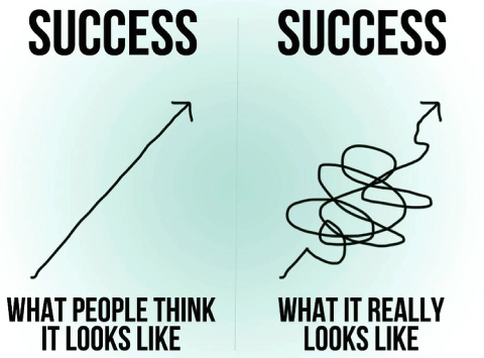
We're always succeeding, with each teeny tiny baby step we take toward meeting our goals. But we're also always failing, because if you accomplish a goal, you tend to set a new one, further out on the horizon and start striving all over again. 

image source

Just remember that there are MANY definitions of success, and you need to define it for yourself. Don't worry about what other people are doing--they're not you, and comparing yourself to other writers and their careers can be maddening. 

How do you define success for yourself? What do you do to remind yourself of all you've already accomplished? 

Monday, August 30, 2021

August Reads

School started in mid August for me, so that really put a dent in my reading time. Still, I managed to finish a few books: 


A little romance, a little horror, some supernatural happenings, a heist or two, and a health dose of wit and humor. Really, quite a good month for reading. 

I started with Eleanor and the Egret, a graphic novel by John Layman and Sam Kieth. My local coffee shop keeps a spinner rack stocked with a variety of comics and when I buy my "hurray! It's Friday!" treat of a pastry and a fancy coffee, I also often buy myself a comic. That's how I found the first issue of Eleanor and the Egret and I loved it so much, I ordered the trade. 

I'm so glad to have run across this bizarre and good hearted story of a young woman and an egret who become art thieves together. 


Alexandra Christian and I share a publisher, and I got her new book, Dr. Watson and the Ladies' Club Coven, as soon as it released in May 2021, but I hadn't read it yet! Wanting something short that I already knew I would love, I put this book next in my e-book queue. Like her previous Shadow Council Archives novella, The Ghost and Dr. Watson, this novella features Dr. John Watson after Sherlock Holmes has died in a world where supernatural happenings don't turn out to be phosphorescent paint and humans with ill intent, but the real deal. Highly recommended for fans of Sherlock Holmes and the supernatural. 

Earlier this summer, I read Monster, She Wrote by Lisa Kröger and Melanie R. Anderson, a sort of annotated bibliography of works of speculative fiction by women across history. In that book, I learned that Edith Wharton, an author I knew from her literary, historical classics like The Age of Innocence and Ethan Frome had also written a number of Gothic tales. So when I was offered a good deal on a collection of her Gothic tales from Chirpbooks (a discount audiobook company), I jumped on it. The Wharton Gothics included stories with real ghosts alongside atmospheric tales in which the dread came from natural instead of supernatural causes. 


Meanwhile, over on my Kindle, I pounced on the next of Lucy Blue's Stella Hart Romantic mysteries, just released in July. You might remember that I read two of them last month and enjoyed them immensely. The third one, The Baronet Unleashed, was just as much fun. This one took us into old Hollywood which was a fun setting, and kept all the witty dialogue and charming romance going. I'm already looking forward to the next in the series!

Sad that I couldn't immediately read another Stella Hart, I dug through my Kindle library for something else that might scratch that particular itch and found the first of the Miss Fisher's Mysteries series by Kerry Greenwood, Cocaine Blues. I bought it some time ago, when I was watching (and LOVING) the television series, but I hadn't read it yet. 

Like Stella Hart, Phryne Fisher is a firecracker of a woman, though she's more adventurous and less concerned about what other's might think of her than Stella. I quite enjoyed this introductory adventure with Miss Fisher and will definitely be back to read more of them. 

So that was my August in books. Right now, I'm in the middle of two books: The Count of Monte Cristo, which I'm reading for my first Monday Classics book club and quite enjoying as an audiobook and 2,000 to 10,000: How to Write Faster, Write Better, and Write More of What You Love by Rachel Aaron, a very practical book I'm hoping will help speed my process as a writer. In paper, I'm mostly reading comics right now. 

How about you? Read anything fabulous this August? I'd love to hear about in the comments! 

Wednesday, August 18, 2021

Not a Superhero


They probably meant well. 

It seems flattering at first blush, being called a superhero. 

It implies that I'm special, someone who handles work that an ordinary human would not be able to do--jobs that require super-human strength, endurance and effort. 

But the problem with that overblown, hyperbolic, and manipulative rhetoric is that teachers aren't superheroes. We're people. 

Don't get me wrong. I'm an amazing person. I can do more with 90 non-supervisory minutes a day than some people do in entire eight hour work days. I'm a master of efficiency, and surprisingly good at improv, too, given how often the rug is pulled out from under me mid-stride. Many of the teachers I work with are as amazing as me. Some are even MORE amazing. 

But, they're not superheroes. Neither am I. I'm just a middle-aged woman who's fed up with this particular method of dodging discussion of real issues. 

I know superhero imagery is appealing, and has become a favorite metaphor for lots of overworked, underpaid public servant sorts of work. But a lot of the people using this comparison don't know superheroes. 

I, do, though. I read, watch, and write superheroes. I know them well. 


And here's something we all need to remember: 

Superheroes are fictional.

Real heroes exist. Some of them are teachers. But superheroes are imaginary. 

Only imaginary heroes can shoulder the load alone, out of the goodness of their hearts, with no thought of reward or rest. Superheroes don't need help from ordinary folk. They don't need things like reasonable workloads, safe working environments, a living wage, or even our respect. 

But if society can cast teachers as superheroes, it lets the rest of the people off the hook. We don't have to make any sacrifices for the public good, like paying higher taxes so that students can learn in buildings that aren't falling apart, or paying teachers enough money that young, passionate, talented people might be attracted to this line of work. 

When I am called a superhero, I remember James Jonah Jameson, editor of the Daily Bugle, the angry spittle-flinging man ranting about the ineptitude and untrustworthy nature of the very superheroes who continue to save his butt and the butts of all the ungrateful citizens of imaginary New York and the world beyond.

Superheroes *do* get thanked from time to time, mostly in moments of crisis like alien invasions and such. 

Real heroes get thanked under similar circumstances, like a teacher throwing herself in the literal line of fire when another problem society ignored too long walks through the front door with a gun, or dying during the pandemic because they went to work in person despite the risk "for the kids." 

Remember those five minutes at the start of the pandemic when parents all over America realized what a teacher's job actually was and expressed gratitude? 

Yeah, that was over as soon as it went on "too long." When the superheroes were revealed as all too humanly vulnerable. A grateful public turns into a resentful public very quickly when the superheroes stop saving them. 

If teachers stumble--regardless of why (or even if they don't stumble, but someone manages to spin the story just right)--those teachers we were just praising as superheroes are suddenly on the front page again, but this time as the recipients of blame, anger, and ire. We're called selfish or incompetent, accused of indoctrinating students when we try to teach them to think for themselves. All from people who have never done our jobs (and honestly probably couldn't handle the job if we got them to try it). 

So, instead of throwing empty compliments like "superhero" at teachers, how about working to increase the likelihood of success? Remember that teachers are ordinary human with ordinary limits. If the job truly requires a superhero, no wonder we're going through a giant teacher shortage. Superheroes don't exist and ordinary people trying to be superheroes can die trying. 

I don't need flattery, and I'm not accepting more than my share of the blame. Instead, I want to see a world where success is possible and the work is sustainable. It's possible . . .it's just expensive. America has gotten off cheap on education so far, and we're starting to see the truth in "you get what you pay for." 

But, for now, what I really want to say is: take that cape and shove it. 

Thursday, August 12, 2021

Summer's Over and I'm Not Ready for School to Start


I still love teaching. Helping kids find their way in something they're trying to learn, getting to know the future generations as people . . . these are deep joys. Still. After 26 years of classroom life. That's saying something. 

But here, four days before my first teacher workday of the new 2021-2022 school year, I am absolutely not ready to go back. 

Teaching is always exhausting. Getting through to kids requires huge emotional investment, and the system is set up to undercut teachers at every step of the way: paying us so poorly that we struggle to make basic ends meet, trying to legislate things that should be professional decisions, piling on extra documentation requirements without providing time in the schedule to do the work, blaming us for every problem a child faces without giving us the corresponding credit when a child succeeds. 

Luckily, 90% of the time, it's just me and kids in my classroom. Their parents, school administration, and politicians may try, but they cannot really intrude on that relationship . . . not at the level of spending they're willing to do anyway (spies, whether digital or in person, are expensive). They're simply not there when the rubber hits the road. The kids and I are on that journey alone. 

Last year, teaching was a whole new kind of exhausting. 

One thing I value about the work is the predictability. Kids, of course, are not predictable, but generally, my classes meet at the same time every day with the same people in them studying the same things. I know when I can go to the bathroom and if I'm going to get to eat lunch or not (yes, that is often an "if"). I need those parameters to work within. 

Starting in March 2020, there was no predictability. I was sent home from school with directions to prepare for 3 or 4 weeks of asynchronous teaching and didn't start working in a classroom again for a year (and even then, it wasn't "normal" since I had to teach kids at home via zoom and kids in my room at the same time, with all new health precautions and the rules changed roughly every three days about what was and was not allowable). 

And 2021-2022 promises more of the same. 

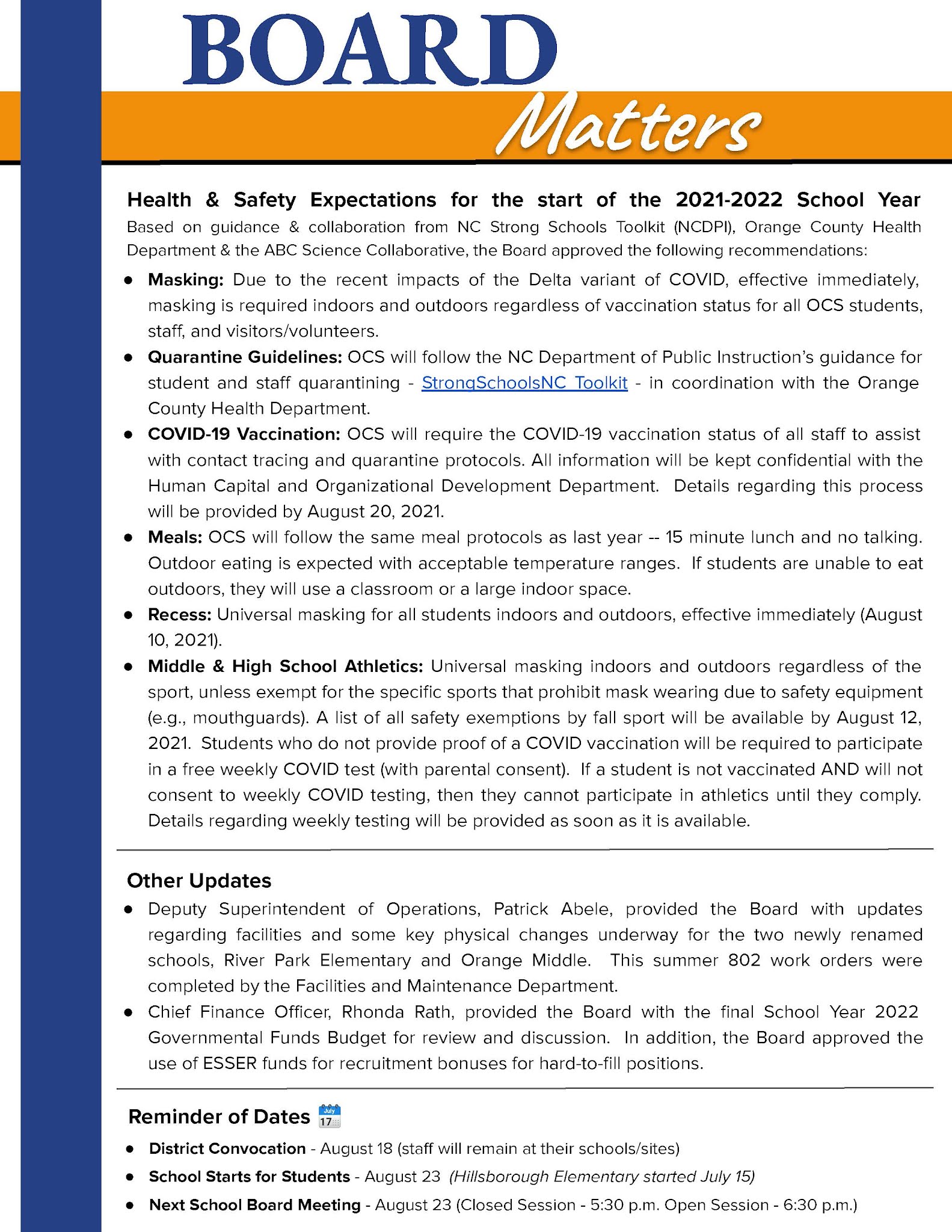
I've been handed a set of parameters for 2021-2022. Who knows if these are the rules for three minutes, three months, or three years? 

Twitter Link

I'm glad, at least, that it appears I will no longer be asked to teach in two environments at the same time (online and in person). Just just looking at this list of restrictions depresses me. 

I'm trying to trust that my immunization will keep me from becoming too sick (like hospitalized, life-threateningly sick), but I have little doubt that I or my child (starting high school this year) will catch it this year. 

There are roughly 600 kids in my school building, 200 of whom do not qualify for immunization yet. There are roughly 1020 students in my kid's high school, all of whom are eligible for immunization. If county stats average out among children, 78% of them are immunized (Hurray! Last I heard, we only need 60-70% for herd immunity to help, if it's going to help with this).

Our district's year-round elementary school has already had several cases (I'm vague on numbers because there isn't very good transparency: the district is trying to ride that line between sharing information to allow people to protect themselves and avoiding causes panic). A colleague who just put her baby back in day care so she can return to work just found out that her baby (not old enough to be immunized) has caught it (thankfully, a mild case, so far). 

I'll do the best I can, of course, to give my students a good experience within these limits, but it's challenging. Finding a spark of joy and enthusiasm is difficult. I already feel snowed under and I haven't started. 

I took my summer as slowly as I could, trying to balance taking some rejuvenating opportunities (like seeing my family and attending author events) with self-care. But eleven weeks wasn't enough to find my balance and recharge. I can't even imagine how my colleagues who took on summer work must be feeling (luckily, my husband gets paid better than me, and funds my nasty teaching habit, letting me stay unemployed during summer hiatus). 

So, to all the teachers out there, take care of yourselves. Push back when the world pushes too far--you know they'll eat us alive if we let them. Keep working on the balance between dedication and burnout.

To all the kids and families of school children, remember that teachers are people, and when you feel you need to advocate for your children, do so with kindness and a heart to help, not blame. 

For everyone else, pray for us, if you're people who pray. Vote for us and policies that support us, if you're people who vote. Remember that these kids will take care of you in your old age--don't you want them to grow up whole, hale, and educated?