I've mostly been reading my own work this week. Last week, I finished book one of a historical fiction trilogy I'm working on. So this week was a shifting gears week, back to my superheroes. As you would imagine, that's a completely different world and style. Making the shift was harder than I thought it would be.
When it became clear I wasn't going to be able to just jump in and pick up where I left off, I re-read a lot of the first novel and what I had written so far on the second and made myself some charts. Charts are vital for me as a writer in following all the different threads and making sure I don't make silly continuity errors, like having some appear in a scene after he already died, or having a character in two places at the same time. In a sequel, it's even more vital because I can't contradict what took place in book one.
I also read a few stories for an online critique group I participate in for developing my short stories, and worked on another beta read. I do read a lot! Mostly, it's just not yet published.
So far as published books, I did manage to read more of Greatshadow by James Maxey--I'm in the end battle now and still really enjoying it. James has created an interesting band of adventurers with a variety of motivations and abilities. In a recent part I read, a man transformed into a worm and was cut in half. When he turned back into a man, there were now two of him.
I'm also reading Don Quijote, the next choice for my library's Monday classics book club. I'm doing a lot better with Cervantes than I did with Faulkner. I last fully read Don Quijote in college and I've been trying to read it in Spanish for years, but it's a serious stretch for my Spanish skills, so it's slow going. For book club, I'll stick with the English. Mine is translated by Tobias Smollett. It's the same one I read previously, just a new copy since the old one fell apart on me.
Book clubs are a great motivator for me since they give me a deadline and help me prioritize time to finish things. As my blog title suggests, I'm always trying to balance the hours of the day for everything I want out of them: sleeping, working for pay, writing, playing, reading, social life. Even in summer, when most of my hours are mine to arrange, it's difficult to balance things so that each day feels comprised of the right things and leaves me feeling good.
Now, NJ is a reader! Books are her life. We took in our reading log to the library a couple of days ago, so she could get her prizes. Over the course of twenty days (since we'd last turned in our count), she read over 1900 minutes. That's practically a full work week! Her obsession with Tiny Titans continues and we decimated the graphic novels section, picking her up old favorites like Babymouse, and a few new things to explore like Geronimo Stilton and Squish. For our audio book, we chose a Ghosthunters that we had missed: The Moldy Baroness. It promises to be very exciting.
M had a camp all this last week, so read less. She did finish Fangirl by Rainbow Rowell while she was traveling and said she really enjoyed it, though Eleanor and Park was better. She's been choosing more emotional storylines lately after a lifetime of being an adventure fan. Watch out Rick Riordan, you might be replaced!
Summer is beginning its wind-down now, sadly. One of us starts school on August 18. We'd best get back to our books if we're going to get it all read by then!
Monday, July 21, 2014
Saturday, July 19, 2014
#SaturdayScenes: No. 12
_____________________________________
“She’s awake.” Mary heard the voice, but, when she tried to open her eyes, she plummeted back into darkness. Waking felt like a steep climb up a slimy-walled pit. It took several more tries before she was able to convince her eyelids to lift. When she finally succeeded, she immediately closed them again. She had to still be asleep.
She sat up in bed, ducking her head into her hands and rubbing at her eyes with the heels of her
| http://www.ceronedesigns.com/gallery/bunnyandflowers.jpg |
Sliding her feet out of the bed, she sat up. She felt a little dizzy and her mouth was dry and cottony and tasted terrible. She stood, gripping one of the posts of the bed to support herself as she found her balance. She was wearing a hospital gown, she realized. One that was too short for her, and printed with pink checks and white daisies.
She could see a bathroom a few steps away and pushed off towards it. Her knees wobbled, but she was able to stumble to the doorframe and into the bathroom. She made it just in time to relieve her suddenly painfully full bladder into a too small toilet. She was washing her hands at a sink that only came up to her thighs when she heard the door open.
“Ah! I’m glad to see that you’re awake. Here.” The woman handed her a pile of pink hospital scrubs. “These will fit you better.”
When Mary just stood there, dumbstruck, the woman smiled. “It’s alright. I’ll wait.” She pushed Mary back into the bathroom and closed the door to the smaller room.
Mary stood behind the door listening. She heard the sound of bedsprings creaking and figured the woman must have taken a seat on the bed. Mary had no idea what was going on, but figured whatever it was would be better with pants that covered her ass, so she pulled on the scrubs as quickly as she could, gripping the towel rack for balance. She banged her elbow painfully, scrambling to open the door.
The woman was, indeed, seated on the bed. She was a short, slender woman with big squarish black glasses and brown hair pulled back from her face in a severe bun. She didn’t look any older than Mary, though she wore a lab coat and a badge that announced that she was Dr. Kimberly Sugg.
“That must feel better. Please sit down.” The woman patted the bed beside her and pulled a small medical light out of a pocket. “Just follow the light, please.” Mary cooperated with a series of small commands, similar to what the doctor had asked her to do when they’d thought she might have a concussion after that car wreck last year. Her mind tried to form questions, but it was like her thoughts were too spread out and she couldn’t quite rein them in and form something coherent from them.
“I’m sorry for the confusion. When they told us they had Ms. Braeburn’s daughter, we assumed you were a child and you were placed in the girl’s room. I’ll have you moved to another room soon.”
Mary finally managed to speak. “Does that mean you have my mother?”
“Us? No. She’s being held at another division. We’re the pediatric division.” The woman tapped her ear then, apparently activating some kind of ear piece. “She’s fine. Is transport ready?” Turning back to Mary, the woman smiled. “I know you must be confused. They’ll explain everything soon.” There was a tap at the door. Dr. Sugg stood and opened the door, admitting a tall, thin man who had to duck to get through the doorway. He was pushing a wheelchair. “You probably don’t need the chair, but we don’t want to risk you falling. The drugs can affect your nervous system for a few hours after waking.”
The man approached the bed, and place his arm under Mary’s, presumably to help her stand. His grip was gentle, but firm. She let him lead her to the wheelchair. Dr. Sugg waggled her fingers at her as the man rolled her away. “Bye bye now!”
_____________________________________
If you would like to check out more scenes by some really great writers, you should search under the hashtag #Saturdayscenes. The movement is the brainchild of +John Ward , who suggested that writers should share their work each Saturday.
_________________________________
My other #SaturdayScenes contributions:
Week One: Elopement Day from WIP, Cold Spring
Week Two: Linda Makes a First Impression from WIP, Her Father's Daughter, sequel to Going Through the Change
Week Three: Claiming Alex, from unpublished novel His Other Mother
Week Four: Things Get Hairy for Linda, from unpublished novel Going Through the Change
Week Five: a poem: A Clear Day in Kodiak, Alaska
Week Six: a snippet from an idea barely begun, Lacrosse Zombies
Week Seven: Mathilde's Visit, from WIP, Cold Spring
Week Eight: Sherry bakes, from His Other Mother
Week Nine: I Said So, Didn't I? (a scene in dialogue)
Week Ten: Losing Faith (a poem)
Week Eleven: Shop Girl, from WIP, Cold Spring
Week Eight: Sherry bakes, from His Other Mother
Week Nine: I Said So, Didn't I? (a scene in dialogue)
Week Ten: Losing Faith (a poem)
Week Eleven: Shop Girl, from WIP, Cold Spring
Wednesday, July 16, 2014
GenCon Bound
I had never heard of GenCon before my husband and I began dating. This is kind of funny when you consider how close I lived to one of the largest gaming conventions in the country during long portions of my life. Of course, before my husband came into my life, I was a girl who enjoyed games, not a gamer girl. Even now, compared to hard-core gamers, I have barely put my toes into the water.
The year we married, T and I went to GenCon. In fact, we joke that we brought our daughter home with us as GenCon swag (the timing almost works).
That first year, I was startled, to say the least. This is a HUGE event. Overstimulating doesn't begin to cover it. The dealer's hall alone can take an entire day to fully explore. It's visually overwhelming, too, with cosplayers and demonstrators everywhere. Luckily, I had a great tour guide, who set me up with a tourney to enjoy (Dreamblade!) and understood that I'd need to retreat to our room from time to time to read in the quiet.
We've only been back once so far. (Children are expensive and take up a lot of time.) But the second time we went, I learned about the Writer's Symposium, sort of an event within an event there at the con. It features seminars and workshops for writers. Of course, it concentrates on genre writers . . . after all, it is a gaming con. But the advice is applicable to any kind of writing. I attended a few sessions that year. There was one about writing physical combat scenes (the session was called Mano a Mano) that proved invaluable to me two years later, when I was writing the final battle scene in my superhero novel. I can't wait to see what I can learn this year!
The best part is the price. Most writing conferences are too rich for my blood. It's a catch-22 in that I don't feel I can justify the expense when I'm not yet making money on my writing, even if that's a good way to learn how to make money from my writing.
But, I can go to the Writer's Symposium for the cost of my $80 pass, and little else. Most of the
Writer's Symposium events are free. The few I chose that did cost, were $8 each. Now, that fits my budget. Plus, now I have a cousin in Indianapolis. She'll let me crash with her and save me the hotel monies as well.
So this year, I'm in an odd spot, heading to the Best Four Days in Gaming, without my gamer guy. I'll be spending most of my time in the Writer's Symposium, learning about the business of writing from writers who are maybe just a little ahead of me in this venture, and from bigger names in the field. I'll get three days of focus on writing in an environment full of my potential readers. I'm one lucky girl.
The year we married, T and I went to GenCon. In fact, we joke that we brought our daughter home with us as GenCon swag (the timing almost works).
That first year, I was startled, to say the least. This is a HUGE event. Overstimulating doesn't begin to cover it. The dealer's hall alone can take an entire day to fully explore. It's visually overwhelming, too, with cosplayers and demonstrators everywhere. Luckily, I had a great tour guide, who set me up with a tourney to enjoy (Dreamblade!) and understood that I'd need to retreat to our room from time to time to read in the quiet.
We've only been back once so far. (Children are expensive and take up a lot of time.) But the second time we went, I learned about the Writer's Symposium, sort of an event within an event there at the con. It features seminars and workshops for writers. Of course, it concentrates on genre writers . . . after all, it is a gaming con. But the advice is applicable to any kind of writing. I attended a few sessions that year. There was one about writing physical combat scenes (the session was called Mano a Mano) that proved invaluable to me two years later, when I was writing the final battle scene in my superhero novel. I can't wait to see what I can learn this year!
The best part is the price. Most writing conferences are too rich for my blood. It's a catch-22 in that I don't feel I can justify the expense when I'm not yet making money on my writing, even if that's a good way to learn how to make money from my writing.
But, I can go to the Writer's Symposium for the cost of my $80 pass, and little else. Most of the
Writer's Symposium events are free. The few I chose that did cost, were $8 each. Now, that fits my budget. Plus, now I have a cousin in Indianapolis. She'll let me crash with her and save me the hotel monies as well.
So this year, I'm in an odd spot, heading to the Best Four Days in Gaming, without my gamer guy. I'll be spending most of my time in the Writer's Symposium, learning about the business of writing from writers who are maybe just a little ahead of me in this venture, and from bigger names in the field. I'll get three days of focus on writing in an environment full of my potential readers. I'm one lucky girl.
Monday, July 14, 2014
Summer Reading: Week Six
I had writing critique group this Sunday (hurray!), so my top priority was to read the excerpts from my fellow writers. It's a different sort of reading than just reading. I'm reading to provide feedback, so I read each piece at least twice, making margin notes as I read about my reading experience: what bumped, what was awesome, what I don't believe, what errors my friends made, etc. It's really useful for my own growth as a writer, and not just on the days that it's my work being critiqued.
I learn a lot from being forced to define as precisely as possible what the problem is in the piece. I learn even more trying to come up with suggestions about how best to fix it. The discussions open my brain in the most exciting ways. My critique group is the best!
I also had a huge writing week. I wrote an average of 2,000 words a day, and, as a result finished the draft of Cold Spring that I was working on. In finishing the draft, I did a lot of nonfiction reading (web articles and books) about various historical details that came up. How did writers write historical fiction before the internet? I'll have a lot of research to do before I can really take on book two in that saga.
So, the only novel reading I did was casual and light. I didn't finish anything at all this week! I continued to read Greatshadow by James Maxey and Mothers by +Michelle Read but can't really report on those yet as I've not finished. I can tell you that I'm still engaged with both and intend to finish them. That's saying something as I've become, in recent years, more willing to abandon a book that doesn't really pull me in.
My other reading was online: blogs, articles, etc. I followed the Hobby Lobby decision and the opinion articles afterwards. I grew up thinking our society was past the most blatant and rampant sexism of our past, so this and other recent political volleys have been a bit of a shock. Politics is exhausting. It's worse than housework for that Sisiphyusian feeling of futility--you win a fight, and immediately have to fight it again.
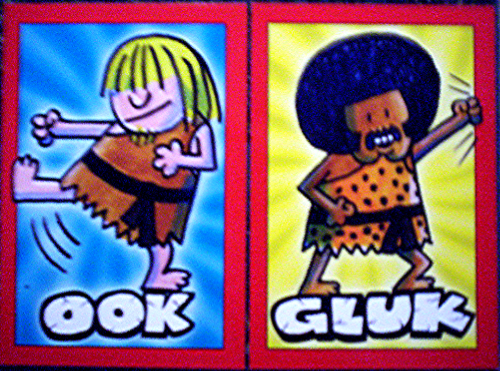
NJ's reading was much more fun. After the success of Captain Diaper Baby, we were back at the library looking for everything else we could find in that vein. Captain Underpants was all checked out, so we got Ook and Gluk. An unfortunate side effect has been rampant caveman speak from my normally articulate seven year old, but it comes with lots of laughter, so I can't complain too much.
One of the hard things right now is convincing NJ to give books back to the library. I've had to make a rule that she can't have more library books without giving back an equal number of library books we already checked out. Each trip to the library (and we go at least twice a week during the summer) requires a good twenty minutes moving the books into different piles and deciding which ones she is ready to part with. Sometimes there are tears when I insist that certain books have to go back this time because they are actually due. That girl loves her books!
Our neighborhood also has a Little Library in the community park now, so that's another place to exchange a book we're finished with for a new one. She wants to go every day, worried she'll miss a really good book, but it's even harder to let go of books she owns than it is to rotate library books.
M, the teen, is back home now (another hurray!), so soon I'll be able to update about her summer reading. I'm happy to be able to report that she does read things longer than a text message :-)
I hope you're all finding time for books in your lives this summer, too. What are you reading?
I learn a lot from being forced to define as precisely as possible what the problem is in the piece. I learn even more trying to come up with suggestions about how best to fix it. The discussions open my brain in the most exciting ways. My critique group is the best!
I also had a huge writing week. I wrote an average of 2,000 words a day, and, as a result finished the draft of Cold Spring that I was working on. In finishing the draft, I did a lot of nonfiction reading (web articles and books) about various historical details that came up. How did writers write historical fiction before the internet? I'll have a lot of research to do before I can really take on book two in that saga.
So, the only novel reading I did was casual and light. I didn't finish anything at all this week! I continued to read Greatshadow by James Maxey and Mothers by +Michelle Read but can't really report on those yet as I've not finished. I can tell you that I'm still engaged with both and intend to finish them. That's saying something as I've become, in recent years, more willing to abandon a book that doesn't really pull me in.
My other reading was online: blogs, articles, etc. I followed the Hobby Lobby decision and the opinion articles afterwards. I grew up thinking our society was past the most blatant and rampant sexism of our past, so this and other recent political volleys have been a bit of a shock. Politics is exhausting. It's worse than housework for that Sisiphyusian feeling of futility--you win a fight, and immediately have to fight it again.
NJ's reading was much more fun. After the success of Captain Diaper Baby, we were back at the library looking for everything else we could find in that vein. Captain Underpants was all checked out, so we got Ook and Gluk. An unfortunate side effect has been rampant caveman speak from my normally articulate seven year old, but it comes with lots of laughter, so I can't complain too much.
One of the hard things right now is convincing NJ to give books back to the library. I've had to make a rule that she can't have more library books without giving back an equal number of library books we already checked out. Each trip to the library (and we go at least twice a week during the summer) requires a good twenty minutes moving the books into different piles and deciding which ones she is ready to part with. Sometimes there are tears when I insist that certain books have to go back this time because they are actually due. That girl loves her books!
Our neighborhood also has a Little Library in the community park now, so that's another place to exchange a book we're finished with for a new one. She wants to go every day, worried she'll miss a really good book, but it's even harder to let go of books she owns than it is to rotate library books.
M, the teen, is back home now (another hurray!), so soon I'll be able to update about her summer reading. I'm happy to be able to report that she does read things longer than a text message :-)
I hope you're all finding time for books in your lives this summer, too. What are you reading?
Saturday, July 12, 2014
#SaturdayScenes: No. 11
I finished a draft of my new novel on Thursday. So, in celebration, I bring you a #saturdayscenes from Cold Spring, my historical fiction piece. This scene comes near the end of the book.
Chapter Thirty-Two: 1930, Shop Girl
Freda liked working at Whitaker’s. She liked her striped apron and little white cap. She liked listening to the women talking as they shopped. She liked the thousands of small ways that it had brought she and Simon together over the past two years. Working by his side was like getting a taste of what it would be like to be his wife someday. They worked well together, finishing each other’s sentences and knowing which way the other was going to move. It was good to see that they could work as well as play together. Of course, Simon wasn’t in the store that often anymore, his duties for City Council taking a lot of his time and energy.
When they were in the store together, Simon never failed to treat her respectfully, as he might any other employee. The occasional rumor still floated by within Freda’s earshot, but she didn’t let it worry her, trusting to her future with Simon. When they were alone together, he had began to call her “Miss Wurth,” mocking the formal tone they used with each other at the store, until her touches had him calling out her first name again. “Oh, yes, Freda.” Simon had still not yet broached the topic of their marriage again, but Freda believed in him, and trusted that he would choose the right moment. In the meantime, she could be a wife to him in spirit, if not in fact. She tried to ignore the sinking feeling in her stomach that sometimes came upon her when she thought about her position. She had to trust to the goodness of the man to whom she had given her heart. Some days that worried her more than other days.
When Simon had first proposed that Freda take the job as shop clerk, two years before, Freda had expected that he would have to fight for her. On the contrary, Mr. Whitaker hadn’t objected at all. In fact, he had welcomed her warmly, seeming glad to have the opportunity to know her better and to train her in the store management. He had paid her a good wage, too, one that Freda suspected was a little higher than another woman would have earned for the same work. It was enough to let Freda take care of the farm taxes and refill the emergency fund in the coffee can in her kitchen.
In her two years at the grocery, Freda had worked most of the jobs in the store. She had weighed the vegetables and bagged them up for delivery. She had helped fussy ladies choose material for their dresses and cut the requested amounts from the huge heavy bolts. She helped Mr. Whitaker count up the money at day’s end and do the inventory. He said that she had a better head for figures than his son did. Freda had beamed all day from the compliment. Most days it was wonderful.
This, however, wasn’t one of those days. Freda had been alone in the shop most of the day. Mr. Whitaker had stayed home nursing his sore back and Mrs. Whitaker had excused herself late in the morning to see to her husband. The store had been very busy, and Freda felt like she had been running all day. It was going to be very good indeed to get home and put her feet up.
Her tiredness made it hard to muster a smile when Mary Perkins, the mayor’s daughter, came in at nearly the end of the work day. Mary had been rude to Freda over and over again during her tenure at the store. While other women who shopped in the store called Freda by name if they knew her or “Miss” if they didn’t, Mary always called her “shop girl.” There was something in Mary’s tone that made the two innocuous words sound more like “insect” or “mongrel.”
She didn’t speak to Mr. and Mrs. Whitaker with that tone. In fact, she seemed to become simperingly sweet if one of them were nearby. She was also polite and even somewhat friendly if young Mr. Gibson, the other shop clerk, waited on her. Freda had no idea why, but Miss Perkins seemed to have singled her out as the target for all her sharp-tongued ill-nature.
It was even worse when Mary simpered at her Simon. If Simon were in the store, she’d always manage to make sure it was he who helped her with her purchases. She’d touch him more than was necessary and flutter her eyelashes at him. Sometimes, Simon seemed to flirt back. Freda reminded herself that Simon was a politician now and that his personal charm was essential to his success, but she wished he would be a little less charming when it came to Miss Perkins. She didn’t complain directly, but she was sure Simon knew how she felt about it.
Given this history, Freda tried to keep herself busy in another part of the shop whenever Mary was in the store and let someone else wait on Mary and her friends. Today, though, she was alone in the shop. Freda would have to deal with the mayor’s daughter herself. Taking a deep breath, Freda drew herself up straight and waited for the strident call of “Shop girl!”
Freda knew that Mary had been to a finishing school in Boston. She overhear her lamenting to the other town girls about the lack of refinement and breeding in Cold Spring. Obviously, she didn’t think much of the small Kentucky town her father had brought her to. The fabrics Whitaker’s stocked were never elegant enough for her. The home goods were not appropriate for the home of a lady of sophistication. Even the produce, apparently, was of larger size and higher quality in Boston.
Though she dearly wanted to, Freda never spoke up to defend her store, her employer or her town. She knew that Mr. Whitaker would want her to provide quiet service, not give her cause for complaint. So, she bit her tongue yet again today, listening to Mary chatter to her friends as they made fun of the new table linens the store had just gotten in the week before. Freda thought them lovely and often fingered them when she was alone in the shop, imagining buying them to use on her own table when she hosted a fine dinner party for her husband and his friends. It hurt to hear them disparaged, almost as if they were already hers.
Fighting down her anger, Freda stepped to the back of the shop and brought out more bags of beans. It wasn’t really necessary. There were still five on the shelf. But, it gave her something to do and took her out of earshot for at least a few minutes.
She was surprised when she turned around after placing the beans and found Mary standing directly behind her. “Can I help you, Miss?” Freda asked, her voice even and her face carefully blank.
“No. It simply can’t be true,” Mary said.
Freda blinked. What couldn’t be true? She held her tongue, giving Mary the opportunity to speak her mind, but not asking. Curiosity killed the cat, she thought. There was definitely something cat-like about Mary Perkins, and Freda felt instinctively that, were she to respond, she’d see the claws up close.
Mary seemed disappointed by her response, or lack thereof, and flounced away, speaking loudly as she left to make sure that Freda heard her hurtful words. “They say that frumpy spinster once had the heart of Mr. Whitaker’s handsome son. I simply refuse to believe it!”
Freda leaned heavily against the counter. It was a relief the woman had left, and at least now she knew why Miss Perkins hated her so much. She was interested in Simon. She could hardly wait to tell him what had happened. He would laugh with her over the idea of a silly and shallow little thing like Miss Perkins setting her cap for her Simon. She was everything he’d always said he’d hated. She lowered her hand to her stomach, trying to quiet the strange feeling that had erupted there. Had. She was quite sure that the girl said had. Not has.
If you would like to check out more scenes by some really great writers, you should search under the hashtag #Saturdayscenes. The movement is the brainchild of +John Ward , who suggested that writers should share their work each Saturday.
My other #SaturdayScenes contributions:
__________________________________________________
Freda liked working at Whitaker’s. She liked her striped apron and little white cap. She liked listening to the women talking as they shopped. She liked the thousands of small ways that it had brought she and Simon together over the past two years. Working by his side was like getting a taste of what it would be like to be his wife someday. They worked well together, finishing each other’s sentences and knowing which way the other was going to move. It was good to see that they could work as well as play together. Of course, Simon wasn’t in the store that often anymore, his duties for City Council taking a lot of his time and energy.
When they were in the store together, Simon never failed to treat her respectfully, as he might any other employee. The occasional rumor still floated by within Freda’s earshot, but she didn’t let it worry her, trusting to her future with Simon. When they were alone together, he had began to call her “Miss Wurth,” mocking the formal tone they used with each other at the store, until her touches had him calling out her first name again. “Oh, yes, Freda.” Simon had still not yet broached the topic of their marriage again, but Freda believed in him, and trusted that he would choose the right moment. In the meantime, she could be a wife to him in spirit, if not in fact. She tried to ignore the sinking feeling in her stomach that sometimes came upon her when she thought about her position. She had to trust to the goodness of the man to whom she had given her heart. Some days that worried her more than other days.
When Simon had first proposed that Freda take the job as shop clerk, two years before, Freda had expected that he would have to fight for her. On the contrary, Mr. Whitaker hadn’t objected at all. In fact, he had welcomed her warmly, seeming glad to have the opportunity to know her better and to train her in the store management. He had paid her a good wage, too, one that Freda suspected was a little higher than another woman would have earned for the same work. It was enough to let Freda take care of the farm taxes and refill the emergency fund in the coffee can in her kitchen.
In her two years at the grocery, Freda had worked most of the jobs in the store. She had weighed the vegetables and bagged them up for delivery. She had helped fussy ladies choose material for their dresses and cut the requested amounts from the huge heavy bolts. She helped Mr. Whitaker count up the money at day’s end and do the inventory. He said that she had a better head for figures than his son did. Freda had beamed all day from the compliment. Most days it was wonderful.
This, however, wasn’t one of those days. Freda had been alone in the shop most of the day. Mr. Whitaker had stayed home nursing his sore back and Mrs. Whitaker had excused herself late in the morning to see to her husband. The store had been very busy, and Freda felt like she had been running all day. It was going to be very good indeed to get home and put her feet up.
Her tiredness made it hard to muster a smile when Mary Perkins, the mayor’s daughter, came in at nearly the end of the work day. Mary had been rude to Freda over and over again during her tenure at the store. While other women who shopped in the store called Freda by name if they knew her or “Miss” if they didn’t, Mary always called her “shop girl.” There was something in Mary’s tone that made the two innocuous words sound more like “insect” or “mongrel.”
She didn’t speak to Mr. and Mrs. Whitaker with that tone. In fact, she seemed to become simperingly sweet if one of them were nearby. She was also polite and even somewhat friendly if young Mr. Gibson, the other shop clerk, waited on her. Freda had no idea why, but Miss Perkins seemed to have singled her out as the target for all her sharp-tongued ill-nature.
It was even worse when Mary simpered at her Simon. If Simon were in the store, she’d always manage to make sure it was he who helped her with her purchases. She’d touch him more than was necessary and flutter her eyelashes at him. Sometimes, Simon seemed to flirt back. Freda reminded herself that Simon was a politician now and that his personal charm was essential to his success, but she wished he would be a little less charming when it came to Miss Perkins. She didn’t complain directly, but she was sure Simon knew how she felt about it.
Given this history, Freda tried to keep herself busy in another part of the shop whenever Mary was in the store and let someone else wait on Mary and her friends. Today, though, she was alone in the shop. Freda would have to deal with the mayor’s daughter herself. Taking a deep breath, Freda drew herself up straight and waited for the strident call of “Shop girl!”
Freda knew that Mary had been to a finishing school in Boston. She overhear her lamenting to the other town girls about the lack of refinement and breeding in Cold Spring. Obviously, she didn’t think much of the small Kentucky town her father had brought her to. The fabrics Whitaker’s stocked were never elegant enough for her. The home goods were not appropriate for the home of a lady of sophistication. Even the produce, apparently, was of larger size and higher quality in Boston.
Though she dearly wanted to, Freda never spoke up to defend her store, her employer or her town. She knew that Mr. Whitaker would want her to provide quiet service, not give her cause for complaint. So, she bit her tongue yet again today, listening to Mary chatter to her friends as they made fun of the new table linens the store had just gotten in the week before. Freda thought them lovely and often fingered them when she was alone in the shop, imagining buying them to use on her own table when she hosted a fine dinner party for her husband and his friends. It hurt to hear them disparaged, almost as if they were already hers.
Fighting down her anger, Freda stepped to the back of the shop and brought out more bags of beans. It wasn’t really necessary. There were still five on the shelf. But, it gave her something to do and took her out of earshot for at least a few minutes.
She was surprised when she turned around after placing the beans and found Mary standing directly behind her. “Can I help you, Miss?” Freda asked, her voice even and her face carefully blank.
“No. It simply can’t be true,” Mary said.
Freda blinked. What couldn’t be true? She held her tongue, giving Mary the opportunity to speak her mind, but not asking. Curiosity killed the cat, she thought. There was definitely something cat-like about Mary Perkins, and Freda felt instinctively that, were she to respond, she’d see the claws up close.
Mary seemed disappointed by her response, or lack thereof, and flounced away, speaking loudly as she left to make sure that Freda heard her hurtful words. “They say that frumpy spinster once had the heart of Mr. Whitaker’s handsome son. I simply refuse to believe it!”
Freda leaned heavily against the counter. It was a relief the woman had left, and at least now she knew why Miss Perkins hated her so much. She was interested in Simon. She could hardly wait to tell him what had happened. He would laugh with her over the idea of a silly and shallow little thing like Miss Perkins setting her cap for her Simon. She was everything he’d always said he’d hated. She lowered her hand to her stomach, trying to quiet the strange feeling that had erupted there. Had. She was quite sure that the girl said had. Not has.
________________________________
_________________________________
My other #SaturdayScenes contributions:
Week One: Elopement Day from WIP, Cold Spring
Week Two: Linda Makes a First Impression from WIP, Her Father's Daughter, sequel to Going Through the Change
Week Three: Claiming Alex, from unpublished novel His Other Mother
Week Four: Things Get Hairy for Linda, from unpublished novel Going Through the Change
Week Five: a poem: A Clear Day in Kodiak, Alaska
Week Six: a snippet from an idea barely begun, Lacrosse Zombies
Week Seven: Mathilde's Visit, from WIP, Cold Spring
Week Eight: Sherry bakes, from His Other Mother
Week Nine: I Said So, Didn't I? (a scene in dialogue)
Week Ten: Losing Faith (a poem)
Week Eight: Sherry bakes, from His Other Mother
Week Nine: I Said So, Didn't I? (a scene in dialogue)
Week Ten: Losing Faith (a poem)
Wednesday, July 9, 2014
Gotham/Metropolis
Okay, okay. This is going to sound crazy, I know. But hear me out, man. What do you mean, am I high? I don't do that stuff. Yes, I've had a lot of coffee. Now, just listen.
What if Gotham and Metropolis are actually the same place? Like they both exist in the same space at the same time, each completely parallel and unaware of the other side of its own nature, the light and dark of one city.
Gotham is all grit and darkness and Metropolis all shining sunlight, but both are incomplete, each missing the part they hide from themselves, the part that is the "other" city.
This is why Batman and Superman are both allies and rivals, respectful of each other, but wary. Really, they are each other. Pessimism and optimism; skepticism and belief; preparation and reaction; wariness and openness. The two sides of one complete being. Batman is Superman and Superman is Batman.
I know, right? Mind blown. Okay. I gotta go. Stopping by Atomic Empire today. See ya, man.
Tuesday, July 8, 2014
Meet My Main Character (Blog Tour)
It's time for another blog tour. I love these things. It's like playing a writing game with your writer friends. I learn about so many great writers and great books!
This one is the Meet My Main Character Blog Tour, begun by Debra Brown.This tour asks the authors of works-in-progress to answer questions about the main characters of their fictional novels. I was invited by Ronda Reed. Ronda's novel, The Walking Bridge, is in editing now and Ronda hopes to bring it out early next year. I'm glad she invited me. You can read her answers to these questions here.
So enough about my writing friends, let's talk about my book, His Other Mother. :-)
Like most writers, I hate trying to classify my work, but I'll try. His Other Mother is women's issues fiction, by which I mean it is realistic fiction in a real-world setting featuring a female protagonist with issues to work through. In Sherry's case, the issues are infertility and schizophrenia. The novel is structured in five sections which mirror the phases of schizophrenia.
What is the name of your character? Is he/she fictional or historical?
Sherry Morgan is completely fictional. Like any of my characters, she draws from people I have met and even loved, but, mostly, I don't even recognize the pieces that stem from my own life in my work until after the fact. It's certainly not intentional. I suspect it's my subconscious working through my own issues.
When and where is the story set?
The story takes place in a contemporary setting, for the most part, in roughly 2010. It's set in Hilltown, which is a fictionalized version of my current hometown: Hillsborough, North Carolina. I didn't want to be tied to the actual geography of the town, so fictionalizing my setting allowed me to use things as I chose and ignore things that didn't serve my story.
What should we know about her/him?
Sherry wants a baby more than anything else in this world.
This desire is at the center of this novel. It affects everything and everyone around her, including her husband, Kirk, and Maxie and Corbin, the mother and baby she fixates on.
What is the main conflict? What messes up his/her life?
Sherry's problems begin when she and her husband, Kirk, decide to have a baby. They struggle with infertility and Sherry, in particular, is a mess over it. When she loses a pregnancy, she suffers a Brief Reactive Psychosis. She fixates on another woman's child and kidnaps him from the scene of an accident at the grocery store. As you might expect, this leads to trouble.
What is the personal goal of the character?
Motherhood.
Is there a working title for this novel, and can we read more about it?
His Other Mother. I've posted some scenes from the novel on this blog over the year or so since I finished writing it.
Here's the kidnapping.
Here's the bread-baking scene.
And here's one of my favorite scenes: Kirk at the beach.
When can we expect the book to be published?
I'm pursuing traditional rather than indie publishing for this one, which means things like time tables are out of my hands. I really believe the book needs the publishing machine behind it to find its audience. So, it's out there in submission land, waiting for the next response. I've had two publishers ask for more before opting out, so I'm hopeful that the novel will find a home soon. In the meantime, I'm writing my other books (two superhero novels and a piece of historical fiction).
_________________________________________________
That was fun.
If you'd like to read more of these posts, check out the blogs of my writing friends next week to see what they have to say about their characters!
Kristin Molnar is an urban fantasy writer and lives in North Carolina with her family.
Chad Clark is an independent author specializing in horror and science fiction.
Elizabeth Hein is a mother, author, and cancer survivor. She grew up in Massachusetts and now lives in Durham, North Carolina. She writes women's fiction with a snarky edge. When not writing, she is trying to raise two young women and a husband.
Subscribe to:
Posts (Atom)