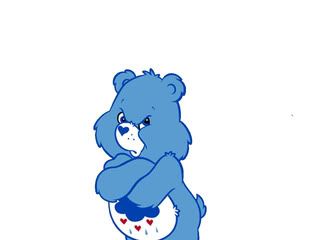
We sure do love to complain, don't we? We get together and kvetch about our jobs, bellyache about our children, or grump about the state of the world in general. Are humans just querulous by nature?
It's strange, because complaining often does really make us feel better--even if nothing changes. Just "getting it off your chest" can help. There's a release in having expressed your discontent, in finding sympathy from others who agree. We call it venting, because that's what it really does. It releases the pressure and allows some fresh air inside the room.
Of course, it's hard to be around someone who is always complaining. The worst is a one-note complainer, always haranguing on the same wrong that's been done them. We have other words for these folks. Harsher ones, like whiner, moody, bad-tempered, bitter.
If you give in to a desire to complain all the time, you will find that people avoid you. We are all sensitive to the moods around us to some degree and too much time around negative people drags us down.
It's a lesson I have to remind myself of daily, especially at this time of year. I'm a teacher, and this is April. In the flow of a school year, this means that I'm exhausted from the previous months of work, and looking forward into TESTING SEASON (which might as well be called teacher-hunting season). If the testing process doesn't kill me itself by sucking all the joy and love out of the school building, the blame games that come with the results will bury me alive.
Still, it is April. There's plenty to be happy about. Spring has finally arrived. There are flowers blooming in my garden and new freckles on my daughters' cheeks. I'll have a birthday soon, and, even though that will mean I'm older, it will also mean that someone will make me cake and buy me gifts.
See? It's all in looking at the bright side.
________________________________________
This post is part of the Blogging from A-Z Challenge.
Saturday, April 19, 2014
Friday, April 18, 2014
P: Pulp (A-Z Blog Challenge: Evocative words)
But I also read a lot of "for fun" things. I loved old hard-boiled detective films and comic books. Tennessee Williams. In other words, over the top drama.
While I enjoyed reading and viewing that sort of thing, I never really considered writing it. It didn't fit my image of "real" writing. I was going to be Emily Dickinson (but, you know, with a boyfriend), not Mickey Spillane.
Then, I graduated. I got a job. I had kids. Even though I teach, I'm assuredly not in the ivory tower. It's a public middle school. The tower wasn't built of ivory in the first place and now it has holes and is held up by sticks we found in the yard. In other words, life got real. I had less time to read and write, though I still did both. I found that what I was reading was not what I was writing. That seemed weird.
Someone in my writing critique group talked about having fun while she wrote. I thought long and hard about that. Was I having fun?
I was writing a serious literary novel (His Other Mother, not yet published) about a woman dealing with fertility issues and schizophrenia. I felt good about it. I loved it. It felt important and real and good. But it was not fun. It was hard. So hard that I was having trouble getting to the ending. I knew it wasn't going to be happy and that was emotionally hard to do. I loved my main character, Sherry, and it was difficult to take her to the logical and necessary ending. I thought about Thomas Hardy, and how I'd read somewhere that he used to weep as he tortured his characters. But, his books are wonderful. They haunt me. I think Sherry could haunt people like that.
I decided that after I finished His Other Mother, I would be allowed to write a play piece. Something fun. So, I wrote Going Through the Change (also not yet published). It's a superhero novel about four menopausal women who develop incredible abilities through the machinations of a mad scientist. Writing it was still hard work--any good writing requires structure and rewriting and lots of real work--but it was fun. I laughed while I wrote.
So, now I'm working on two new novels. One is another serious literary novel, historical fiction this time. I think it will be called Cold Spring and it's about two sisters in rural America in the early twentieth century. The other is a sequel to Going Through the Change. I don't have a good title for it yet.
I'm finding that I need both sides of my literary brain. I need to lose myself in both tragedy and comedy. I need literary, beautiful language in my pulp and I need large, dramatic moments in my literature. The two kinds of writing aren't so completely separate after all, though their readerships are quite different.
I'm not sure what this means for my publishing life. My guess is a pseudonym for one or the other type of writing. But, for now, I'm pleased with the balance, letting both sides of my soul roll out onto the computer screen. So maybe I am Emily Dickinson and Thomas Hardy. And maybe I'm Mickey Spillane, too . . .or Stan Lee. Just call me Emily Spillane. :-)
________________________________________
This post is part of the Blogging from A-Z Challenge.
Thursday, April 17, 2014
O: Obsequious (A-Z Blog Challenge: Evocative words)
You might think that Eddie Haskell is a remnant of the 50s, long gone. But I assure he is alive and well and walking middle school hallways today. His obsequious tone is heard every day, every time a young man finds himself in trouble with his teachers, who are mostly women old enough to be his mother.
Mostly, these boys are using the tone ironically. It's not that they really think the insincere praise will be believed. Instead, they hope that it will make the angry woman laugh, that she will charmed by them and her ire will be defused.
I don't know how I feel about it, being the teacher on the receiving end.
On the one hand, I understand the value of humor in diffusing a tense situation. But it rankles a little. There's something patronizing in it, something that says my anger is not to be taken seriously. I don't anger easily. I'm not quick to raise my voice. But, when I do, I'm serious about it. I mean it. I don't like the gender relations implied here.
Then I waffle, thinking of it from the kid's point of view. A middle school age boy draws a lot of ire in this world. He is loud, giggly, wiggly, distractible. He may look like a man, but he is still a child.
If you look at classroom interactions for children of this age, the boys get in more trouble than the girls. They don't play the game as well as the girls yet. If I heard my name said in annoyance and anger as often as I know some of these boys do, I would be looking for a way to diffuse the situation, too.
So, as in so many things, I try to take it slowly. To guide young men through respectful, appropriate interactions with the women in their lives, one conversation at a time. It's a big job. I hope I can handle it with the grace and humor that Mrs. Cleaver did.
________________________________________
This post is part of the Blogging from A-Z Challenge.
Mostly, these boys are using the tone ironically. It's not that they really think the insincere praise will be believed. Instead, they hope that it will make the angry woman laugh, that she will charmed by them and her ire will be defused.
I don't know how I feel about it, being the teacher on the receiving end.
On the one hand, I understand the value of humor in diffusing a tense situation. But it rankles a little. There's something patronizing in it, something that says my anger is not to be taken seriously. I don't anger easily. I'm not quick to raise my voice. But, when I do, I'm serious about it. I mean it. I don't like the gender relations implied here.
Then I waffle, thinking of it from the kid's point of view. A middle school age boy draws a lot of ire in this world. He is loud, giggly, wiggly, distractible. He may look like a man, but he is still a child.
If you look at classroom interactions for children of this age, the boys get in more trouble than the girls. They don't play the game as well as the girls yet. If I heard my name said in annoyance and anger as often as I know some of these boys do, I would be looking for a way to diffuse the situation, too.
So, as in so many things, I try to take it slowly. To guide young men through respectful, appropriate interactions with the women in their lives, one conversation at a time. It's a big job. I hope I can handle it with the grace and humor that Mrs. Cleaver did.
________________________________________
This post is part of the Blogging from A-Z Challenge.
Wednesday, April 16, 2014
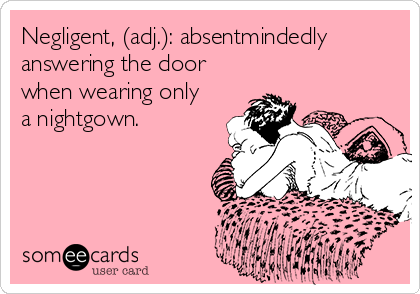
N: Negligent (A-Z Blog Challenge: Evocative words)
You should know better!
That's the difference between negligence and ordinary forgetfulness or carelessness. If I forget my keys or a book I was supposed to return, I was careless. If I forget to pick up my child, I'm negligent. Like yesterday's post about Mendacity. There are lies and there are LIES. It's all a matter of scale.
In our litigious society, the standard for what can be construed as negligence is becoming distorted indeed. A fast food place is sued because someone burned herself on their coffee. Was it really negligence that the coffee wasn't labeled as hot? After all, most of us expect coffee to be hot. Could we instead sue the mother of the coffee-burnt woman for not teaching her child that coffee might be hot?
That situation smacks of the ridiculous and is certainly very different than an employer who knows that something in the workplace environment will give the employees cancer, but chooses not to do anything about it.
This is one of the reasons that words are so important, and that hyperbole and other types of exaggeration can be dangerous.
As Mark Twain said, "The difference between the right word and the almost right word is the difference between lightning and a lightning bug."
Let's keep a sense of proportion here, people.
________________________________________
This post is part of the Blogging from A-Z Challenge.
That's the difference between negligence and ordinary forgetfulness or carelessness. If I forget my keys or a book I was supposed to return, I was careless. If I forget to pick up my child, I'm negligent. Like yesterday's post about Mendacity. There are lies and there are LIES. It's all a matter of scale.
In our litigious society, the standard for what can be construed as negligence is becoming distorted indeed. A fast food place is sued because someone burned herself on their coffee. Was it really negligence that the coffee wasn't labeled as hot? After all, most of us expect coffee to be hot. Could we instead sue the mother of the coffee-burnt woman for not teaching her child that coffee might be hot?
That situation smacks of the ridiculous and is certainly very different than an employer who knows that something in the workplace environment will give the employees cancer, but chooses not to do anything about it.
This is one of the reasons that words are so important, and that hyperbole and other types of exaggeration can be dangerous.
As Mark Twain said, "The difference between the right word and the almost right word is the difference between lightning and a lightning bug."
Let's keep a sense of proportion here, people.
________________________________________
This post is part of the Blogging from A-Z Challenge.
Tuesday, April 15, 2014
M: Mendacity (A-Z Blog Challenge: Evocative words)
Mendacity.
What a word! Most dictionaries define it simply as untruthfulness, but the connotations are stronger than that. This is no mere fib we're talking about, no white lie, no innocuous sin of omission. This is big, powerful and persuasive lying. Audacious lies that can break a person on the soul-level. Lies with evil intent.
Sheer mendacity.
Put this word with its common bed-mate and it's even worse. Sheer mendacity. Utter, unmitigated, unadulterated.
Or maybe it's sheer in the sense of steep and abrupt. Sheer like the drop from a cliff.
Or sheer as in transparent. Mendacity that doesn't even try to hide behind a screen. Entirely visible. Just pushing and pushing and seeing if anyone will step up and call it what it is.
Mendacity is a kind of lying that requires a real commitment. It's not for the shy or weak-willed. It takes a big personality.
That what makes the word work so well in the scene above. Tennessee Williams, writer extraordinaire of scenery-chewing emotionally harrowing speeches for his characters, loved the word, most famously used here in Cat on Hot Tin Roof.
His are not works of quiet emotion or subtlety. No, the pain is unbearable, the protest over the top. The emotions are all at full volume. A woman can't be just upset in a play by Tennessee Williams. No, she's distraught. A man is not merely saddened, but devastated.
It's not melodrama. The anguish is quite real and honestly felt. But it is assuredly dramatic.
The lies are big, too. Big enough to hide a wealth of other dark emotions inside. Mendacious.
Thank you, Tennessee Williams, wordsmith extraordinaire.
________________________________________
This post is part of the Blogging from A-Z Challenge.
Monday, April 14, 2014
L: Languid (A-Z Blog Challenge: Evocative words)
Today was a beautiful spring day. The kind full of the promise summer and long hours full of fun and freedom. The kind I remember from childhood as long, lazy and languid. Lovely.
Of course, I was busy. I had life errands to run that kept me indoors too much of the day. Responsibilities to meet.
When I finally got out to enjoy the day, it was already early afternoon. I took my dog for a long walk, which is good for both of us, in heart and body.
On our walk, we passed a community green space, just one of those side of the road patches of grass and greenery that don't belong to any particular person. It was overgrown with wildflowers and pretty flowering weeds. I had this desire to lie down in the little patch of greenery and stare up at the clouds for a while. To maybe pick some of the weed-flowers and weave them into a crown.
I didn't do it. Neither of my kids were with me--kids are an excellent excuse to do things adults aren't supposed to do anymore. Plus, if I laid down in the side of the road, someone would call 911 thinking I'd had a heart attack or something. My dog would go nuts. It wouldn't end well. So, sadly, there were no flower crowns in my spring afternoon.
In the midst of what my mother terms "the busy years" with two school age children, a dog, a husband, a family, a career, and a little bit of social/personal life to manage, I miss languid days. Daydreaming. Not keeping track of time, knowing my mother would come fetch me when it was time to rest up for another long, flowing day the next day. Sometimes it sucks to be a grown-up.
Yesterday, my baby was seven. May she have many languid days in her future!
________________________________________
This post is part of the Blogging from A-Z Challenge.
Of course, I was busy. I had life errands to run that kept me indoors too much of the day. Responsibilities to meet.
When I finally got out to enjoy the day, it was already early afternoon. I took my dog for a long walk, which is good for both of us, in heart and body.
On our walk, we passed a community green space, just one of those side of the road patches of grass and greenery that don't belong to any particular person. It was overgrown with wildflowers and pretty flowering weeds. I had this desire to lie down in the little patch of greenery and stare up at the clouds for a while. To maybe pick some of the weed-flowers and weave them into a crown.
I didn't do it. Neither of my kids were with me--kids are an excellent excuse to do things adults aren't supposed to do anymore. Plus, if I laid down in the side of the road, someone would call 911 thinking I'd had a heart attack or something. My dog would go nuts. It wouldn't end well. So, sadly, there were no flower crowns in my spring afternoon.
In the midst of what my mother terms "the busy years" with two school age children, a dog, a husband, a family, a career, and a little bit of social/personal life to manage, I miss languid days. Daydreaming. Not keeping track of time, knowing my mother would come fetch me when it was time to rest up for another long, flowing day the next day. Sometimes it sucks to be a grown-up.
Yesterday, my baby was seven. May she have many languid days in her future!
________________________________________
This post is part of the Blogging from A-Z Challenge.
Saturday, April 12, 2014
K: Kleptomaniac (A-Z Blog Challenge: Evocative words)
I think I was an older kid or an earlier teenager when I first heard the word kleptomaniac.
I misheard it and thought is was Keptomaniac. That made sense to me since my parents were talking about a visitor to our home who had stolen some small items of mine. I think they were talking about what to say to the girl's parents and how to get them back. She had Kept my stuff, and I thought she was a Maniac.
Sometime later, I learned the real word. And that it was a real thing. That idea that you could have an uncontrollable compulsion to steal was new to me and fascinating. Even cooler that we had a word for that.
Then I learned there was other "manias." Tons of them in fact. It was almost as fascinating a list as the list of phobias I had been collecting.
Language can be so specific at times. Who knew that we needed a word that means "excessive desire to stay in bed"? (It's clinomania, BTW) I mean, isn't that just called adolescence?
For a while, I thought I wanted to be a psychiatrist because I was so interested in these kinds of words to describe our obsessions, peccadilloes and predilections. But really, I was just in love with words.
I loved how some of these terms seemed so obvious as to be made up on the spot. Scribbleomania: obsession with scribbling? Really?
Others made me feel smart because I recognized the word parts. Xenomania (inordinate attachment to foreign things) and her sister xenophobia (unreasonable fear of foreign things).
A whole lot of the words were about sex in one way or another. Andromania, Cytheromania, Erotomania, and, of course, Nymphomania.
I'm still fascinated, both by the words and the obsessions they describe. All of our messy little quirks formalized in language. I guess that means I made a good choice in writing. I could wallow in this stuff all day.
________________________________________
This post is part of the Blogging from A-Z Challenge.
I misheard it and thought is was Keptomaniac. That made sense to me since my parents were talking about a visitor to our home who had stolen some small items of mine. I think they were talking about what to say to the girl's parents and how to get them back. She had Kept my stuff, and I thought she was a Maniac.
Sometime later, I learned the real word. And that it was a real thing. That idea that you could have an uncontrollable compulsion to steal was new to me and fascinating. Even cooler that we had a word for that.
Then I learned there was other "manias." Tons of them in fact. It was almost as fascinating a list as the list of phobias I had been collecting.
Language can be so specific at times. Who knew that we needed a word that means "excessive desire to stay in bed"? (It's clinomania, BTW) I mean, isn't that just called adolescence?
For a while, I thought I wanted to be a psychiatrist because I was so interested in these kinds of words to describe our obsessions, peccadilloes and predilections. But really, I was just in love with words.
I loved how some of these terms seemed so obvious as to be made up on the spot. Scribbleomania: obsession with scribbling? Really?
Others made me feel smart because I recognized the word parts. Xenomania (inordinate attachment to foreign things) and her sister xenophobia (unreasonable fear of foreign things).
A whole lot of the words were about sex in one way or another. Andromania, Cytheromania, Erotomania, and, of course, Nymphomania.
I'm still fascinated, both by the words and the obsessions they describe. All of our messy little quirks formalized in language. I guess that means I made a good choice in writing. I could wallow in this stuff all day.
________________________________________
This post is part of the Blogging from A-Z Challenge.
Subscribe to:
Posts (Atom)
