Saturday, November 30, 2013

NaNoWriMo 2013: I won!

As of yesterday evening, I am a winner in 2013 NaNoWriMo. For those not in the know NaNoWriMo is short for National Novel Writing Month, or as other people know it: November.  The idea is that you write 50,000 words in 30 days. It amounts to 1,667 words per day if you break out in even pieces. You "win" if you succeed in reaching the target word count.

For some writers, that's a piece of cake. But not for me. I don't get to write full time. I also teach and mom.  Using the Magic Spreadsheet, I've built a strong daily writing habit over the past year or so, but not a 1,667 word a day habit. My current daily goal (outside NaNoWriMo) is a mere 550 words a day. And those can be hard fought on any given day.

Still, I had an idea for a new novel that had been pulling at me for a few weeks. And I'm crazy. And some of my friends were trying it, so I thought I'd try it, too.

For writers like me, NaNoWriMo is marathon running from whatever chair you sit in to write. Athletic. Inspiring. And, for most of us, not sustainable in regular life. It's something you do once, to show that you can. Or maybe yearly to show you still can. It's not business as usual.

I didn't start out really believing I could do it, but I thought it was worth the effort even if it merely goaded me into writing more than I normally would have in one month's time. But Magic Spreadsheet proved that gamification is a very effective way to get Samantha Dunaway Bryant to do something. I guess I have my father's love for measurable signs of efficiency combined with my mother's love for small treats and prizes. The further I got, the more important it became for me to finish. And finish I did! Yesterday. A whole day early, even!

I found I was ridiculously motivated by the statistics and charts. Even when I was tired and frustrated, I'd push through to keep my bars alone the line. I'd pep talk myself. "You can do it, Dunaway" (I still call myself Dunaway when I'm pep talking myself, though I've been Bryant for more than seven years now). "It's only three hundred more words."


It was entirely different than the way I usually write. It forced me to keep on going even when I felt I didn't know where I was going. It forced me to just highlight areas that I'd have to research for later, or make notes of questions I was going to have to answer.

My novel critique group friends can testify that generally speaking, I keep what I write. Some of my writing friends write pages and pages and pages that don't actually make it into the final project. Not so for me. Usually, by the time something is committed to paper (or Scrivener, in this case), I'm committed, too. I might alter it, expand it, or rewrite it, but it's rare that I just cut something entirely.

I'm curious if that will hold true when I go back to finish (50,000 words did not get me to the end of the story, and I'm still not at all sure how this particular story will end) and edit this one. I'm going to put it away for now. I need to do the rewrite on Going Through the Change, now that it's been through critique group, so that's my December project.  Plus, I've found great benefit in letting something sit for a little while and coming back to it with fresh eyes.

That's something that was lost in this pellmell headlong tumble down novel mountain we call NaNoWriMo: time to let it sit, let it breathe like fine wine. It remains to be seen if what I created is worth drinking.

So, was it worth it? Unequivocally yes. 

50,000 words in one month is an accomplishment I feel proud of. Not letting myself sit and think or research turned the story back on itself, making me let the characters lead and show me what they would do.

Is it my new M.O.? Unequivocally no. 

Especially in the last few thousand words that I wrote, I really felt I was flying blind. If I was respecting the process and not just feeding into the game, I would have stopped and read some more about women's forays into the workforce in the 1930s, instead of floundering around trying to write scenes for my character based on the very sketchy knowledge I have of the time period.

Freda was whispering in my ear that I had a lot to learn about the time period. I didn't even have her wearing the right shoes!

There's a difference between necessary research (lines of work open to women in 1930 in Indianapolis) and letting myself get distracted by interesting research that still matters but only in details that can be added afterwards (what kind of shoes she would wear). NaNoWriMo has helped me learn the boundaries between those, and keep myself focused on the task at hand with iron concentration. That will serve me well in my future projects and help make me a more efficient writer.

Efficiency is going to matter. Unlike my mad scientist in Going Through the Change, I'm not getting any younger. And I still have a lot of stories to tell!

Wednesday, November 27, 2013

Chuck Wendig's Flash Fiction Challenge, Part 2

Chuck Wendig is one of my favorite writing-bloggers.  For the next few weeks, he's got some of us playing a game of Telephone.  A writer puts out a story starter of 200 words (Here's mine from last week); another writer picks up where s/he left off, adding the next 200 words. I picked a piece from Wanderer. Here are her words:

Easy Street
        Marcel was certain that the pounding beast in his chest was audible to the entire city as he leaned, panting, against the wall of the alley. Just out of sight, back in the blistering sunlight, the city rumbled on; he could faintly hear the ding of a trolley and the clackety-clack as it thudded over the iron tracks and the intermittent sounds of a saxophonist hawking his street-corner jazz to the tourists. Marcel gulped in a mouthful of the heavy, still air, and slunk further into the shade. It was slightly cooler, but no less humid. New Orleans was seething in the heat, oozing the smell of baked concrete, creole cooking, and the faint tang of the murky Mississippi from every pore.
        Marcel wiped the sweat off his face with the back of one shaking hand, noticing the way the moisture slicked his dark skin—like the flickering mirage off asphalt. He leaned over and vomited, the acidic contents of his nearly empty stomach splattering the alleyway. He coughed at the acrid taste of his own fluids and scooted down the wall, slouching down until he sat on the pavement. He gripped his head in his hands.
         It’s all over.
_______________________________________________________
And now my contribution:

It began as such things do, innocently enough.  Marcel woke in an amorous mood and his thoughts had turned to Elise. Elise had flitted through his thoughts often since he met her a few weeks earlier. Each encounter was more fuel to fire growing between them. But for some reason he hesitated to act on his attraction. Hesitation was unusual for Marcel, especially in the bedroom.

Now Marcel wished he had listened to the still, quiet voice that told him that all was not as it seemed. But, this morning, he had thought only of the way Elise's hair had brushed across her bare shoulders, pulling his eyes and his mind across her flesh. Not giving himself time to think, he called her.

He could see now that Elise was trying to tell him not to come over, to warn him away, but, at the time, he thought she was just playing hard to get, that she wanted him to work for it. He had been so stupid. Now the thought of Elise's flesh was enough to make Marcel sick again. There had been so much blood.  He let his head fall back against the alley wall, his mouth full of the bitter taste of vomit and fear.


Monday, November 25, 2013

Chuck Wendig's Flash Fiction Challenge


 So, Chuck Wendig is having an interesting Flash Fiction Challenge over at terribleminds.com. The idea is to write 200 words, then next week take someone else's 200 words and run with them, then someone else's, etc., etc. until we've all gotten through the holidays and ended up with 1000 word stories. 

I'm intrigued. So, here's mine. It's 268 words. I suck at sticking to specifications apparently. I'm interested to see where it goes.


______________________________________________
It was some time before she could think of him without bitterness. Longer than it should have been, probably.  After all, their time together had been short.  But Alina knew that the impact a person had on your life was not necessarily measured in time. Her father, after all, had nearly twenty years to impress himself on her soul, and, in the end, he didn’t matter. She barely blinked when he died.

But, the boy.  He was different. She had spent only a few hours with him at the retreat. She hadn’t even gotten his name. He had introduced himself as the son of one of the trainers. He hadn’t given his name or asked for hers. That hadn’t bothered her at the time. It had felt like a beginning. She was sure they would have plenty of time to learn the details of each other’s lives.

He hadn’t acted like he knew who she was. That was lovely. Was it possible that he really didn’t know who she was?  He had just talked to her like she was a girl. He had asked to share her table, offered to fetch her a hot cocoa, which she refused.  He had complimented her drawing, talked about the walking paths near the lodge that he planned to walk the next day. It was the kind of conversation she had seen many times, but had never been a part of before.

She looked for him, of course, the next day.  And the day after that. Part of her watched for him the rest of the retreat week. But, he never reappeared.

Friday, October 25, 2013

Honey, I'm Writing a Novel OR Not Now! Mommy's Writing!

Dear Husband,

Your writer wife stayed at home with the kids while you were away, so there are a few things you should know.

That is not a pile of horse dung on the porch. It is clay which the youngest dug out of the garden. She's drying it and planning to dye it bright colors and sell it to the neighboring children as playdoh.  Her dress is probably permanently brown now, but I wrote 700 words while she made her first solid entrepreneurial venture. Oh, I should get her out of the bath now. I think it's been two hours.

The broken glassware in the garbage happened when I tried to walk through the big fight scene using our children and the dog as stand-ins for my characters.  The dog does not follow directions well, but we do think it's possible for Leonel to throw Patricia forward in a slingshot motion like they did in that roller derby movie. Next time, though, we're going to set up more pillows.  The bruises will heal quickly, I'm sure.

The smell is because Dr Liu went on this 1200 word rant against the establishment while I was cooking a frozen pizza. Apparently my villain talks louder than the timer on our oven, but not louder than the smoke alarm. I still fed us though.  Both girls seemed pleased with peanut butter spoons and popcorn. The big girl even cooked the popcorn. She didn't trust me to listen for the slow down of popping kernels. I don't blame her.

There was a phone call,  I think. But I didn't answer it.  It wasn't a publisher on the Caller ID, so I figured it couldn't have been that important.  If it was about the car, I'm sure they'll call back.

Oh, you're home! I missed you. Could you put the kids to bed? Yes, they're still up. What do you mean, it's 10:30? Why is the dog sticky? Okay, okay . . . just a few more pages. I love you, too.

Thursday, October 10, 2013

Greasers and Socs

There are two kinds of people in this world: Greasers and Socs. Which one are you?

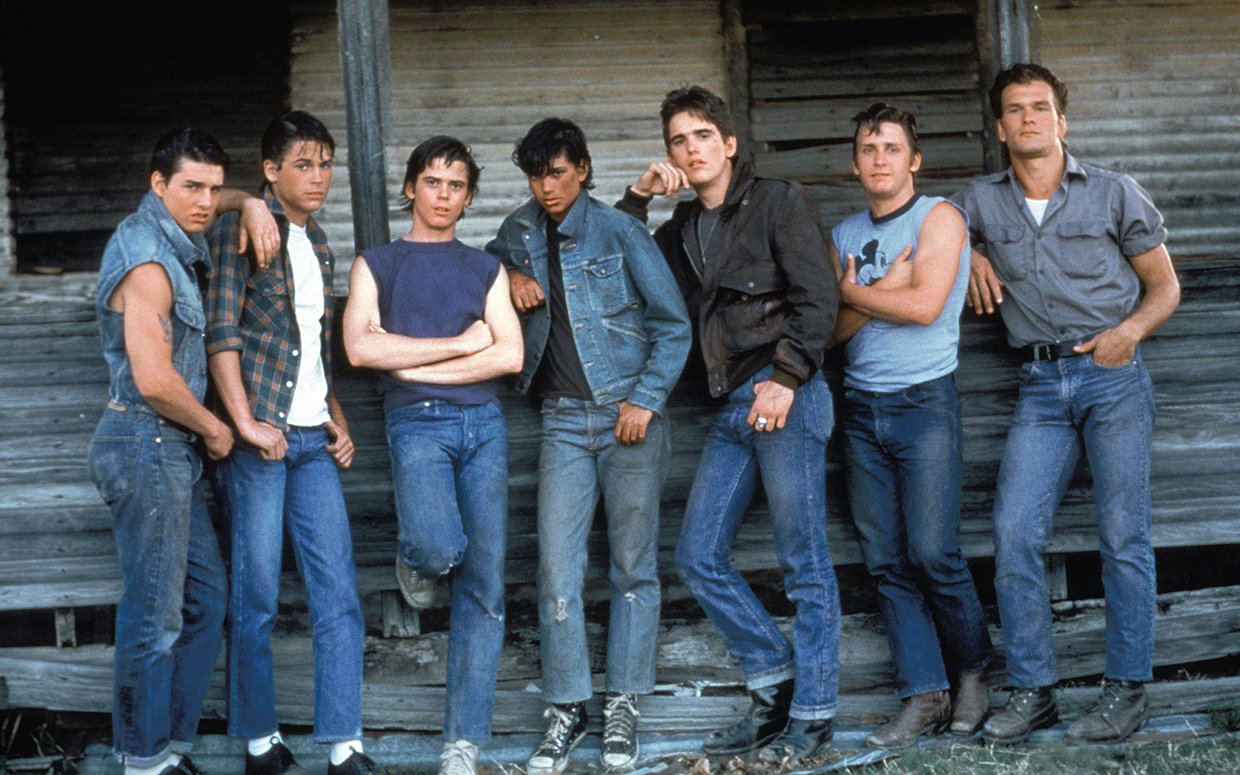
The terms come from S.E. Hinton's novel The Outsiders. It's a classic of young adult fiction and if you haven't read it, shame on you! There's a movie, too, which I have fondness for in spite of the fact that Tom Cruise is in it.

It's a story of two gangs: The Greasers and the Socs.

Socs take their name from "socials." They are children of privilege with letterman jackets, nice cars, and an overinflated sense of self importance. They are definitely the bad guys. Hinton's sympathies (and the readers') are solidly with the Greasers.

Greasers have it rough. They don't have "good" parents or even any parents at all. Their lives are impacted by need, violence, neglect, and substance abuse. They meet with societal censure for their clothing and homes. They are from the wrong side of the tracks.

It might be a very simple world view, but I think all of us are either Greasers or Socs. Once we are adults, it's more about your life attitude than your socio-economic-status, but the designations hold. Let's talk for just a few minutes and I'll tell if you are one of us or one of them.

Socs have money. They have always had money. They don't know what it's like not to have money, and they don't have sympathy for money problems. If you grew up poor, it's less likely that you will ever be a soc. Because they don't know what it's like not to have something you need, Socs don't appreciate what they have. The worst of them don't even know what it's like not to have something you merely want. Having all the things they want doesn't make them generous. In fact, it makes them hoard what they have, trying to collect more and more and not caring that they have more than they need while others struggle to meet their basic needs. As adults, they drive BMWs too fast and cut off other drivers. They shove in line. They think the rules don't apply to them. They worry about me and mine first at all times.

I'm a Greaser. Compared to some of my childhood friends, I grew up privileged. But I still know what it's like to have to wait for things I need and not be able to get things I want. I've seen ebb and flow in income and know that sometimes you have to look at the long game. You have to sacrifice in one area to do what is needed in another. Because I couldn't and can't have whatever I want when I want it, I have learned to prioritize needs and wants and to appreciate the things I have. I try to help others. Us Greasers are in this together. We support one another.

“That's why people don't ever think to blame the Socs and are always ready to jump on us. We look hoody and they look decent. It could be just the other way around - half of the hoods I know are pretty decent guys underneath all that grease, and from what I've heard, a lot of Socs are just cold-blooded mean - but people usually go by looks.”
S.E. Hinton, The Outsiders 

For this reason, parents, I argue against raising Socs. Even if you have the income to do it, you don't do your children any favors by raising them with a sense of entitlement and self-importance. It's a dangerous road, slick with oils and without enough guardrails. It's easy to veer off the path into questionable morality and then into outright illegal and immoral acts. Socs can go a long time without getting caught, the cost to the soul notwithstanding, but when the consequences catch up to them, it's spectacular. There are washed out mug shots and corpses littering the ground.

We all want our children to do well, but there's a difference between handing your children everything and giving them the life skills they need. Greaser children have empathy. They know that it's important to work hard and do well for themselves, but they also know that their needs might not be the most important needs in the room at any given moment. They understand that resources are limited and that they should go to those in deepest need first. They try to solve problems themselves, and are patient about waiting for help when it is needed.

I'd rather teach a room full of Greasers than a room full of Socs. Soc children will constantly call for my attention over things it is entirely possible to solve for oneself. They want the validation of my attention, even when they are snatching it from another child who needs it more. Greaser children will try to help each other first. Only after they've exhausted their options will they ask for help. When they get help, they remember to say thank you for it.

In fact, I prefer Greasers to the point that I have to watch my bias in my interactions with others, keep myself from assuming you're a Soc on the inside based on the appearance of your outside. I have a basic mistrust of people who are too pretty, especially pretty in a polished, practiced way. It makes me wonder about your priorities. If your surface is too smooth, I doubt you have depth.

“It seemed funny that the sunset she saw from her patio and the one I saw from the back steps was the same one. Maybe the two worlds we lived in weren’t so different. We saw the same sunset.”
S.E. Hinton, The Outsiders

One of the themes in the novel was the idea that we all watch the same sunset. It's another version of the old saw about all living under the same sky.  It's a nice idea. But I wonder about its truth. Maybe I'm just getting cynical as I get old, but I truly wonder if the Socs of this world really do see the same sunset I do. If we view it and interpret it so differently, is it really still the same sunset?

Saturday, October 5, 2013

Friday Mom-a-Thon

Friday has gotten complicated around here. 

The Mom is exhausted from a week of mom-ing and teaching and would like to sit on the couch and stare at the fireplace (with or without a fire in it; it doesn't matter--just so no one asks for anything). 

The Teen wants to go out and is full of wonderful excited energy, but she isn't old enough to drive herself yet (and, thank G-d, neither are her friends). 

The Munchkin shouldn't be allowed to stay up past 8:00--it tends to ruin Saturday if she does. 

The Hubby has traffic goblins to fight and often can't get home at any sort of reasonable time, especially not if stops are need to buy stuff (as often happens).

The end result is a singular athletic event we call the Mom-a-thon.

The athlete in this event is not particularly athletic. She is heavier than she'd like to be and dressed in Mom-jeans and a teacher-geek tee-shirt (because we're allowed on Fridays). It's not as stylish as a sleek uni-tard emblazoned with the flag of my country, but we're all better off if I don't wear such things. Really.

The warm-up is a lovely espresso drink from my local market.  This may not seem like the kind of thing an athlete ought to do to warm up for an extended race, but it's surprisingly effective, better than yoga. It's my reward for having survived the work week. There's one particular gal who usually makes it.  She's wonderful. Besides making great coffee, she knows us (the Teen goes with me) and asks about little things we tell her.  I'm sure she doesn't get paid enough for how much better she makes my day. 

If my brain is firing on enough cylinders, I remember to get cash back when I check out. I'll need it for the Teen's Friday night expenses and Saturday morning guitar lesson. If not, it becomes one more thing to handle between 4:00 and 6:00.

Then, the first event starts: The Kiss and Go Lane. The Kiss and Go Lane should probably be called the "Harried Parents Hurl Your Tweens from the Car Lane." It's almost as dangerous as driving in a grocery parking lot right after work.  There are clear patterns the cars are supposed to follow, but they don't. You never know if the person in front of you is going to stop suddenly, turn in a random direction, or fail to stop when they should. The hubby handles the Kiss and Go Lane for the Munchkin. The Teen goes to the same school I teach at, so we're trying to get around the Kiss and Go Lane to get to the teacher parking. Luckily, espresso helps my reflexes.  We survive and even score extra points for landing our favorite parking place: nearest the exit.

Friday at our school is club day. Thanks to the warm-up of a double-shot latte, I am able to pull off thirty minutes of theater games.  Bonus points because the kids seemed sad when we ran out of time.

The third event is broken into three rounds. I'm an elective teacher, which means I teach all three grade levels at my middle school.  My rounds are called "eighth grade," "seventh grade," and "sixth grade."  This is extra challenging because the energy level of the kids goes up across my day in direct inverse to my own energy levels.

There's a dance tonight, the first one of the school year, so my sixth grade students, for whom this is their first ever middle school dance, are practically vibrating when they arrive in my room.  Teaching sixth graders under these conditions is akin to throwing a threadbare saddle with a broken buckle across the back of a rabid rhinoceros and trying to ride it. I live through it, but feel somewhat beaten and bloodied. On the way out, several kids remember to say thank you and wish me a good weekend. I am buoyed.

The fourth event is the after school run-around. This is a juggling act combined with one of those puzzles where you have to get things across the river without letting the lions eat the lambs. I get an assist in that the teen can be left at home unsupervised.  Still, it was five stops between leaving school and arriving at home. Everyone is eating dinner by 6:00, so the judges award me an extra star.

The traffic goblins are winning tonight, so the Munchkin goes with me to deliver the Teen and her friends to the place with the music and the laughter. We stay for a little while, but I have to get her home before she turns into a goblin herself, so back into the car we go. 

Another hour later, a clean and sweet smelling Munchkin is tucked into bed, only half an hour late. Half points, since bedtime was missed. We'll find out tomorrow how bad that is.  The Hubby has defeated the traffic goblins at last and is left at home to watch over sleeping Munchkin while I go back to the place with the music and the laughter to retrieve the Teen.

I like the place they have chosen tonight. It has wi-fi, coffee, and live music, but I can sit far enough away from it that I can still hear myself think. I write while I wait for hugs goodbye. I try not to get the heebie-jeebies (or at least not let them show externally), when the Boyfriend kisses the Teen goodnight.

On the way home, in the quiet of the car. The Teen thanks me. She says she feels lucky to have a mom who will go to this kind of trouble for her. Some of her others friends aren't so fortunate. That folks is game-set-match. Mom won this Friday Mom-a-Thon. And there are seven days to prepare for the next one!


Saturday, September 21, 2013

Writing in the Midst of Life

Like many women (and men, too), I wear a lot of hats in my life. I'm a wife, mother, sister, and daughter. I'm a teacher. I'm a homeowner with a family so that makes me a taxi driver, a cook, housekeeper, pet care provider, academic tutor, maid, an event planner, a sanitation expert, and (sometimes it feels like) all around drudge and flunky.

That's not meant to be a complaint. I've made all the choices that brought me here and I love my family, my job and my home, even if they steam-roll me from time to time.

What it's meant to be is context.  This is the context in which I try to build a writing life. 

When I was a child and young woman, I imagined my life as a writing as full of long quiet hours of reading and contemplation followed by long quiet hours of productivity.  That, of course, is not my life.

But I need to write. I am downright cranky when I don't get that creative outlet.  There's a kind of joy I get in writing that I don't find anywhere else in life.  And, if I kept waiting for those long quiet hours to do it in, I wasn't ever going to write anything.

So I found a way to write in midst of life.  I committed to myself that I would write at least 250 words every single day. And I've done it. For more than 200 days. And writing in these smaller chunks is changing how I write.  I've always been more a pantser than a planner when I write. For those who know me and my infamous color coded google calendar, that's probably a surprise.  But, yes, in my writing, I'm all spontaneity. I don't know what's going to happen until I write and find out.

Maybe it's because I began my writing life as a poet, but novels don't come to me in huge sweeping outlines. I get a scene. A thought. A condition. Then I write to find out what's going to happen. Discovery writing. This is well suited to writing in short periods of time amid the chaos of home. It's almost like reading a serial novel.  I leave myself with a cliffhanger each day and come back the next day to find out what happened. But, I have to write it myself when I get there.


Yesterday, Patricia found out that Dr. Liu couldn't have been her kidnapper. Tonight, when I get to write, I'll find who the kidnapper was. I can't wait!